
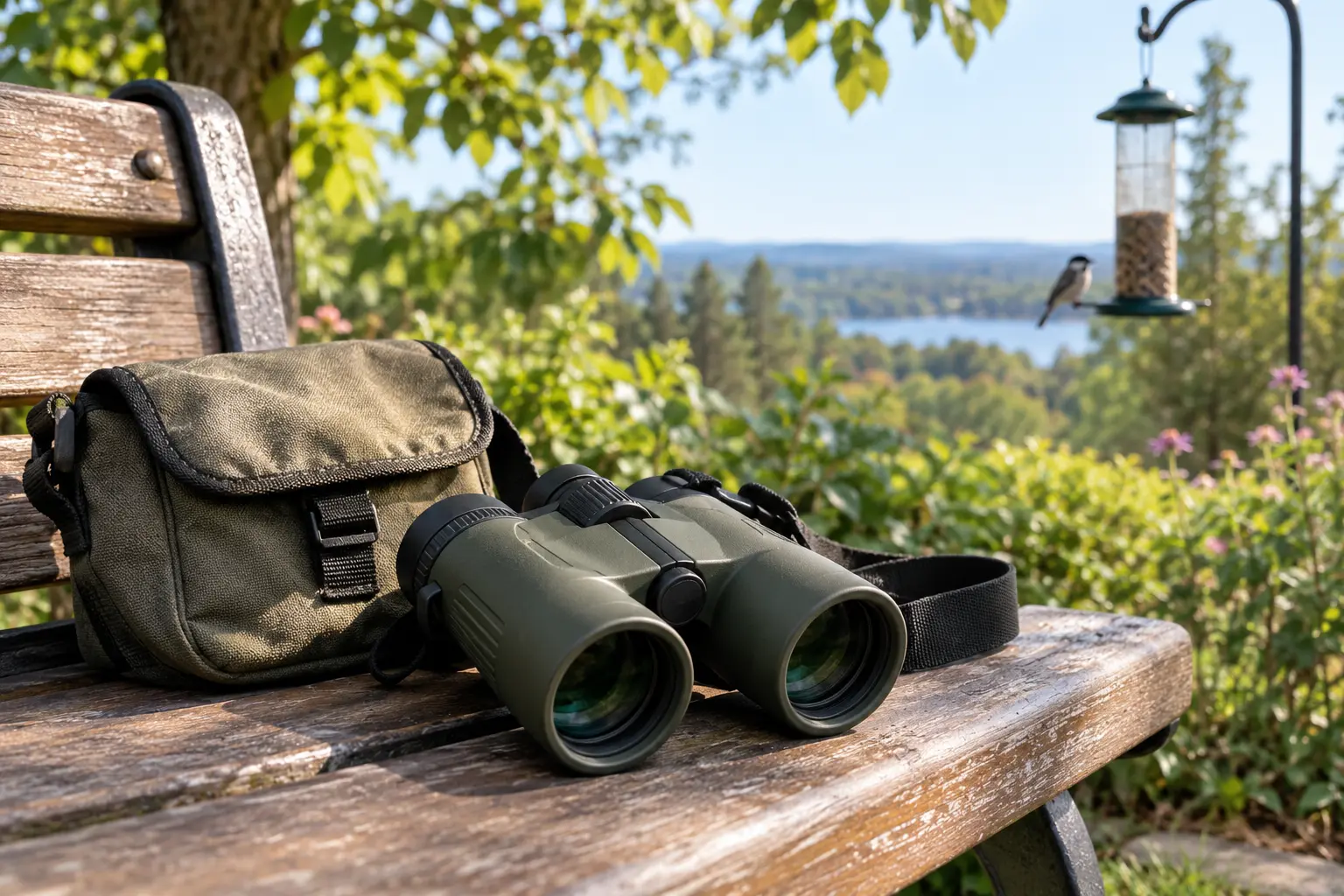
The best binoculars for bird watching under $200 should make common birds easier to find and identify while keeping the purchase straightforward. For most new birdwatchers, a comfortable 8×42 is a useful place to start: enough magnification for everyday sightings, with a size that can serve parks, gardens and woodland walks. This guide compares five models with different strengths in eye relief, close focus, field of view and outdoor protection. Amazon buying links let you check the current offer while planning for a carrying strap or other essentials. The main decision is whether you need to see very close feeder birds, keep your glasses on or minimize the initial cost. Match that priority to the quick verdict and comparison table, then confirm the retailer's final price stays within your $200 limit.
Affiliate Disclosure: We may earn a commission at no extra cost to you when you make a qualifying purchase through affiliate links in this guide. Buying buttons open Amazon.com. Read our full affiliate disclosure.
Best Binoculars for Bird Watching Under $200: quick comparison
On smaller screens, swipe across the table to compare all features and buying options.
| Image | Model | Eye relief | Field of view / 1,000 yd | Close focus | Best use | Where to buy |
|---|---|---|---|---|---|---|
 | Nikon PROSTAFF P3 8×42 | 20.2 mm | 377 ft | 9.8 ft | Best for eyeglass comfort on a budget | Check PriceAmazon |
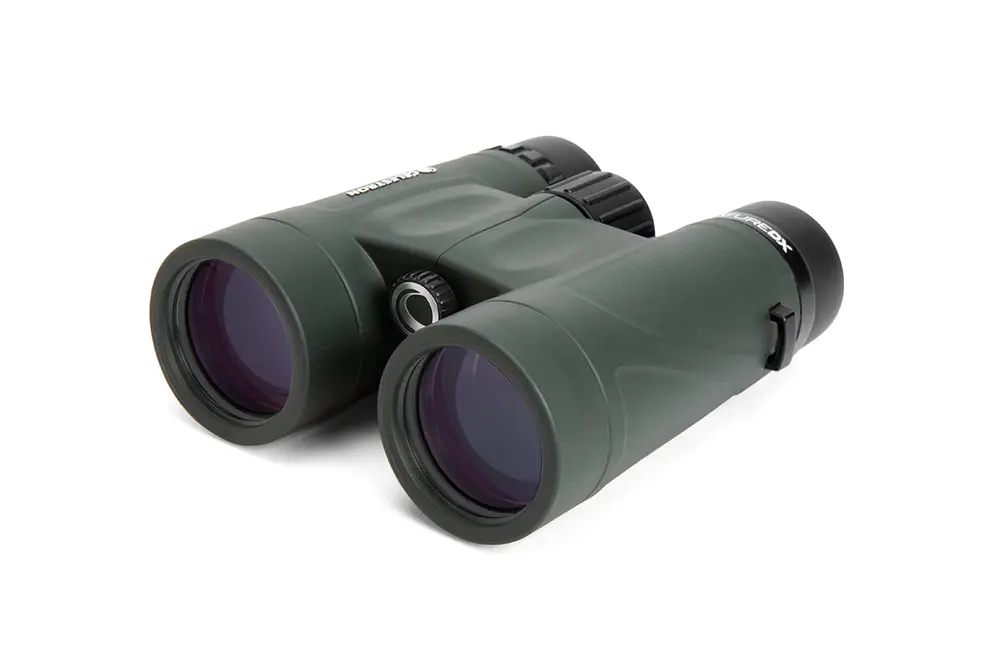
 | Celestron Nature DX 8×42 | 17.5 mm | 388 ft | 6.5 ft | Best for backyard birds and close focus | Check PriceAmazon |
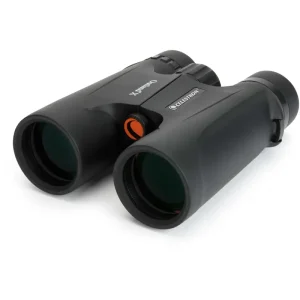 | Celestron Outland X 8×42 | 17.8 mm | 368.4 ft | 13.1 ft | Best lower-priced weather-ready option | Check PriceAmazon |
 | Bushnell R3 8×42 | 21 mm | 325 ft | 16 ft | Best for generous eye relief with rugged-weather emphasis | Check PriceAmazon |
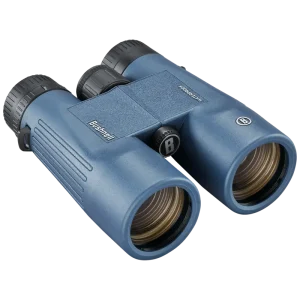 | Bushnell H2O 8×42 Roof | 17 mm | 360 ft | 15 ft | Best straightforward waterside alternative | Check PriceAmazon |
Open Amazon for the current price and availability. Confirm the exact model, condition and package contents, including any separately required eyepiece, tripod or accessories. Tax and shipping may affect the total.
How we chose these models
These five 8×42 models represent different entry-level buying priorities: the P3 for published eye relief, Nature DX for closer subjects, Outland X for a simpler starting point, and two Bushnell alternatives with different specifications. Keeping the optical format consistent makes the practical differences easier to compare. Budget suitability depends on the exact current seller, condition and package; a model is not assumed to stay below $200 at every retailer.
- Check the complete current offer against the budget before choosing.
- Compare eye relief and minimum focus before minor feature labels.
- Use the manufacturer documentation for the exact generation named in the guide.
These comparisons use manufacturer documentation and published model specifications. We have not conducted hands-on product tests. See how we review optics for the research and correction process.
01 / Best for eyeglass comfort on a budget
Nikon PROSTAFF P3 8×42
This model stands out for its published 20.2 mm eye relief. That number is particularly worth investigating if you wear thick-framed glasses or have struggled to see the full view through shorter-relief models. Nikon also documents a relatively modest 20.3-ounce weight, making the P3 appealing for prolonged carrying on birding walks.

Amazon.com
Product image: Nikon.Choose the P3 when you primarily watch woodland or park birds at ordinary distances, want an easy-to-manage 8×42 format, and place substantial value on comfortable viewing with glasses. It is less compelling for extreme close-up garden observation.
Nikon’s published 377-foot field at 1,000 yards and 20.2 mm eye relief are documented for the P3 8×42. Do not mistakenly import specifications from the PROSTAFF P7 or the discontinued 3S.
The 9.8-foot minimum focus means it is not the strongest option for viewing butterflies or birds immediately outside a window. The field is respectable rather than the widest on this list. Nikon’s stated waterproof and nitrogen-filled construction is useful for outdoor outings, but should never be taken as permission for careless immersion.
For the Nikon PROSTAFF P3, determine whether its eye position genuinely works with your prescription frames, since that is the model’s main role here. Try focusing a distant sign with both eyes and confirm the eyecups allow a full round field. A generous-looking relief figure is only useful when the instrument stays comfortable after several minutes rather than one quick glance.
Reasons to choose it
- 20.2 mm eye relief for a glasses-on fit trial.
- 20.3 oz 8×42 body for everyday carrying.
What to weigh up
- 9.8 ft minimum focus limits very nearby feeder subjects.
- 377 ft field is not the widest option in this shortlist.
02 / Best for backyard birds and close focus
Celestron Nature DX 8×42
Its 6.5-foot close focus is a real use-case advantage when you watch feeder birds, butterflies, or dragonflies at short range. Celestron specifies phase-coated BaK-4 prisms and fully multicoated lenses. A 388-foot field provides a comparatively generous view useful for finding moving birds in branches.
Amazon.com
Product image: Celestron.This is a sensible candidate if you observe backyard subjects as often as distant birds and value versatile close focusing more than the lowest possible carry weight. It also gives a useful benchmark for examining what modestly more expensive coatings or designs may add.
The cited Celestron SKU 71332 page lists a 388-foot field, 6.5-foot focus, 17.5 mm eye relief for the standard Nature DX 8×42. Manufacturer stock can vary by listing; do not equate the brand website’s stock with confirmed Amazon availability.
Published 17.5 mm eye relief may fit many people wearing glasses, but is less generous than Nikon P3’s number. More importantly, Celestron has had multiple similar Nature DX 8×42 listings, including SKU 71332 and another SKU with differing weight and stock status.
Celestron Nature DX is particularly interesting for bird feeders and nearby garden views. Check whether its minimum focus reaches the feeder from your actual window or walkway before judging the lens design. A smooth wheel should allow you to shift to more distant birds without moving your hands excessively. The most useful budget upgrade is often a dependable focusing experience rather than an extra claim about glass technology.
Reasons to choose it
- 6.5 ft close focus for garden subjects.
- 388 ft field for finding garden birds.
What to weigh up
- 17.5 mm eye relief requires a personal fit check.
- Standard Nature DX does not use the ED variant’s optical design.
03 / Best lower-priced weather-ready option
Celestron Outland X 8×42
The Outland X is aimed at shoppers who want common practical features without paying for a more elaborate optical specification. Celestron lists waterproofing, nitrogen filling, adjustable twist-up eyecups, BaK-4 prisms and multicoated lenses. The combination covers the basic features to compare when choosing a first outdoor binocular.

Amazon.com
Product image: Celestron.For a family learning to identify common park and garden birds at ordinary distances, this may be a practical first purchase. It is less attractive when butterfly observation is central or you regularly work in confined backyard spaces.
This comparison uses the black Outland X 8×42 SKU 71346. A separate green edition carries different published specifications, so listings must not be conflated.
Its 13.1-foot minimum focus is the longest in our selected group and is a clear disadvantage for very nearby feeder or insect observation. Its 368.4-foot field is narrower than the Nature DX’s stated figure. ‘Multicoated’ should not be casually equated with ‘fully multicoated’; these terms refer to different coating descriptions.
Outland X has a value-oriented weather-ready role, but buyers should verify the exact binocular version and manufacturer protection wording. Try it with the same outdoor gloves or glasses you normally use and pay attention to how readily the focus wheel can be reached. A lower price can be compelling if the field and grip suit you; it is not automatically good value when discomfort keeps you from using the binoculars.
Reasons to choose it
- Nitrogen-filled waterproof construction.
- Twist-up eyecups and 17.8 mm listed eye relief.
What to weigh up
- 13.1 ft close focus limits nearby garden viewing.
- Multicoated design differs from higher-specification ED options.
04 / Best for generous eye relief with rugged-weather emphasis
Bushnell R3 8×42
The R3 has an unusually generous manufacturer-listed 21 mm of eye relief in this group. Bushnell’s R3 manual also documents an IPX7 water-resistance test, an appealing characteristic for damp outings if users follow the actual immersion limitations. At a maker-listed 21.3 ounces, its weight is competitive with several standard 8×42 options.

Amazon.com
Product image: Bushnell.Prioritize the R3 for a glasses-wearing observer who mainly watches subjects at moderate to long distances and wants documented water resistance plus substantial published eye relief. Consider wider-field competitors for dynamic forest birding.
Bushnell’s current R3 8×42 product page (model BU-R3-842) lists 21 mm eye relief, a 325-foot field at 1,000 yards and 21.3-ounce weight. Its manuals directory also provides R3 documentation. Confirm any close-focus figure against the exact model’s latest documentation before purchase.
There is a meaningful tradeoff: the listed 325-foot field at 1,000 yards is notably narrower than the P3 or Nature DX, and the 16-foot close focus is poor for observing nearby feeder birds. It should not rank first for someone who wants to locate small moving birds quickly in dense trees.
Bushnell R3 warrants a fit check because its viewing comfort and outdoor construction are part of its appeal. Adjust the hinge and eyecups deliberately, then compare a near and distant subject without straining your eyes. Do not infer that a rugged-looking housing provides unlimited water protection. The manufacturer’s actual weather rating, warranty region and authorized U.S. seller should determine how confidently you can recommend it.
Reasons to choose it
- 21 mm listed eye relief.
- IPX7-rated construction for outdoor conditions.
What to weigh up
- 16 ft minimum focus is relatively distant.
- 325 ft field is narrower than several other 8×42 choices.
05 / Best straightforward waterside alternative
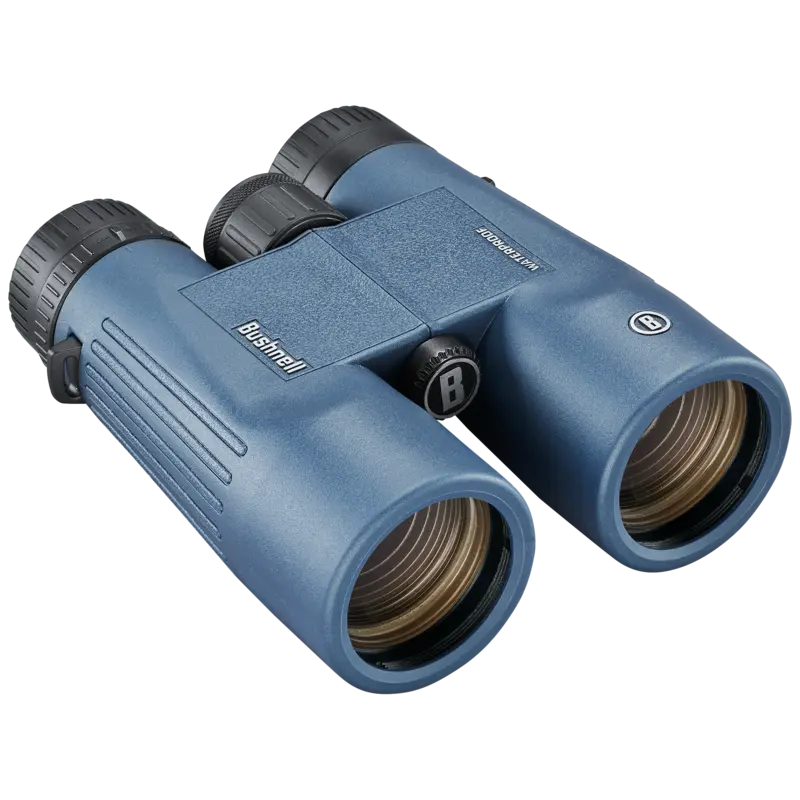
Bushnell H2O 8×42 Roof
The H2O series is worth considering when your birdwatching commonly takes place beside rivers, ponds or coastal paths. Bushnell’s user manual specifies IPX7 resistance for the series and lists the 8×42 roof configuration with 17 mm eye relief. This is a different option from the R3, with different field and focus tradeoffs.
Amazon.com
Product image: Bushnell.Consider this for open waterside birding where the weather-resistance claim is useful and the viewing subjects are usually far enough away that minimum focus does not matter. Do not choose it solely because its name implies a particular degree of waterproofing; consult the actual manual.
The referenced Bushnell manual identifies 8×42 roof model 158042R with 360 feet at 1,000 yards, 17 mm eye relief, 15-foot close focus and 22.7-ounce weight.
A 15-foot minimum focus leaves little flexibility for nearby insects or birds close to a balcony. A 360-foot field is wider than the R3 but smaller than Nature DX. The 17 mm relief may be enough with some eyeglasses and not others, and the model must be distinguished from the heavier H2O 8×42 Porro version.
Bushnell H2O is positioned for straightforward waterside viewing, so check its actual sealing description and how securely it can be carried near wet ground. Observing stationary waterbirds from a permitted bank is a better evaluation than trying to judge optical clarity from a brightly lit store shelf alone. Confirm that the listed roof-prism 8×42 matches the product photo and seller offer, because Bushnell H2O versions and formats can vary.
Reasons to choose it
- Waterproof, nitrogen-filled construction.
- Straightforward 8×42 format for ordinary outdoor viewing.
What to weigh up
- 15 ft close focus does not suit nearby feeder subjects.
- 17 mm eye relief needs a personal fit check.
What to consider before buying
Why 8×42 is a sensible starting format
For general birdwatching, 8x binoculars typically offer a more forgiving handheld view than high-powered alternatives, while 42 mm objective lenses provide a versatile balance between size and potential light delivery. The category does not guarantee image quality, and an excellent 8×32 may be preferable for someone who hikes all day. But choosing five directly comparable 8×42 units here helps separate meaningful specifications rather than letting different magnifications distract from usability. If you mostly watch distant seabirds in open spaces, you may eventually prefer 10x; for a first all-round pair, the steady 8x format is worth trying.
How to compare field of view fairly
Linear field of view describes how much landscape appears across the image at a specified distance. The Nature DX’s 388-foot listed field is wider than the Bushnell R3’s 325 feet at 1,000 yards, which may help a birder find birds moving through vegetation. A broad field can also reduce the need to move the binoculars constantly as a bird crosses the scene. However, published width is not a measurement of edge-to-edge sharpness. Compare the same units and identify the exact model generation. An unusually wide advertised field may still be uncomfortable if the eye relief or eyecup design prevents you from viewing its full extent.
Close focus and observing a backyard feeder
Minimum focusing distance decides whether binoculars can bring nearby objects into focus. If a feeder hangs about seven feet from your seat, a model with a 6.5-foot specification might work, while a 13- or 16-foot model likely will not focus that near. That makes the Nature DX a stronger candidate for close garden viewing than the R3 or Outland X. The number is not a score for sharpness: two models that can focus on a feeder may differ in colour, contrast and ease of use. Read our guide to close focus before deciding how short a minimum you actually need.
Eye relief for birdwatchers wearing glasses
Eye relief is a specified viewing distance behind the eyepiece. Frames and lenses can prevent your eyes from reaching that position. The Bushnell R3 and Nikon P3 have comparatively generous advertised relief here, but a larger number does not guarantee a comfortable fit: eyecup shape and recessed lenses also matter. Bring the glasses you use outdoors and see whether you can view the whole circular image without pressing the eyepieces against your lenses. Adjustable eyecups matter for friends and family members who switch between viewing with and without glasses. Our eye-relief guide describes the fitting process.
Understanding waterproof and fogproof claims
A binocular intended for nature walks should tolerate some poor weather, but waterproof wording varies. Bushnell’s R3 and H2O manuals document IPX7 resistance with explicit limits; that does not mean they can be used underwater indefinitely. Celestron lists waterproof and nitrogen-filled construction for the selected Nature DX and Outland X, and Nikon identifies waterproofing and nitrogen filling for P3. Always consult the current model’s manual before exposing optical equipment to severe weather. Dry the exterior after rain and store the binoculars as recommended. Waterproofing, impact resistance and fogproofing are not interchangeable properties.
What coatings and prism descriptions mean
Product descriptions may mention fully multicoated optics, BaK-4 glass, roof prisms or phase-corrected coatings. Celestron documents phase coatings on Nature DX, while Outland X has a different coating description. The differences are useful questions to investigate rather than permission to invent field-test results. To judge visual quality fairly, compare independent observations conducted under similar conditions, or test several models yourself against the same detailed scene.
What you give up in lower-priced binoculars
Spending under $200 can mean compromises in focusing feel, optical correction near the field edges, materials or included accessories. Those compromises are not identical across models, and the cheapest choice will not necessarily be the worst for your particular use. Prioritize features that affect every outing: comfortable eye placement, adequate field, workable close focus and a weight you will carry. It is better to buy a modest, correctly fitted instrument than to chase a premium-sounding coating or marketing label while ignoring an awkward eyecup or too-short viewing distance.
How to select binoculars for children and smaller faces
Adults choosing shared family binoculars should check the manufacturer’s interpupillary-distance range rather than assuming any 8×42 body suits every child. The distance between the pupils determines whether two barrels can line up with both eyes. Large or heavy binoculars can also be hard for children to hold steadily. Supervise young users and never point binoculars toward the sun; concentrated sunlight can cause severe permanent eye injury. When fit cannot be achieved comfortably, a smaller instrument may be more appropriate than forcing one of the five adult-focused 8×42 models in this article.
Handheld comfort and long birding walks
The published mass is only part of the carrying experience. A binocular with a balanced body and smooth focus wheel may feel easier to hold than one weighing slightly less but requiring an awkward grip. Think about how many hours it hangs around your neck, whether a harness helps distribute the load, and how easily you can raise it quickly toward a sudden sighting. A well-fitted strap also helps protect the instrument from drops. Do not assume the largest objective is automatically the best choice for someone who moves constantly through woods or along a trail.
Set up your binoculars before the first birding trip
First adjust the hinge until you see one circular view through both eyes. Focus on a detailed stationary object. Depending on the manufacturer’s instructions, use the main focus while viewing with one eye, then adjust the diopter for the other eye so both sides appear sharp together. Return both eyecups to a setting that suits whether you wear glasses. Practise moving from a distant tree to a nearer branch and back. This short setup session helps you judge whether focus travel is smooth and makes it easier to find birds quickly when you are outdoors.
When to choose 10x instead
Ten-times magnification makes distant subjects look larger, which can be useful across open water or broad plains. The tradeoff is that hand motion is more apparent, and many models have narrower fields of view than their 8x counterparts. At this budget level, the best outcome often comes from comfortable handling rather than simply maximizing magnification. If you usually bird in wooded parks, 8x deserves special consideration. If the majority of your observations happen across long distances and you can hold the optic steadily, compare appropriate 10x models separately instead of assuming these five 8×42 options satisfy every need.
Why exit pupil is not a quality score
An 8×42 binocular has a calculated exit pupil of 42 divided by eight, or 5.25 mm. That tells you the diameter of the beam leaving an eyepiece, not its total light transmission or actual resolving ability. Observers’ pupils vary with lighting and physiology, and an impressive geometric value cannot compensate for poor optical construction. This guide deliberately avoids claims such as a fixed percentage improvement in brightness based on exit pupil. For a fuller explanation, read what exit pupil means.
How to use reviews without being misled
A useful independent review specifies which model was assessed, what viewing conditions were used, and whether the evaluator physically handled the sample. Look for meaningful observations about central sharpness, chromatic fringing, focus feel and edge behaviour rather than unsupported superlatives. Ratings aggregating several model sizes can mislead: a 10×42 owner’s complaint or praise may not apply to the 8×42 SKU.
What to verify before clicking an affiliate link
Check exact magnification and objective diameter, item number, product generation, whether the listing is new or used, the seller’s location, fulfilment terms, current checkout price and return policy. A name shared across several variants can cause an affiliate button to direct shoppers to the wrong item. Use the source list for model specifications and the Amazon link for the current offer. If the total exceeds your $200 limit, compare another model rather than stretching the budget for an incidental feature.
Our budget buying decision framework
Start with the birds you watch most often: garden feeders, woodlands, wetlands or distant fields. Set a firm ceiling including any taxes and shipping. Then shortlist models whose current selling price meets that ceiling, and check how field, eye relief and close focus match your situation. If you wear glasses, eliminate instruments that prevent a full view. If your feeder is nearby, eliminate those whose minimum focus is too long. Choose between remaining options on weight, warranty, seller reliability and any credible independent optical comparisons you can find. This is more useful than assigning an arbitrary score to every feature.
Final buying advice
For an everyday birdwatching starting point, the Nikon P3 and Celestron Nature DX deserve investigation for different reasons: eye-relief comfort versus close-focus versatility. The Outland X and Bushnell H2O provide lower-priced alternatives, while the Bushnell R3 stands out for documented long eye relief and outdoor water-resistance guidance. Each also has limitations that could make it a poor purchase for a particular person. None has been declared a laboratory-tested winner. Choose an exact model based on where you observe, how it fits your face and eyes, and the real selling price when you are ready to purchase.
Before you choose
Frequently asked questions
Can binoculars under $200 be useful for serious birdwatching?
Yes. A correctly adjusted, comfortable pair can help you learn plumage, behavior and identification skills without a large initial spend. Concentrate on a stable view and easy subject acquisition. A more expensive instrument may improve particular aspects of the view, but it cannot replace practice or make a poor-fitting pair comfortable.
Is 8×42 a better budget choice than 10×42?
For general park and woodland birding, 8×42 is a sensible starting point because hand movement is less apparent than at 10x. Within a product family it often provides a wider view too. Consider 10x for distant birds in open habitats if you can hold the image steadily and accept the different field.
Which specification matters for a feeder outside my window?
Measure the closest distance from your viewing position to the feeder, then compare it with the binocular's minimum focus. A model that cannot focus that near will not give a sharp view of those birds. Also try looking through an open window when safe; household glass can affect what you see.
Should I spend the whole $200 on the binoculars?
Include any accessories you actually need, such as a comfortable strap, lens protection or a suitable carrying case. Check what the exact package already includes. Spending a little less on a well-fitting pair can be more useful than choosing the highest-priced option and finding it awkward to carry.
How do I check the current Amazon price?
Open the Amazon buying link for the model you want, then confirm the magnification, objective size, condition, seller and package contents. Include shipping and tax when comparing the total with your $200 limit. The table links to current offers rather than promising a fixed checkout price.
What is the first thing to do after buying beginner binoculars?
Set the hinge for your eye spacing, adjust the eyecups and follow the manual's focus and diopter procedure. Practice finding a large stationary target, then move to familiar garden birds. Store the binoculars dry and learn the correct lens-cleaning method before dirt or rain makes cleaning necessary.
Sources and buying information
Product details come from manufacturer documentation for the models listed. Use the Amazon buying links for the current offer, seller, condition and package contents. For H2O 158042R, the model-specific manual is the source for the technical specifications.
About the author
Simon Jack
Simon Jack is the named author of FieldLens Guide's research-based binocular, spotting scope and wildlife observation articles. His published editorial approach focuses on verifying model-specific manufacturer specifications, explaining optical tradeoffs in plain language, and matching equipment to real birdwatching, hiking and nature-observation needs. These articles do not claim hands-on product tests unless explicitly documented.