
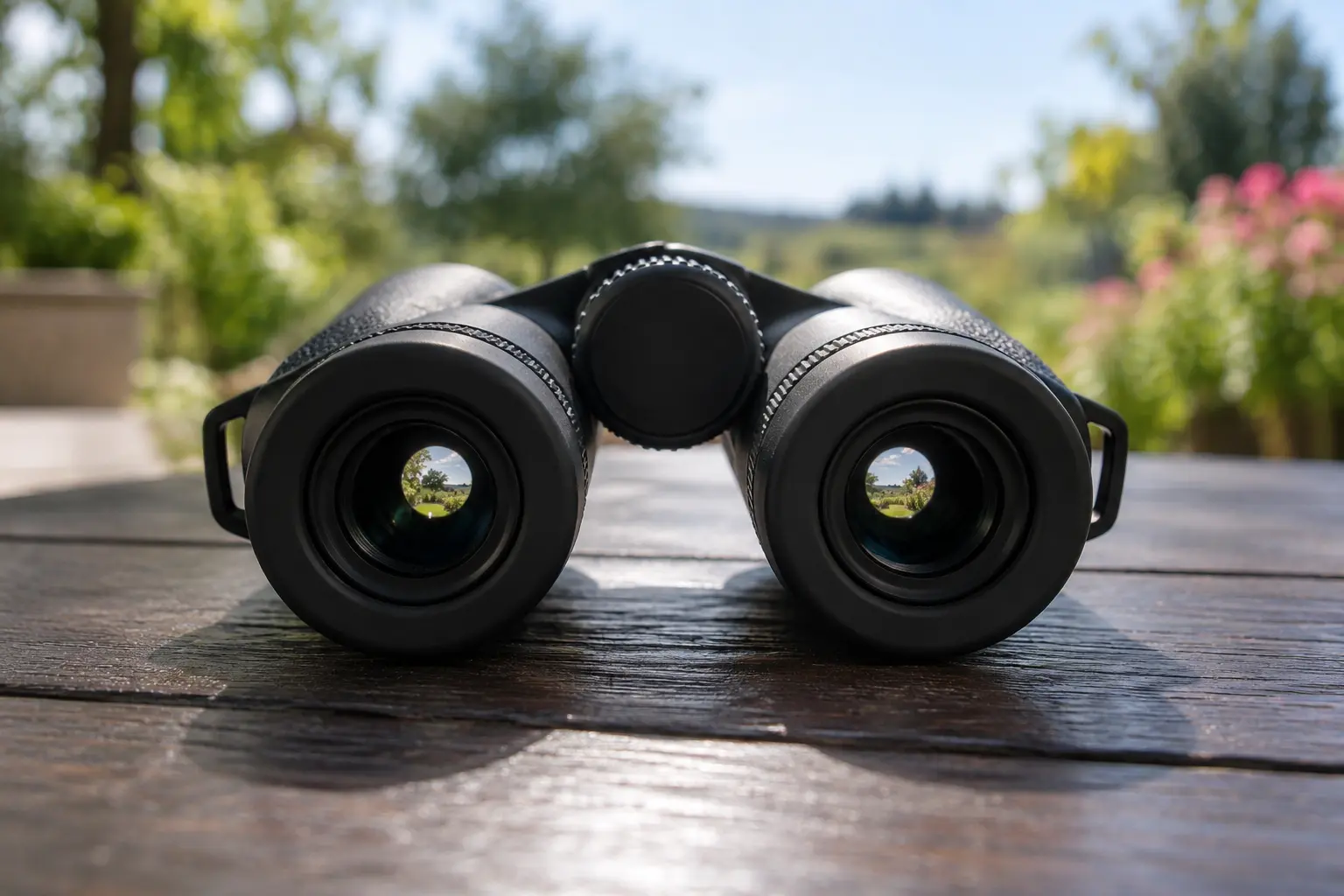
What is exit pupil in binoculars? It is the diameter of the small illuminated circle of light leaving each eyepiece. Divide the effective objective-lens diameter by magnification to calculate it. Exit pupil helps explain light delivery and eye-position tolerance, but it is not a direct score of a binocular’s overall optical quality.
How to calculate exit pupil
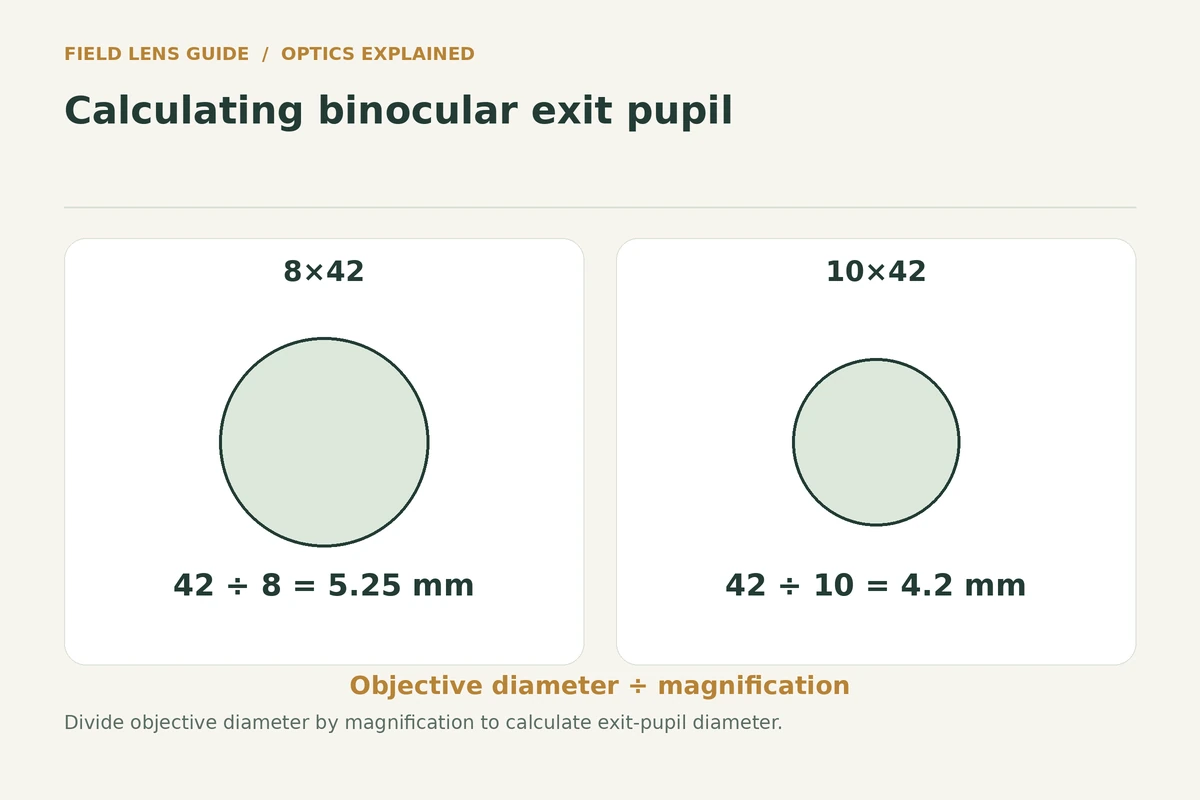
The formula is objective diameter in millimetres divided by magnification. An 8×32 has 32 ÷ 8 = 4 mm; an 8×42 has 42 ÷ 8 = 5.25 mm; and a 10×42 has 42 ÷ 10 = 4.2 mm. These are calculated diameters, not independent laboratory measurements.
Why ambient light matters
Your own pupils contract in bright sunlight and dilate in darker conditions. When your eye pupil is smaller than the binocular exit pupil, not all of the delivered light enters your eye. In brighter daylight, the advantage of a larger exit pupil may therefore be limited. In dim light, it can make a more noticeable difference when the eye pupil is large enough. The low-light wildlife binocular comparison applies these tradeoffs to real model specifications without treating exit pupil as a brightness test.
Is a larger exit pupil always brighter?
Not necessarily. Two binoculars with the same exit pupil can deliver different views because of lens transmission, coatings, stray-light control and optical construction. Equally, a larger theoretical exit pupil does not guarantee a brighter perceived image than a smaller exit pupil from a better-designed optic. Treat exit pupil as one parameter, not the verdict.
What it means for birdwatching
For daylight birdwatching, a 4 mm exit pupil may provide ample light under many conditions. A larger exit pupil can make slight misalignment less frustrating and help in dim surroundings. If birds are fast-moving, field of view and focus control can matter at least as much.
The connection with eye relief
Exit pupil and eye relief describe different things. Exit pupil is a diameter; eye relief is the viewing distance behind the eyepiece. Glasses wearers should pay attention to both, but proper eye relief and eyecup fit remain central to seeing the full field. Our eye relief guide explains why.
How to use the number when shopping
Calculate exit pupil, note where you usually observe wildlife, then compare the actual model’s field of view, weight, eye relief and overall optical quality. If you often watch at dawn, test the binoculars under similar light where possible. If most observation occurs in bright daylight, prioritize fit and handling.
How exit pupil relates to your own eyes
The amount of light that enters your eye is influenced by your pupil diameter, which changes with ambient light and individual physiology. In bright daylight the pupil can be considerably smaller than the binocular’s exit pupil. Extra delivered diameter then may not provide a visible brightness advantage. In dim conditions the pupil generally widens, allowing more of a larger exit pupil to be used. This is an explanation of optical geometry, not a guarantee of better performance from one named product. Brightness perception also depends on contrast, transmission, and how the observer adapts to darkness. Compare this calculation with twilight factor and its limits, which uses a different formula and can favor a different format.
Exit pupil and ease of positioning
A larger exit pupil may give the observer more freedom to position the eye without immediately losing part of the image. This can be useful when viewing from a moving platform or quickly lifting binoculars toward a passing bird. However, the allowable viewing distance behind the eyepiece is controlled by eye relief, which is a separate specification. People who wear spectacles need to check that the eyecups permit the correct viewing position. Do not assume a generous exit pupil solves a short usable eye-relief problem.

Common exit-pupil calculations
For 8×25 binoculars, divide 25 by 8 to get approximately 3.13 mm. For 8×32, the result is 4 mm. For 8×42, it is 5.25 mm. For 10×42, the result is 4.2 mm. For 10×50, it is 5 mm. The arithmetic is straightforward, but the implication depends on lighting and optical construction. These values do not tell you whether the binocular is waterproof, has a wide field of view, focuses close, or produces a sharp image toward the edges.
Why transmission and glare control matter
Manufacturers may promote coatings, special glass and prism technologies to distinguish models. Such choices can affect the amount and quality of light reaching the eye, but the exit-pupil formula does not measure those effects. Two models with the same nominal exit pupil can perform differently under backlighting or at dusk because of internal reflections, transmission and contrast. Whenever a review makes a strong brightness claim, check whether it is supported by comparable test conditions or only by product marketing. A calculated diameter should not be described as independent evidence of visual performance.
Putting exit pupil into the buying process
First identify when you observe: midday hiking, shaded woodland, evening wildlife watching or a mixture. Next calculate the exit pupil of your shortlisted formats, then investigate fit, field of view, weight, coatings, build quality and warranty. Whenever possible look through the models under conditions similar to your normal activity. An 8×32 can be a useful hiking option even if its calculated exit pupil is smaller than an 8×42. Likewise, a larger 10×50 may not be a good fit if its size makes carrying it inconvenient.
Exit pupil compared with twilight factor
Twilight factor is another calculated figure sometimes listed on optical specification sheets. It is commonly derived from the square root of magnification multiplied by objective diameter, but it is not a complete measurement of real-world low-light performance. Neither twilight factor nor exit pupil captures all effects of contrast, coatings, aberrations and observer eyesight. For ordinary buyers, model-specific evidence and comfortable viewing should outweigh attempts to pick a winner from a single formula.
Questions binocular shoppers often ask
Does a bigger exit pupil always make an image brighter? No, because the observer’s pupil and the instrument’s transmission also matter. Is a 4 mm exit pupil too small for birding? Not necessarily; it can be useful in daylight with appropriate optics. Does exit pupil determine field of view? No, these are different optical characteristics. Can a larger exit pupil help when positioning the eyes? Often, but eyecup shape and eye relief can still make viewing uncomfortable. Each question is best evaluated in the context of the exact binocular and observer.
How to compare exit pupil without exaggerating brightness
Imagine two different binoculars both showing a calculated 4 mm exit pupil. Their diameters match, but their images need not appear identical because optics transmit and scatter light differently. Even with a 5 mm versus 4 mm comparison, the observer may notice little difference in strong daylight. Avoid marketing claims that one instrument must deliver a precise percentage more visible brightness solely because of this number. Any meaningful comparison should account for viewing conditions, coatings, contrast, optical alignment, and the observer’s own eyes. Use the formula to understand geometry, then judge real-world performance from credible tests and comfortable direct viewing.
What exit pupil cannot tell you
The figure does not establish the binocular’s field of view, colour rendering, weather sealing, focusing speed or durability. Nor does it indicate whether the eyecups are comfortable with prescription glasses. Product descriptions sometimes group exit pupil with several other specifications under a heading such as optical performance, which can make the number seem like an overall quality score. It is not. A disciplined comparison starts with the intended activity, selects a usable magnification, then checks exit pupil alongside weight, eye relief, field of view and reliable evidence of image quality.
A note on calculated values
The arithmetic assumes the stated effective objective diameter and nominal magnification. Real optical systems can include internal stops, manufacturing tolerances and other design details that change delivered light. For most shoppers the published specifications remain a useful way to compare formats, but they should not be confused with laboratory measurements of brightness or resolution.
Conclusion
Exit pupil helps you understand how much light the binocular can deliver to the eye in different conditions. It cannot replace a full comparison of optics, ergonomics and viewing use.
References
- Nikon: Choosing binoculars by specifications
- Nikon: Exit pupil explained
- Audubon: How to choose binoculars
About the author
Simon Jack
Simon Jack is the named author of FieldLens Guide's research-based binocular, spotting scope and wildlife observation articles. His published editorial approach focuses on verifying model-specific manufacturer specifications, explaining optical tradeoffs in plain language, and matching equipment to real birdwatching, hiking and nature-observation needs. These articles do not claim hands-on product tests unless explicitly documented.