
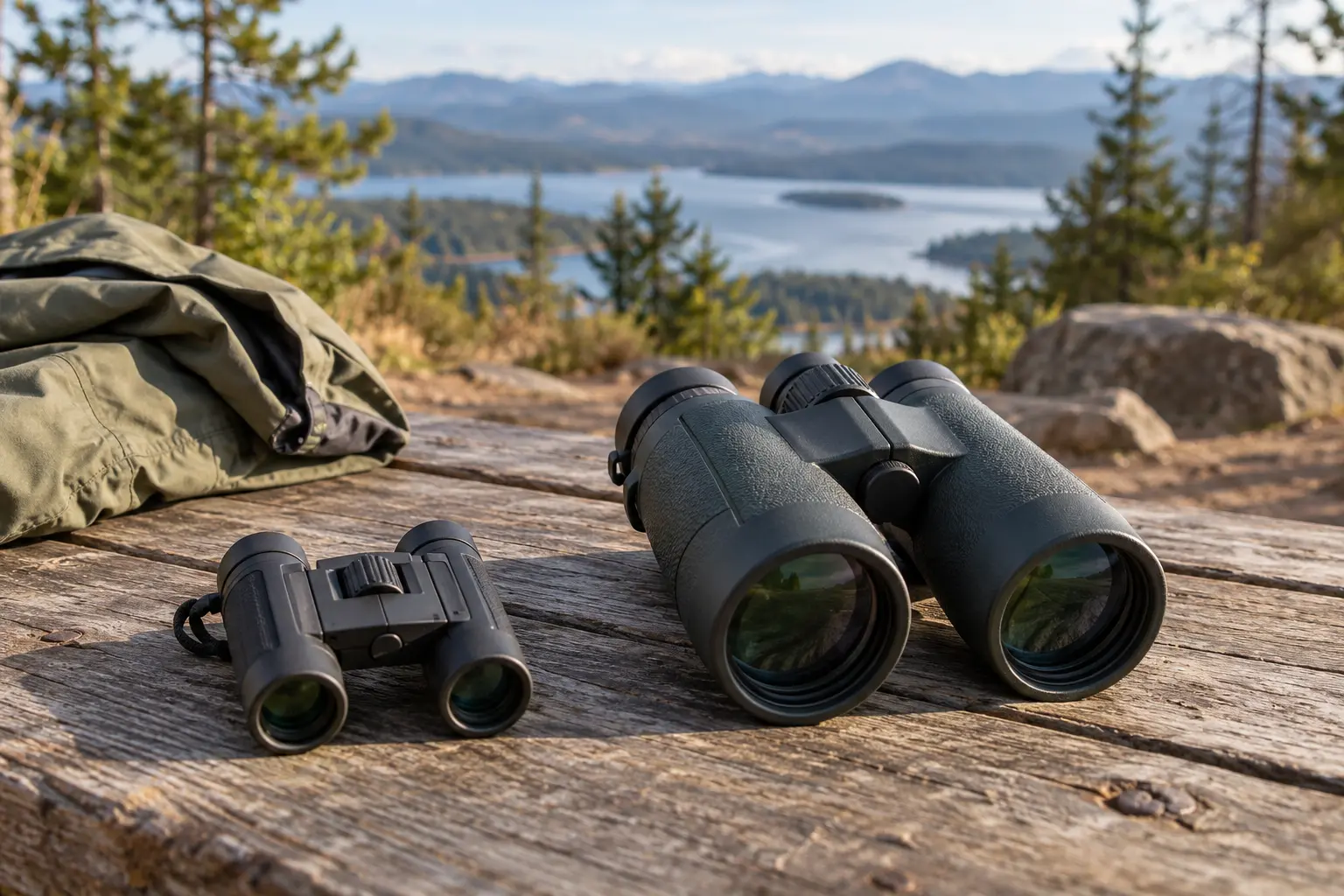
The compact vs full size binoculars decision depends on actual observation needs, eye comfort and carrying burden, not simply a contest between the biggest lenses and the smallest body. This comparison covers pocket 8×25, mid-size 8×32 and full-size 8×42 formats, with realistic situations in which each can be the better practical tool. Manufacturer examples illustrate genuine differences without claiming that objective size is an independent optical-quality score.
Define the size categories
Compact versus full-size binoculars usually refers to the diameter of their objective lenses and the overall body geometry rather than a formally standardized universal size category. Pocket binoculars commonly have objectives near 20–25 mm, intermediate formats around 30–32 mm, and full-size birdwatching instruments often use 42 mm front lenses. Manufacturers can label these groups differently. A small objective often helps reduce packed weight, but housing materials and prism arrangement also affect dimensions. Compare the actual length, folded width and weight of a specific model rather than selecting from a retailer’s category label alone.
What exit pupil changes
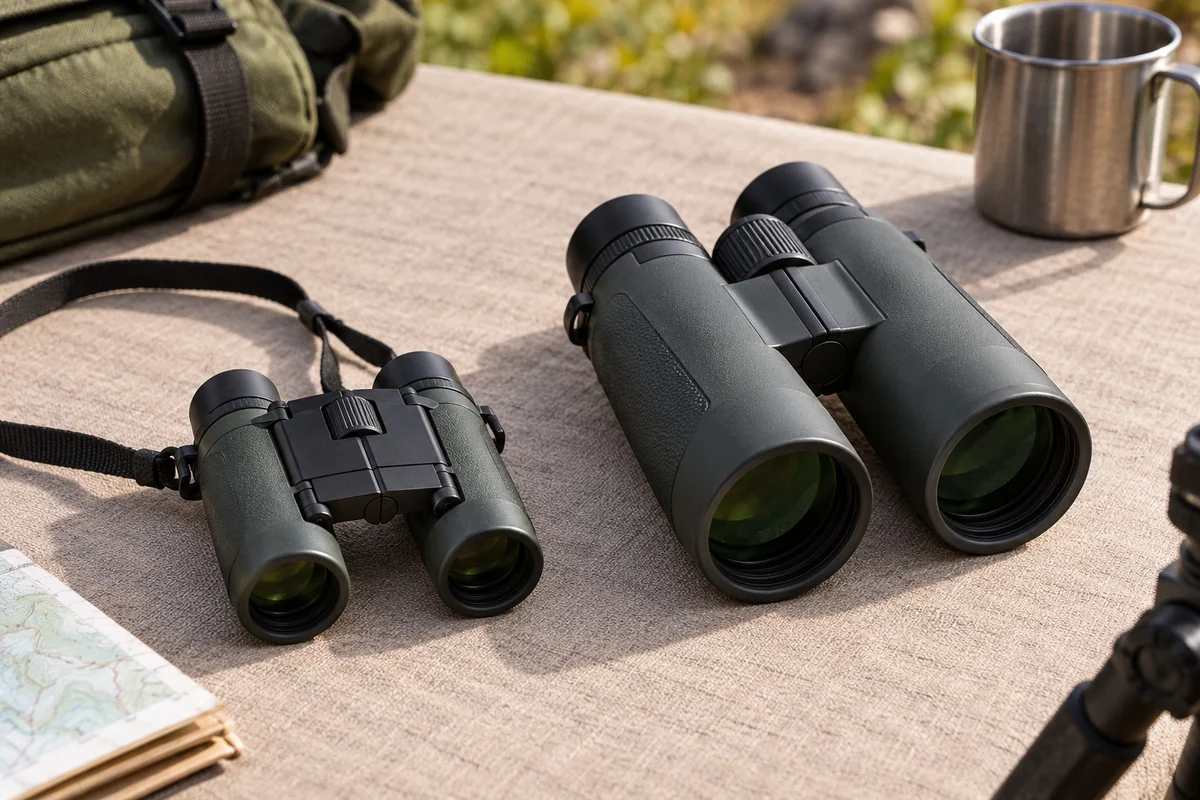
The nominal exit pupil is objective diameter divided by magnification. An 8×25 produces approximately 3.1 mm, an 8×32 produces 4 mm and an 8×42 produces 5.25 mm. This is useful optical geometry, but not a measure of manufacturing quality or actual light transmission. In bright sun, the observer’s pupil can be smaller than all of these values, reducing the practical difference. In weak light or when eye placement is imperfect, a larger exit pupil may make viewing more forgiving. No conventional binocular creates an image when insufficient ambient light reaches the lenses.
Field width is not a size guarantee
A pocket instrument can have a generous field and a full-size one can have a narrow field. Nikon’s 2026 Trailblazer II 8×25 lists 8.3 degrees of real field, while its PROSTAFF P7 8×42 lists 7.2 degrees. These are product-specific results, not evidence that pocket binoculars are generally wider. Field depends on eyepiece design, magnification and other engineering choices. Always compare feet at 1,000 yards or an equivalent common unit. An impressive field is also of limited value if eyecup design prevents you from seeing it with glasses.
For seven named models demonstrating these size tradeoffs on actual trails, use our best binoculars for hiking comparison. This article remains the technical explanation of lens size and viewing comfort rather than a competing general buying guide.
The weight tradeoff
Nikon’s Trailblazer II 8×25 is listed around 310 g, while its PROSTAFF P7 8×42 is 590 g. That difference can become important after an hour of travel or walking between viewpoints. But the smallest optics may be harder for large hands to grip or more sensitive to eye misalignment. A wider well-balanced 8×32 may be easier to hold comfortably than a folding pocket model, even if it weighs more. Use the binoculars for several minutes rather than simply lifting them once in a shop.
Eye relief may outweigh the objective
The user wearing prescription glasses should check eye relief and the actual recessed depth of the ocular lenses. Nikon’s Trailblazer II 8×25 specifies only 10 mm eye relief, compared with 20.2 mm for PROSTAFF P7 8×42. Those measurements suggest a potential advantage for the larger model in spectacle use, but numbers alone cannot guarantee fit. Retract the eyecups and verify that the entire image circle is visible. If a compact binocular cuts off much of its field, its packing benefit may be a poor trade for daily birdwatching.
Handling close subjects
Close focus depends on the focus mechanism, not only objective size. A small model designed for butterflies may focus on subjects less than a metre away, while a pocket travel pair may need several metres. A full-size 8×42 can also have excellent close focus if its design allows it. Compare exact manufacturer’s minimum focusing distances and consider how you use the instrument: garden butterflies from a walkway, birds on a nearby feeder, or distant wildlife across an open field. Never disturb wildlife merely to achieve a shorter observation distance.
Tracking small woodland birds
For birds changing branches rapidly, a broad usable field and smooth focusing wheel may matter more than whether the objective diameter is 25, 32 or 42 mm. A pocket binocular is attractive if it is always carried, but a small focusing wheel can be awkward with gloves. A 42 mm body may offer more comfortable hand placement, yet can be tiring when raised repeatedly over a long walk. Practise locating the same branch with unaided eyes and then lifting each candidate to see which one acquires the target fastest.
Early morning observation
Dawn and shaded woodland may create situations where larger objectives are helpful, provided magnification and other optical properties are comparable. However, full-size is not an independent quality label. Lens transmission, stray-light control, contrast and the user’s own eyes strongly influence the view. A premium compact optic can outperform a poorly assembled full-size model in practical clarity. Without a matched side-by-side test, do not infer a real-world brightness winner from exit pupil alone. Prioritize safe footing and enough ambient light to navigate the habitat.
Travel packing and airline use
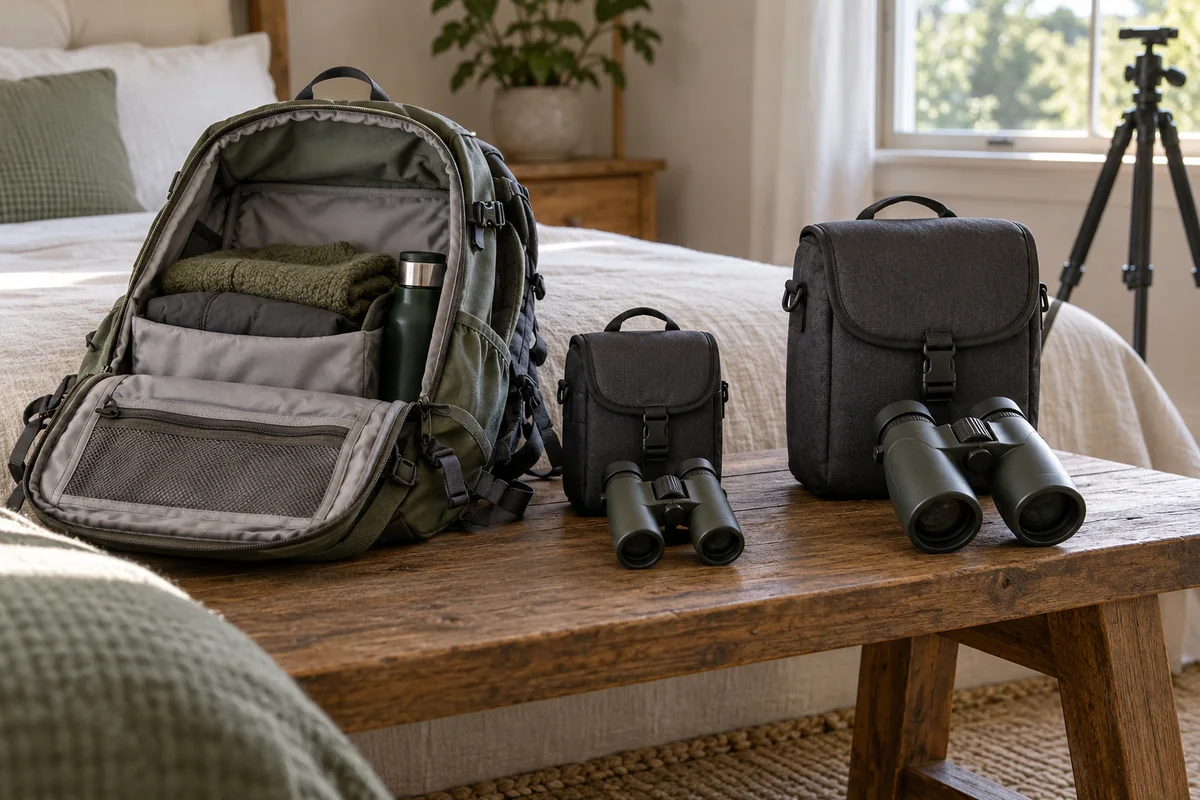
For an airline traveller, compactness is partly about physical folded shape and protecting the lenses during transit. A folding 8×25 may fit inside a small day bag, whereas an 8×42 normally needs more room and perhaps a substantial case. Check airline carry-on rules and protect the optics from impact rather than packing them loose with keys and chargers. Consider how quickly the instrument can be reached for an unexpected wildlife sighting. A product left deeply buried in luggage may deliver less value than a slightly larger binocular that stays accessible.
Waterproofing does not follow body size
Both pocket and full-size products may have waterproof or fogproof construction, and both can exist without adequate sealing. Nikon describes explicit immersion limits for some of its outdoor models; those ratings should not be generalized across all binoculars. A water-resistant travel optic may be adequate for fair-weather use but unsuitable for prolonged heavy rain. Always verify the exact manufacturer environmental claim and read its limitations. Dry the exterior after wet use and avoid sealing damp optics in a case for long-term storage.
What size fits children or smaller faces
Adjustable interpupillary distance determines whether both eyepieces can align with the user’s pupils. Compact does not automatically mean suitable for a child, and some folding pocket designs offer greater adjustment than wider full-size housings. Check the manufacturer’s IPD range and whether the focus wheel can be reached comfortably. A supervised child should use a binocular that fits both eyes and is easy to hold, not simply an adult product marketed as small. Never permit a child to view the sun through binoculars.
An effective side-by-side test
Select a pocket model, an 8×32 and an 8×42 at similar viewing powers, then adjust each to your eyes. Observe a detailed tree in shade, a moving subject and a distant stationary sign from the same point. Compare acquisition speed, eyecup comfort and whether you can see the full field. Lift and lower the instruments repeatedly, noting any wrist or neck fatigue. A five-minute tryout will not measure optical transmission, but it can reveal very real ergonomic differences that a specification table cannot show.
The difference in actual ownership
Pocket binoculars make spontaneous viewing easier because they are less burdensome to carry. A full-size 8×42 may be more comfortable during sustained stationary observation and in changing light, but can require a better strap or harness. Mid-size 8×30 or 8×32 models can bridge these needs. Protection, warranty and cleaning requirements remain relevant at every size. Avoid paying more merely for a larger objective if you primarily watch birds in bright conditions on short walks.
Choosing a format
If luggage volume and frequent carrying dominate, investigate a folding 8×25 and test eye relief carefully. If mixed woodland, travel and moderate dim light are common, consider an 8×30 or 8×32. If you observe for long periods from a garden, hide or lakeside, an 8×42 can be worth its bulk. These are use cases, not a rank of absolute optical quality. Check the actual field, focusing, viewing comfort and weight before choosing. Our 8×32 versus 8×42 guide covers the two intermediate full-size alternatives in more depth.
Manufacturer references
About the author
Simon Jack
Simon Jack is the named author of FieldLens Guide's research-based binocular, spotting scope and wildlife observation articles. His published editorial approach focuses on verifying model-specific manufacturer specifications, explaining optical tradeoffs in plain language, and matching equipment to real birdwatching, hiking and nature-observation needs. These articles do not claim hands-on product tests unless explicitly documented.