
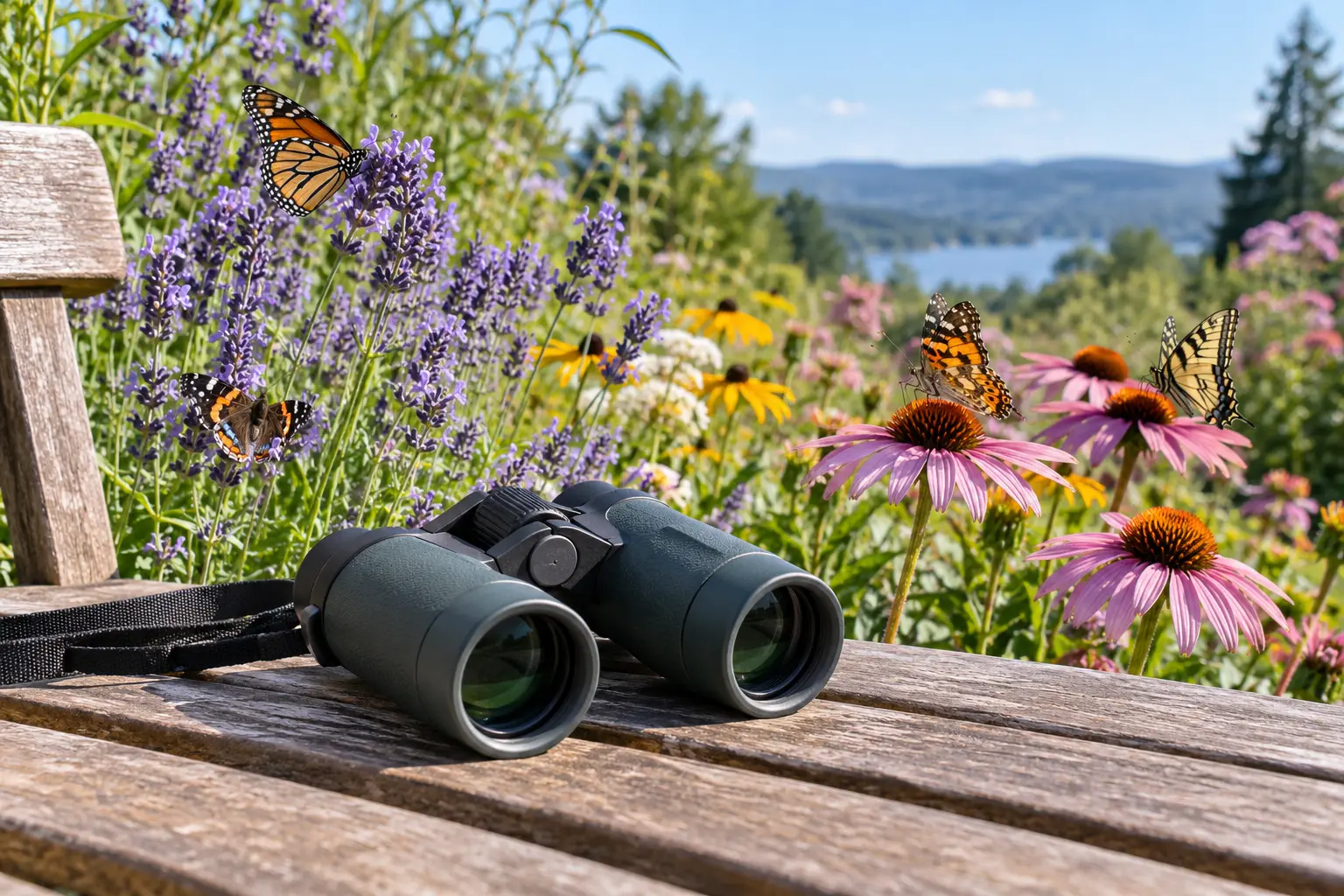
The best binoculars for butterfly watching must focus at the distances where butterflies actually settle, often much closer than ordinary birding subjects. A large magnification number is little help if the insect remains inside the binocular's minimum focus or you cannot merge the two views comfortably. Before choosing, consider whether you mainly watch insects in a flower patch or want one pair for butterflies, birds and longer nature walks. This guide compares a specialist very-close-focus model with four general-purpose alternatives, explaining the tradeoffs in nearest focus, magnification, eye relief, weather protection, size and buying options. The specialist offers a different kind of view from a full-size birding binocular, so the right choice depends on your main interest. Start with the quick verdict, then compare the actual focusing distance and fit before buying.
Affiliate Disclosure: We may earn a commission at no extra cost to you when you make a qualifying purchase through affiliate links in this guide. Buying buttons open Amazon.com. Read our full affiliate disclosure.
Best Binoculars for Butterfly Watching: quick comparison
On smaller screens, swipe across the table to compare all features and buying options.
| Image | Model | Nearest focus | Magnification | Main purpose | Where to buy |
|---|---|---|---|---|---|
 | Pentax Papilio II 6.5×21 | 0.5 m (about 1.6 ft) | 6.5×21 | Specialist very-close butterfly observation | Check PriceAmazon |
 | Opticron Traveller BGA ED 8×32 | 1.8 m (about 5.9 ft) | 8×32 | Compact general nature pair with near focus | Check PriceAmazon model search |
 | Celestron TrailSeeker ED 8×32 | 6.5 ft (about 2 m) | 8×32 | Waterproof compact pair for mixed trails | Check PriceAmazon |
 | ZEISS Victory Pocket 8×25 | 1.9 m (about 6.2 ft) | 8×25 | Premium pocket viewing with short focus | Check PriceAmazon |
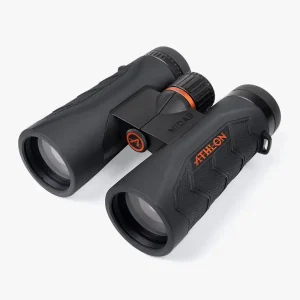 | Athlon Midas G2 UHD 8×42 | 6.5 ft (about 2 m) | 8×42 | Full-size birdwatching with close-focus versatility | Check PriceAmazon |
Open Amazon for the current price and availability. Confirm the exact model, condition and package contents, including any separately required eyepiece, tripod or accessories. Tax and shipping may affect the total.
How we chose these models
The Papilio’s specialist close focusing is the reference point, while the Opticron, Celestron, ZEISS and Athlon show how nearby observation can fit into a broader nature-watching instrument. The shortlist intentionally includes pocket, mid-size and full-size choices. That prevents the nearest-focus number from hiding differences in eye relief, carrying size and the other subjects a reader watches.
- Compare minimum focus with the distance at which you can observe without disturbing the subject.
- Check comfortable image merging at close range with your own eyes.
- Keep field width and general birding use in the decision if the same pair must do both jobs.
These comparisons use manufacturer documentation and published model specifications. We have not conducted hands-on product tests. See how we review optics for the research and correction process.
01 / Specialist very-close butterfly observation
Pentax Papilio II 6.5×21
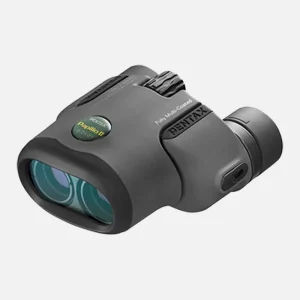
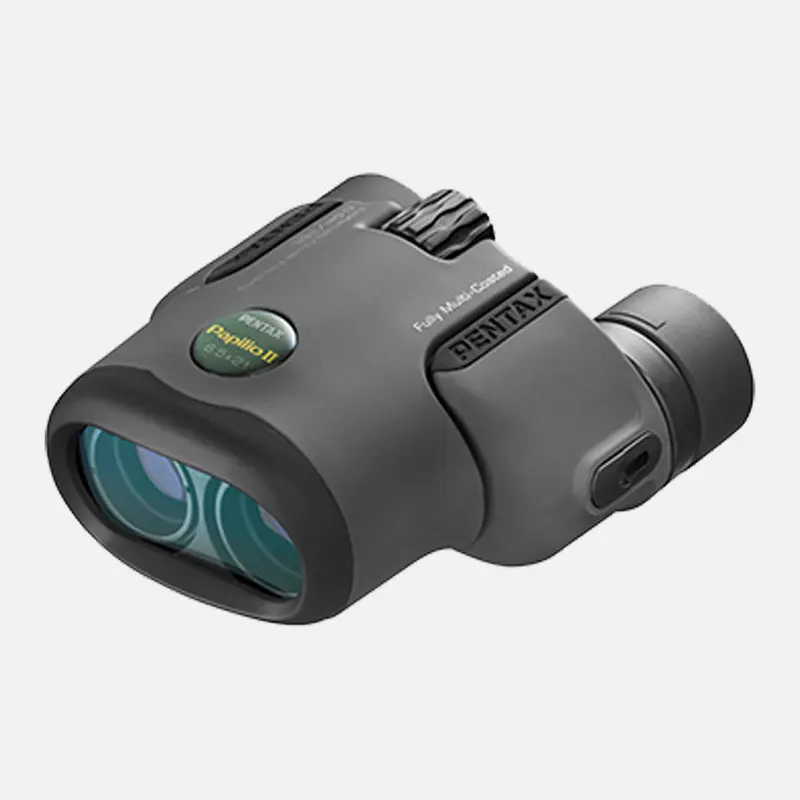
Pentax Papilio II is unusual because its published minimum focus is around half a metre rather than the two or three metres common among general birding optics. That makes a real difference when a butterfly settles on a nearby flower along a permitted path. The 6.5-times power gives a manageable scale for observing moving insects and a published 393-foot field at 1,000 yards. Pentax identifies a Porro-prism design and a roughly 290 g body, making it relatively compact despite not being a folding roof-prism pair.
Amazon.com
Product image: Pentax.The specialized convergence and close-focusing arrangement serves nearby insects and plants especially well. You can observe wing margins, posture and feeding movements at distances where many full-size binoculars cannot focus at all. This does not mean every insect can be approached or that a closer viewpoint is ethically appropriate. A short minimum focus is useful only from a safe permitted location that does not disturb host plants or butterfly behaviour.
The tradeoffs are significant for mixed use. A 21 mm objective is less capable geometrically of gathering light than a 32 or 42 mm lens of the same design, and it is not the main choice for dawn birdwatching. Eye relief of 15 mm calls for a fit test with spectacles. Confirm weather protection directly rather than assuming a specialist nature-viewing product is fully sealed. For frequent close butterfly observation, though, this may be the clearest purpose-built candidate.
Reasons to choose it
- 0.5 m close focus with a convergence mechanism.
- 6.5x power is suited to close-subject observation.
What to weigh up
- Papilio II is not a waterproof design.
- 21 mm objectives prioritize compact daylight use.
02 / Compact general nature pair with near focus
Opticron Traveller BGA ED 8×32
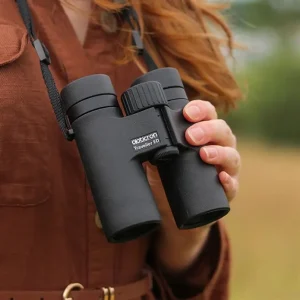
Opticron’s Traveller BGA ED 8×32 gives a different balance from the Pentax. Its minimum focus is 1.8 metres, far less specialized than half a metre, but it combines that distance with an eight-times view, 19 mm eye relief and a broad 143-metre field at 1,000 metres. The manufacturer lists a 452 g mass, a compact 119 mm length and an IPD adjustment range extending down to 51 mm. Those are valuable details for nature observers who travel and wear glasses.

Opens an Amazon search for this model.
Product image: Opticron.The main benefit is versatility. From a garden path you may watch a butterfly at a short but comfortable distance, then focus on a small bird high in a tree without swapping instruments. The broader objective and published long eye relief can make repeated observation feel more forgiving than a very small pocket pair. Its ED glass is an optical design feature, not a guarantee of superior image quality compared with every alternative.
Because the closest focus remains almost two metres, it cannot offer the intimate macro-style experience of Papilio. Its UK manufacturer pricing also does not prove exact U.S. Amazon availability. Check authorized distribution and warranty coverage before making an affiliate purchase recommendation. The Traveller is an excellent comparison candidate for mixed bird and butterfly use, not a specialized winner for insects a few inches away.
Reasons to choose it
- 19 mm eye relief and four-stage eyecups.
- 452 g body with 1.8 m close focus.
What to weigh up
- The complete body and grip should suit your carrying kit.
- A stated 3 m water depth is not a published IPX7 test.
03 / Waterproof compact pair for mixed trails
Celestron TrailSeeker ED 8×32
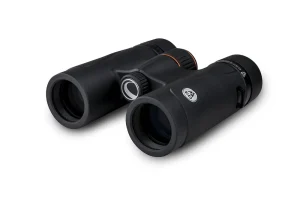
The TrailSeeker ED 8×32 is a compact alternative offering 410 feet of field at 1,000 yards, a 6.5-foot close focus and an approximately 17.6-ounce body. Celestron specifies ED objectives, phase- and dielectric-coated prisms and an IPX7 water-resistance rating. That combination makes sense for naturalists whose garden, meadow and birding outings can involve light showers or wet vegetation. The wide field may make it easier to follow a butterfly moving between nearby flowering plants.

Amazon.com
Product image: Celestron.The model is more versatile than a specialist 0.5-metre binocular. Its 32 mm objectives provide a four-millimetre nominal exit pupil at 8x, and the broad real field remains useful when switching to birds. The waterproof rating is a defined one-metre, thirty-minute manufacturer test and must not be interpreted as permission for indefinite immersion or all water exposure. Close focus should be evaluated from the actual pathway where observation occurs.
The 15.6 mm eye relief is shorter than Opticron Traveller’s published 19 mm, making a practical spectacle trial important. A 2-metre focusing limit may be too long if most butterflies rest close to your feet. It is also a physically larger instrument than Papilio, despite sharing roughly the same broad nature-observation audience. Choose it for varied outdoor use rather than claiming it matches a macro binocular at extreme near distances.
Reasons to choose it
- Defined IPX7 protection: 1 m for 30 minutes.
- 32 mm ED objectives in a mid-size body.
What to weigh up
- 15.6 mm eye relief needs a glasses-on fit check.
- 499 g is more weight than a pocket model.
04 / Premium pocket viewing with short focus
ZEISS Victory Pocket 8×25
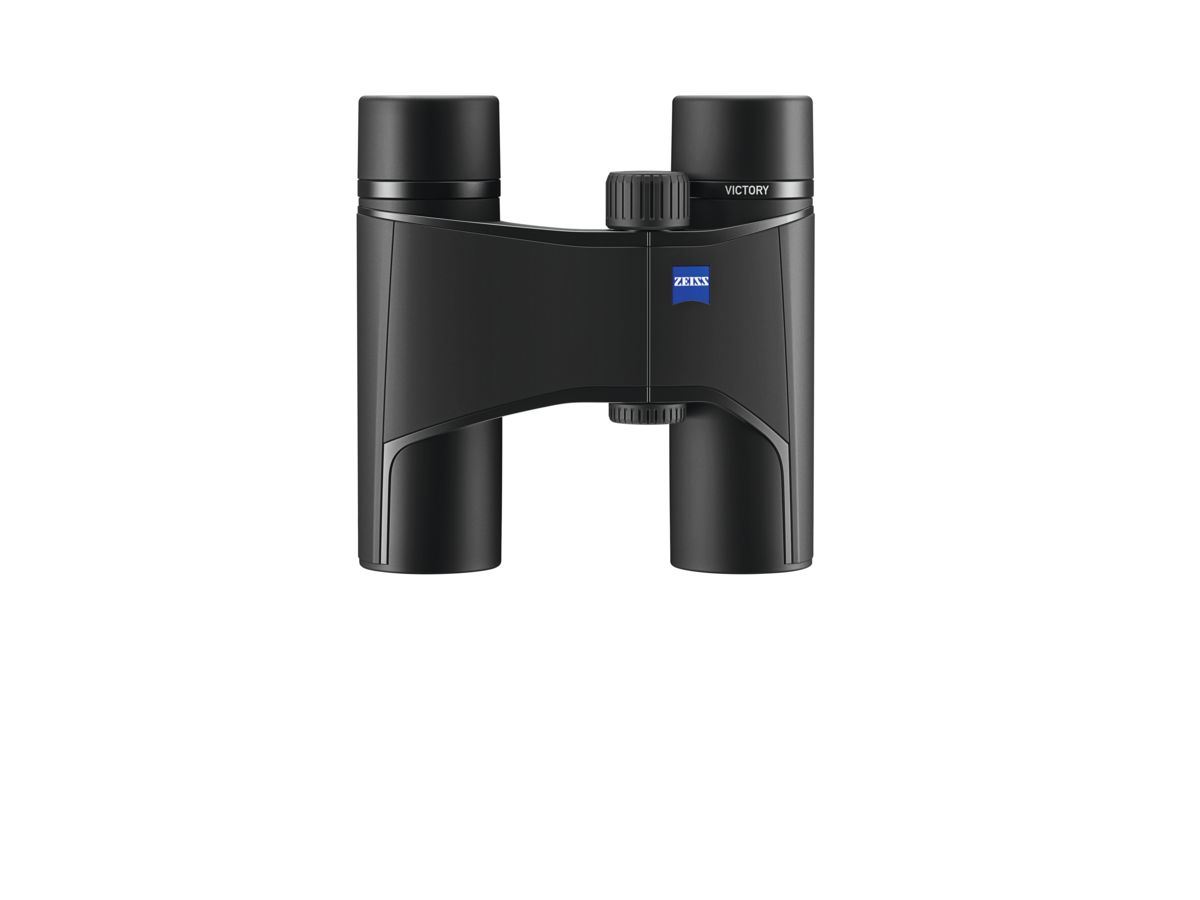
ZEISS Victory Pocket 8×25 emphasizes travel-sized portability and a 1.9-metre near focus. The manufacturer’s technical data lists a 130-metre real field at 1,000 metres, a 16.5 mm eye-relief distance and about 290 g weight. Its asymmetric folding layout is designed for a small storage footprint. For a butterfly observer who likes to carry optics during ordinary walks, having binoculars available when an insect settles can be more important than owning a bulkier specialized pair left at home.
Amazon.com
Product image: ZEISS.The 25 mm objectives create a calculated exit pupil of about 3.1 mm. In bright daylight that may be entirely serviceable, but a full-size 8×42 has a more forgiving nominal beam in lower light. ZEISS describes FL optical design and a moisture-repellent exterior coating; those claims are manufacturer statements and do not establish a measured rank against Opticron or Celestron. The actual eye alignment of such a small body should be tested carefully.
This is a high-cost option relative to ordinary folding pocket binoculars, and the near focus still cannot match Papilio’s half-metre capability. Small grips are not always comfortable for large hands. Check whether premium compactness is worth the price for your actual frequency of garden walks, and verify the exact 8×25 rather than the 10×25 with a narrower field and smaller exit pupil.
Reasons to choose it
- 290 g body with a compact asymmetric fold.
- 390 ft field and 1.9 m close focus.
What to weigh up
- Premium pocket construction may exceed an occasional-use budget.
- 3.1 mm exit pupil favors daylight portability.
05 / Full-size birdwatching with close-focus versatility
Athlon Midas G2 UHD 8×42
Athlon Midas G2 UHD 8×42 is a conventional full-size format that happens to focus as close as about 6.5 feet. Its 426-foot field, 17.2 mm eye relief and 23.3-ounce mass are manufacturer-listed specifications. For a birdwatcher who only occasionally watches butterflies, this may be more economical than keeping two sets of optics. The 42 mm objectives offer a larger nominal exit pupil than the 21 or 25 mm alternatives, which can be valuable for other nature-viewing situations.

Amazon.com
Product image: Athlon.The maker’s UHD glass, dielectric and phase coatings are part of the optical design, while the magnesium chassis and gas-purged body are practical construction choices. Their presence alone does not mean the 8×42 provides a better close-focus image than every small optic. Its wider weight and bulk can make quick insect observations less convenient, particularly when holding a pose near a flowering patch for several minutes.
This is most appropriate for mixed habitats and repeated ordinary birding, with butterflies an enjoyable secondary use. If nearly all your observation occurs within a metre, it is the wrong primary tool because it simply will not focus that close. Check Athlon SKU 113009 rather than the Midas 10×42, which has different field, eye relief and nearest focus.
Reasons to choose it
- 426 ft field and 6.5 ft minimum focus.
- 8×42 design with UHD glass and argon purging.
What to weigh up
- 23.3 oz is a full-size carrying load.
- 17.2 mm eye relief does not guarantee fit with every frame.
What to consider before buying
Close focus decides whether the butterfly is sharp
Minimum focusing distance is the first specification to inspect when butterflies land near a path. A binocular unable to focus on an insect one metre away cannot solve the problem through increased magnification. The Pentax Papilio II stands out with approximately half-metre focus, while the other options begin around 1.8–2 metres. Those latter distances can still be useful when viewing from a garden bench or behind a planting border. The specification should be measured against normal ethical observation distance, not used as an invitation to step into a habitat.
Why very high magnification is often unhelpful
Butterflies shift their wing position, crawl around flower heads and move unpredictably between plants. Lower magnification can make it easier to maintain a merged image while tracking a small subject close to the observer. A 6.5x specialist pair may reveal more usable details than an unstable 10x model with the same short focus. Higher power also narrows the visible scene in many designs and can magnify hand motion. Choose the amount of enlargement that allows you to see wing markings comfortably, not the biggest number on a product label.
Field width and near-view convergence
Published fields are commonly measured in degrees or at a fixed distant reference such as 1,000 yards. These figures do not by themselves describe how comfortable it is to merge binocular images at very short focus. Because the two barrels view close subjects from slightly different positions, convergence can be demanding. A carefully engineered near-focus instrument may offer practical comfort that a general-purpose binocular does not. Test both eyes together at the intended distance and stop if the image feels strained or double.
Eye relief can change the experience
Prescription glasses hold the eyes farther from the ocular lenses. A nominal field may become clipped if the eyecups do not retract sufficiently or if the published relief is too short for the wearer’s frames. The Opticron Traveller’s 19 mm figure is generous relative to several other products here, but it does not guarantee a complete image for every user. Try observing a stationary flower through the actual glasses you use outdoors. A comfortable merged circle matters more than a few extra feet of field in a catalogue.
A 21 mm objective in bright daylight
The 21 mm Papilio uses a smaller front lens than 32 or 42 mm birding binoculars. In daylight that may be perfectly adequate for viewing butterfly detail, especially at moderate magnification. Its nominal exit pupil is around 3.2 mm, compared with four millimetres for an 8×32 and 5.25 for an 8×42. In weak light or during long general wildlife sessions, larger objectives may offer benefits worth their additional carrying burden.
Know what wing surface is visible
A butterfly with wings open may expose patterns different from the underside revealed when it closes them. Identification may rely on shape, pattern distribution, antennae and habitat as well as colour. Binoculars can help observe details without disturbing the insect, but no product can show markings hidden behind closed wings. Wait for natural movement and take field notes rather than chasing the butterfly. Use a suitable regional identification reference and acknowledge uncertainty when the necessary diagnostic feature was not visible.
Focus technique for flowering patches
Choose a comfortable permitted observation point overlooking flowers that butterflies frequently visit. Focus the binoculars on a stationary blossom before the insect arrives, then make a gentle final adjustment after it settles. This approach avoids sweeping across the garden at random. Follow the subject by turning the upper body smoothly, keeping elbows supported if helpful. A close-focusing instrument with an accessible central wheel is more useful than one that requires uncomfortable hand movements every time the subject moves.
Why a waterproof label is not universal
Garden walks and meadows may expose optics to rain, dew or sprinklers. Celestron TrailSeeker ED carries a specific IPX7 test, while other products have different published sealing descriptions. Do not assume a specialized close-focus model is fully waterproof or that a particular rating protects against every immersion or impact. After wet use, dry the exterior according to the manufacturer’s advice and avoid rubbing grit across coated lenses. A clean soft case and secure strap help preserve equipment used regularly near vegetation.
Mid-size versus full-size choices
A 32 mm model can be a useful compromise between the specialized compact Papilio and a conventional 42 mm birding pair. Opticron Traveller and Celestron TrailSeeker ED both combine practical close focus with a relatively easy carrying format. Athlon Midas 8×42 offers larger objectives and a broad field, but also more bulk. Choose according to how much of your observation time goes toward butterflies rather than general birdwatching. A single versatile binocular may be efficient if near encounters are occasional.
Carry the pair you will actually use
An excellent optical instrument left in a cabinet cannot help when a butterfly appears unexpectedly. Weight, packed dimensions and an easy-to-use protective case affect real use. A 290 g pocket pair can be carried on normal walks without much additional load. A full-size 8×42 may offer better general versatility but can become tiring when held for repeated close observations. Consider how the binoculars fit in a pocket or small bag and whether a strap keeps them secure while walking through paths without catching on vegetation.
Avoid unsafe or disruptive approaches
Do not step into protected flower beds, collect butterflies or disturb larvae, eggs and host plants to obtain a closer view. A half-metre focus specification is a capability, not a requirement to move within half a metre of an insect. Use established paths and allow butterflies to approach flowers naturally. When photographing, avoid flash or physical manipulation that changes behaviour. Patient observation usually produces more useful natural-history information than pursuing a moving insect around a garden.
How to compare a specialist with an all-rounder
Choose a stationary flower at several known distances—perhaps half a metre, two metres and farther away. From a safe place, see whether each candidate can achieve sharp focus and whether the image remains comfortable to merge. Then look toward a bird or tree farther away. Record wheel travel, field usability and hand fatigue. This test makes the specialization tradeoff obvious. The Papilio can succeed near a flower where the other binoculars simply cannot focus, but the wider-ranging optics may be more useful during mixed trips.
Why manufacturer claims need context
Pentax, Celestron, ZEISS, Opticron and Athlon use different coating terminology and optical design. A numerical field or close-focus figure can be compared directly only when the same measurement convention is used. Claims about sharpness and colour need credible testing of actual samples under matching conditions. A buyer should check official model codes before accepting third-party product listings.
When binoculars are not the best tool
For extremely tiny features such as subtle scale patterns, a suitable macro camera may be more useful than binoculars, provided photographing can be done without harming insects or their habitat. Binoculars excel at comfortable non-contact observation from several steps away, but do not replace specialist microscopy. A smartphone held behind a binocular eyepiece may create vignetting and camera-alignment problems. Choose the instrument appropriate to your goal: enjoying behaviour, making a field identification or documenting microscopic detail.
The purchase shortlist
Choose Pentax Papilio II 6.5×21 when very close butterflies are the main pursuit. Opticron Traveller 8×32 and Celestron TrailSeeker ED 8×32 are balanced options for mixed bird and insect watching. ZEISS Victory Pocket 8×25 emphasizes premium packability, while Athlon Midas 8×42 serves those who primarily own binoculars for birds and mammals. The relevant comparison is whether it focuses at your normal distance and feels comfortable for repeated observation.
Final butterfly-watching advice
Prioritize close focus, a comfortable merged image, moderate magnification and easy focusing. Use manufacturer distances to create a shortlist but test the actual user experience whenever possible. Protect habitats, observe from permitted paths and let the insect move naturally. Buy a specialist macro-style binocular if nearby butterflies are a frequent focus; otherwise a well-chosen 8×32 may deliver more all-round value. Our selection guide explains the field technique in more depth.
Before you choose
Frequently asked questions
What close-focus distance should I choose for butterflies?
Choose a minimum focus shorter than the distance at which you normally observe. A specialist model can show insects much closer than a general nature binocular, but that advantage only matters if you can observe comfortably without disturbing them. Compare the actual stated distance rather than relying on a close-focus marketing label.
Is higher magnification better for butterfly watching?
Not necessarily. At close distances, a manageable view, comfortable merging of both images and accurate focusing can be more useful than extra magnification. High power also makes hand movement more apparent. Choose a format you can aim and hold steadily while leaving the insect undisturbed.
Can normal birdwatching binoculars work for butterflies?
Yes, when their minimum focus suits the distance to the insect. They can be a practical compromise if birds remain your main interest. Check a nearby flower patch or a stationary target at a similar distance before buying, since some otherwise useful birding binoculars cannot focus close enough for your preferred subjects.
Does close focus mean I should move nearer to the butterfly?
No. Use the capability when a subject is already at an appropriate distance and remains undisturbed. Avoid trampling vegetation, blocking an insect's route or repeatedly chasing it for a view. Patience at a suitable observation position can be more useful than approaching as close as the optics allow.
Are all the binoculars in this guide waterproof?
No. The specialist close-focus choice and the general-purpose alternatives have different environmental protection. Check the exact model's claim before taking it into rain or wet vegetation. Do not transfer a waterproof specification from a newer generation or a similarly named product to the one you are buying.
Why do the two views become awkward very close up?
Close subjects require your eyes and the binocular views to work differently from distant viewing. Correct hinge spacing and a design intended for close observation can matter. Start with the binocular properly adjusted, and compare comfort at the distances you actually intend to use rather than only checking a distant scene.
Sources and buying information
Product details come from manufacturer documentation for the models listed. Use the Amazon buying links for the current offer, seller, condition and package contents.
Related practical guides
About the author
Simon Jack
Simon Jack is the named author of FieldLens Guide's research-based binocular, spotting scope and wildlife observation articles. His published editorial approach focuses on verifying model-specific manufacturer specifications, explaining optical tradeoffs in plain language, and matching equipment to real birdwatching, hiking and nature-observation needs. These articles do not claim hands-on product tests unless explicitly documented.