
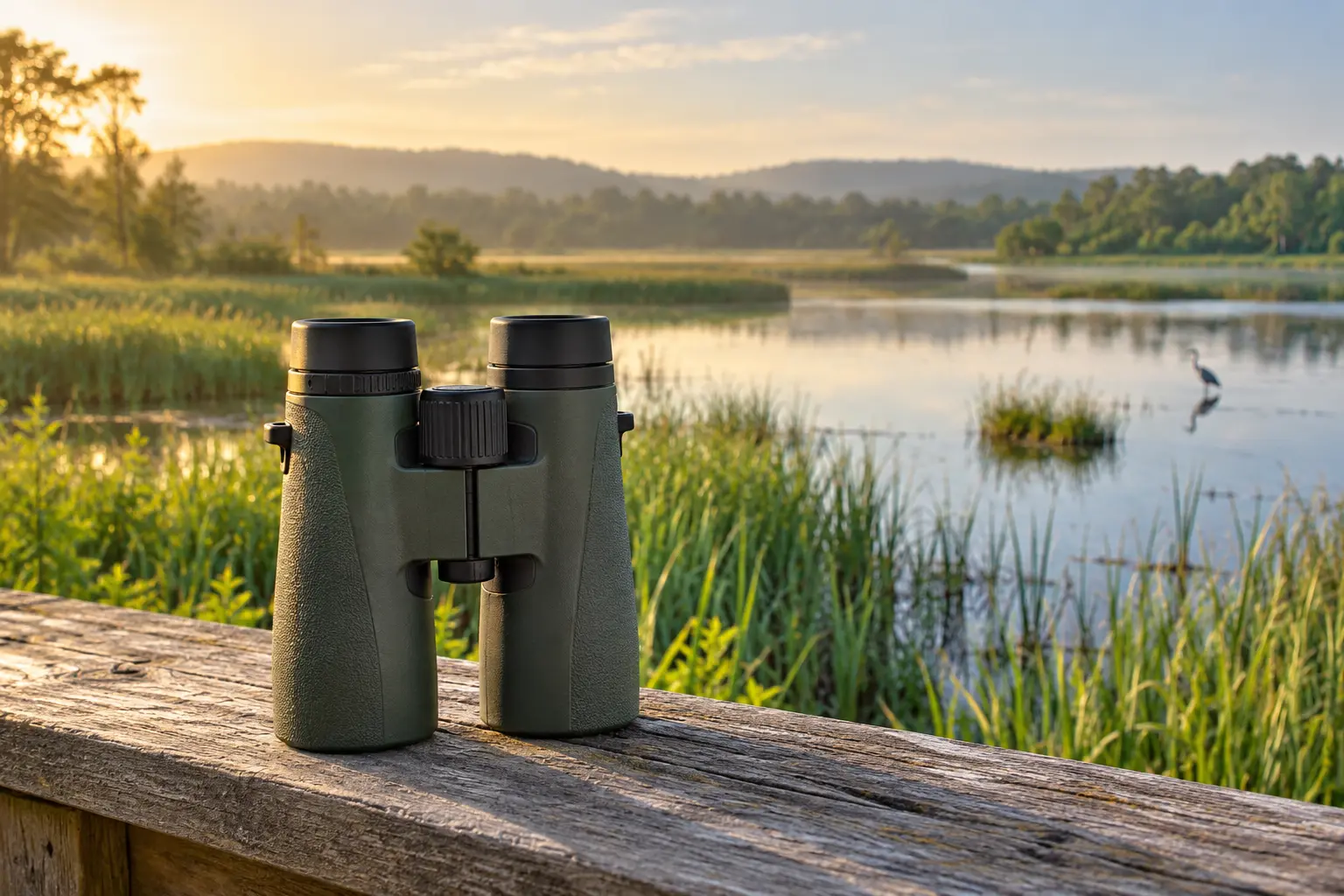
The best 8×42 binoculars for bird watching share the same basic format, but they can feel very different when a bird moves through branches or lands near your viewing position. Field of view affects how much scene you can search, eye relief influences comfort with glasses, and close focus determines which nearby subjects remain sharp. Weight and price add further choices even before you compare the optical design. This guide looks at five full-size 8×42 models with distinct balances of those features, including broad-field ED options, a longer-eyepoint alternative and a lower-priced ED pair. We use manufacturer specifications to make the differences clear and link to Amazon for current prices. Start with the quick verdict, then decide which benefit matters most for your usual habitats and compare the complete binoculars with your own eyes and hands.
Affiliate Disclosure: We may earn a commission at no extra cost to you when you make a qualifying purchase through affiliate links in this guide. Buying buttons open Amazon.com. Read our full affiliate disclosure.
Best 8×42 Binoculars for Bird Watching: quick comparison
On smaller screens, swipe across the table to compare all features and buying options.
| Image | Model | Field / 1,000 yd | Eye relief | Primary role | Where to buy |
|---|---|---|---|---|---|
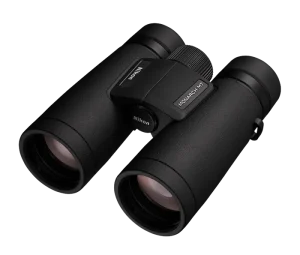 | Nikon MONARCH M7 8×42 | 435 ft | 17.1 mm | Wide field for woodland birding | Check PriceAmazon |
 | Celestron TrailSeeker ED 8×42 | 426 ft | 17.2 mm | Broad field with close focus | Check PriceAmazon |
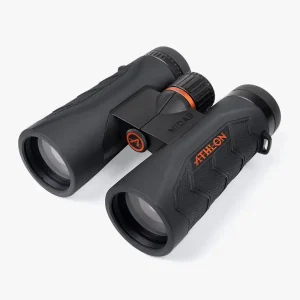 | Athlon Midas G2 UHD 8×42 | 426 ft | 17.2 mm | Versatile full-size nature observation | Check PriceAmazon |
 | Nikon PROSTAFF P7 8×42 | 377 ft | 20.2 mm | Long relief and lighter carrying | Check PriceAmazon |
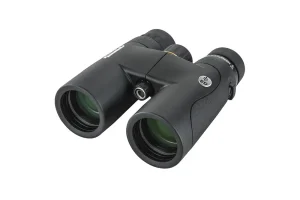 | Celestron Nature DX ED 8×42 | 393 ft | 17.8 mm | Value-oriented ED birding pair | Check PriceAmazon |
Open Amazon for the current price and availability. Confirm the exact model, condition and package contents, including any separately required eyepiece, tripod or accessories. Tax and shipping may affect the total.
How we chose these models
All five choices share the 8×42 format, so the comparison focuses on differences within a common birdwatching size. The MONARCH M7, TrailSeeker ED and Athlon offer different fields and optical specifications; the P7 and Nature DX ED provide additional balances of fit, close focus and cost. We do not infer a measured sharpness ranking from the presence or absence of ED glass.
- Compare published field width at the same reference distance.
- Check the eye relief and nearest focus of each exact model.
- Use the same viewing task when deciding whether a particular feature is worth paying for.
These comparisons use manufacturer documentation and published model specifications. We have not conducted hands-on product tests. See how we review optics for the research and correction process.
01 / Wide field for woodland birding
Nikon MONARCH M7 8×42
Nikon MONARCH M7 8×42 has a manufacturer-listed field of 435 feet at 1,000 yards, a major practical attribute for locating songbirds that repeatedly move through branches. The published 17.1 mm eye relief, 8.2-foot near focus and 23.6-ounce weight place it among conventional full-size birding binoculars rather than pocket optics. Nikon identifies ED objective glass, dielectric reflective prism coatings, phase correction and a locking diopter.

Amazon.com
Product image: Nikon.The M7’s useful distinction is subject acquisition. A broad real field helps retain surrounding branches while a small bird moves, but it does not prove that the outer field is perfectly sharp. A glasses wearer should verify the complete visible circle after retracting the eyecups. The body may feel substantial during a long walk, making strap and grip comfort important. It is appropriate for someone who regularly watches moving woodland birds and values a wider viewing scene.
Compare the M7 with a narrower-field binocular on the same stationary tree and then acquire a moving subject from unaided vision. If the wider field improves your ability to find birds, that is an observable reason to spend more. Nikon’s published waterproof specification has limitations and does not make the optics suitable for underwater use. Check product ID 16765 rather than mixing data from an older MONARCH 7 or a 10×42 model.
Reasons to choose it
- Broad 435 ft field at 1,000 yards.
- ED glass with a locking diopter and repellent lens coatings.
What to weigh up
- 23.6 oz is a full-size carrying commitment.
- 17.1 mm eye relief may fit differently from longer-eyepoint models.
02 / Broad field with close focus
Celestron TrailSeeker ED 8×42
Celestron TrailSeeker ED 8×42 provides a manufacturer-listed 426-foot field at 1,000 yards and 6.5-foot nearest focus. This combination suits mixed observations of woodland birds, nearby feeder activity and more stationary subjects across a meadow. Celestron specifies ED objectives, fully broadband multicoated lenses and phase- and dielectric-coated BaK-4 prisms. The published 17.2 mm eye relief and 23.5-ounce weight are close to the Nikon M7, creating a useful model-level comparison rather than a different optical category.

Amazon.com
Product image: Celestron.Its shorter minimum focus is particularly relevant to gardeners who also enjoy butterflies, but it is not a reason to move toward a sensitive bird. Check edge rendering, focus-wheel feel and eyecup fit rather than inferring real-world sharpness from an ED label. For users who spend time at both garden windows and wooded trails, a versatile focus range may justify a shortlist position.
Compare the same close and distant subjects with the M7, making sure both instruments are adjusted to your eyes. A 426-foot field is broad, but a numerical difference of nine feet from Nikon’s figure is not a guarantee of a meaningful visible distinction. Celestron sells both TrailSeeker and TrailSeeker ED lines; make sure the exact ED 8×42 is in the cart before adding a commercial link.
Reasons to choose it
- 426 ft field with 6.5 ft close focus.
- ED objectives in a full-size 8×42 binocular.
What to weigh up
- Body and carrying accessories are bulkier than mid-size options.
- 17.2 mm eye relief needs checking with your frames.
03 / Versatile full-size nature observation
Athlon Midas G2 UHD 8×42
Athlon Midas G2 UHD 8×42 has a documented 426-foot field and a 6.5-foot close focus, putting its geometry close to the Celestron TrailSeeker ED. Athlon publishes a 23.3-ounce mass, 17.2 mm eye relief and an interpupillary range of 57–74 mm. The manufacturer describes a magnesium chassis, UHD glass, dielectric and phase prism coatings and argon purging.

Amazon.com
Product image: Athlon.The Midas can be worth comparing when you want one binocular for forest birds, feeders and general nature viewing. Its broad field should help subject acquisition, and the relatively short near focus extends the range of observation opportunities. Yet the final buying choice may be decided by grip shape, focus-wheel resistance or the price available from a reliable seller. Those practical differences are not captured by a field-width table.
Use the official Athlon model code 113009. A similarly named 10×42 has different eye relief and field characteristics and should not be substituted in the product button. Compare the image with a high-contrast branch and a shaded scene, acknowledging that you have not performed a controlled optical test simply by reading a manufacturer’s technology list. The Midas is a research-supported candidate, not a verified winner of hands-on testing.
Reasons to choose it
- 426 ft field and 6.5 ft minimum focus.
- 8×42 design with UHD glass and argon purging.
What to weigh up
- 23.3 oz is a full-size carrying load.
- 17.2 mm eye relief does not guarantee fit with every frame.
04 / Long relief and lighter carrying
Nikon PROSTAFF P7 8×42
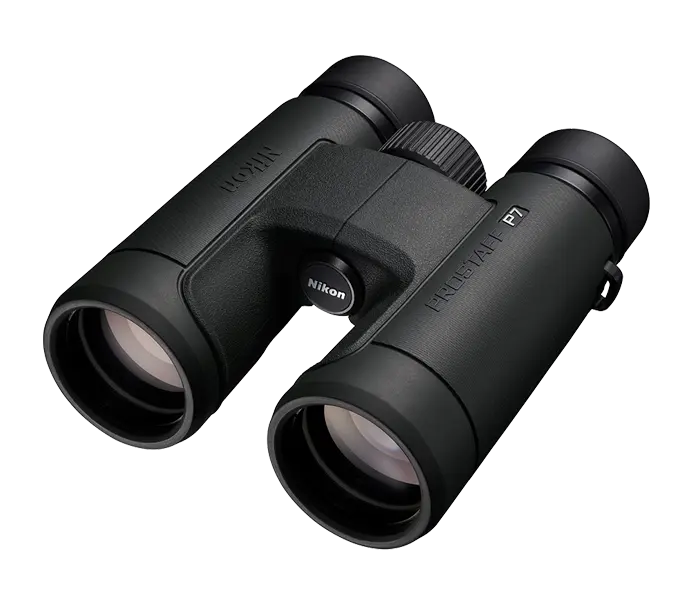
The PROSTAFF P7 8×42 has a narrower manufacturer-reported field of 377 feet but unusually long 20.2 mm eye relief and a relatively light 20.8-ounce body. Nikon specifies an oil- and water-repellent exterior lens treatment, locking diopter, phase-corrected prisms and nitrogen-filled waterproof construction. For a spectacle wearer, the longer viewing distance is a tangible reason to investigate it even when wider alternatives exist. Body weight can also matter during repeated raising and lowering on a trail.
Amazon.com
Product image: Nikon.Neither eye relief nor light weight guarantees the binocular will fit every observer. Eyecup geometry, lens recess and the wearer’s frames change the usable field. The 9.8-foot close focus is less suitable for butterflies and nearby feeder subjects than the six-foot-class alternatives. If fast birds in dense cover are the main challenge, the narrower field may require more careful initial aiming. These are honest compromises rather than reasons to dismiss the model.
Test the P7 in the actual spectacles used for birdwatching, checking the full circular field at the widest eyecup setting that remains comfortable. A person observing mostly from an established hide may prefer clear comfortable eye placement over maximum field width. Verify Nikon 16772 and avoid copying field data from the 8×30 or 10×42 P7. The published immersion tolerance has limits, so it remains necessary to store equipment properly after wet outings.
Reasons to choose it
- 20.2 mm listed eye relief.
- Locking diopter and oil- and water-repellent lens coatings.
What to weigh up
- 9.8 ft minimum focus limits very nearby subjects.
- 377 ft field is narrower than several wide-field 8×42 alternatives.
05 / Value-oriented ED birding pair
Celestron Nature DX ED 8×42
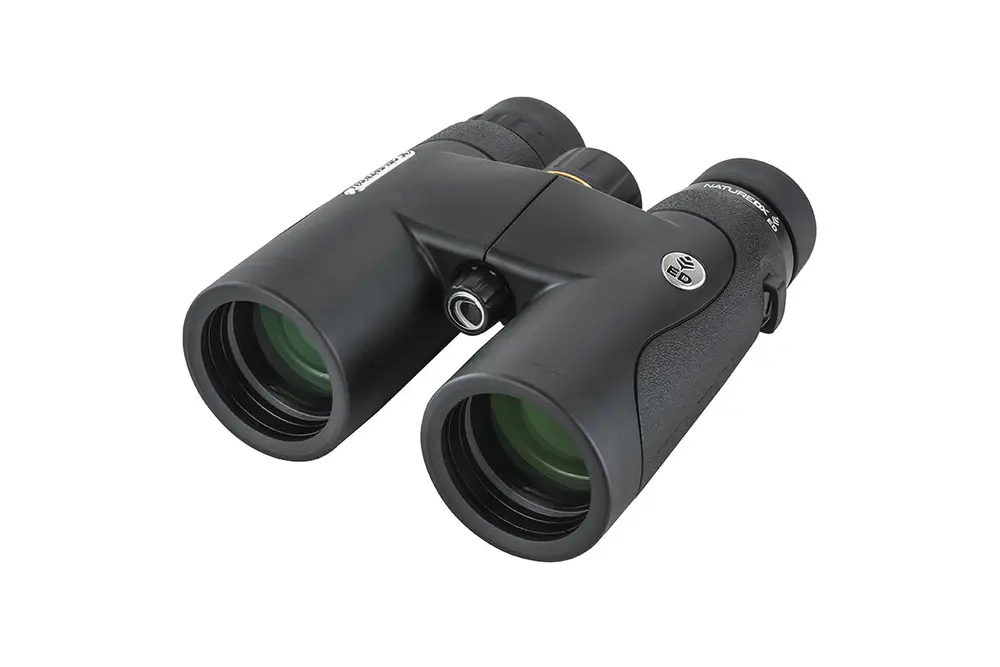
The Nature DX ED 8×42 offers a manufacturer-listed 393-foot field at 1,000 yards, 17.8 mm eye relief and a close focus of 6.5 feet. Celestron identifies extra-low-dispersion objectives, fully multicoated lenses and phase-coated BaK-4 prisms. This makes it a sensible price-class comparison for someone upgrading from entry-level binoculars. It combines an intermediate field with garden-friendly focus, rather than aiming to win the widest-field contest.
Amazon.com
Product image: Celestron.At 24.9 ounces it is heavier than Nikon’s PROSTAFF P7 and somewhat heavier than several other choices on this list. Long carrying sessions may reveal the difference. Waterproof nitrogen-filled construction and a padded case are practical features, but do not prove image quality or resistance to every form of immersion. A slightly narrower nominal field may still be entirely comfortable if the focus wheel and eyecups fit the viewer better than more expensive alternatives.
Verify model number 72332. Celestron also sells an ordinary Nature DX 8×42 with different optical construction, so the ED designation matters for a correct product listing. For mixed backyard and trail birdwatching, the Nature DX ED is a useful comparison baseline, particularly when the buyer wants a documented close-focus figure and a familiar full-size format.
Reasons to choose it
- ED optical design with 6.5 ft close focus.
- 393 ft field and 17.8 mm listed eye relief.
What to weigh up
- 24.9 oz manufacturer-listed weight adds to the carrying load.
- Do not confuse this ED version with standard Nature DX.
What to consider before buying
What the 8×42 format delivers
At eight-times magnification, birds appear larger without the same apparent movement often seen through ten-times handheld optics. The 42 mm objective creates a calculated 5.25 mm exit pupil, which can make eye placement more forgiving under some conditions. This is not a measure of transmission or a guarantee that every 8×42 looks equally bright. Coatings, optical correction and the observer’s pupil matter. An 8×42 remains a practical general format, but a lighter 8×32 or specialized spotting scope may better serve certain people and habitats.
Field width is the central birding difference
The Nikon M7’s 435-foot field, the Celestron TrailSeeker and Athlon Midas at 426 feet, Nature DX ED at 393 and Nikon P7 at 377 show substantial variation within a single format. For moving woodland birds, a wide view helps locate and follow the subject among branches. These values do not establish edge sharpness. A nominally wide field also provides little advantage if eyeglasses prevent the observer from seeing the image border. Compare identical units and check actual usability rather than treating the largest number as an automatic winner.
Eye relief with glasses
Prescription glasses hold the viewer’s eyes farther from the eyepiece. A binocular with insufficient usable eye relief may obscure the circular field even when the central image looks clear. Nikon P7’s 20.2 mm specification offers a different advantage from Nikon M7’s 17.1 mm and Celestron’s 17.8 mm. However, frame thickness, eye socket shape and eyecup recess affect comfort. Try the actual binocular with usual frames, fully retract the eyecups and verify the complete round field without forcing the lenses into the face. For models selected around spectacle fit, read the glasses-wearer binocular comparison.
Minimum focus for garden birding
A bird perched on a feeder may be significantly nearer than the usual subjects in an open landscape. The Midas, TrailSeeker and Nature DX ED are listed around 6.5 feet minimum focus, compared with Nikon M7 at 8.2 and P7 at 9.8 feet. Those differences can change whether nearby details are visible from a safe window or path. Yet close focus is not an invitation to approach a nesting bird. Decide based on distances that occur naturally in your observing area, and respect all local wildlife rules.
Optical coatings explained without marketing
ED objective materials address dispersion and colour fringing. Phase correction concerns certain roof-prism wavefront effects, while dielectric reflective coatings address different light losses. They are not interchangeable features. A maker listing ED glass has not necessarily shown that its instrument beats a competitor in contrast or resolution. Independent controlled comparisons would be needed for such a claim. Read exact construction descriptions, then evaluate centre detail, edge softness and stray-light behaviour through real samples under consistent conditions.
Weight after several hours
A 20.8-ounce P7 and 24.9-ounce Nature DX ED may not feel dramatically different during a short store visit, but repeated walking and holding can change that perception. Strap width, body balance and grip also matter. Try focusing a stationary tree for several minutes and raising the binoculars repeatedly from their carrying position. A heavy instrument can induce fatigue that obscures fine details. A harness can distribute carrying load while hiking but does not automatically steady the image during actual observation.
Focus mechanism and speed
A bird moving from near branches to a distant trunk may require rapid focus changes. Some mechanisms make this easier than others depending on wheel size, location, resistance and travel. Manufacturers often emphasize smooth focus without publishing a metric that reliably captures its feel. Test the same near and far objects after setting the diopter correctly, noting whether you can operate the focus wheel with one hand. A binocular whose optical specifications look exceptional but whose controls feel awkward may be less useful on real woodland walks.
Low light is a separate assessment
A 42 mm objective offers more geometric collecting area than a smaller one at the same magnification, but actual perceived brightness also depends on glass, coatings, pupil size and viewing conditions. These five models share a similar nominal exit pupil, so it is incorrect to claim one is brighter solely because its number appears larger in a marketing table. Choose safe viewing conditions and compare recognizable real detail before paying a premium for a low-light claim.
Weather sealing and cleaning
Outdoor birding includes rain, dew, dust and occasional sudden temperature changes. All-weather marketing should be checked against actual specifications and exclusions. Nikon describes defined immersion limits for certain binoculars and specifically says they are not intended for underwater use. After wet observation, dry the exterior according to the manual and avoid storing binoculars sealed in a damp case. Remove loose grit before wiping lenses. Internal haze or repeated internal fog is a manufacturer service problem, not a reason to disassemble optics at home.
How to compare in a store
Before judging two pairs, set eyecups, hinge width, central focus and diopter correctly. Observe a textured distant tree and a detailed nearby object under similar lighting. Note whether you can see the entire field with glasses, then attempt to acquire a moving subject or change focus between branches. Check for coloured fringes around high-contrast edges and whether the outer image remains useful. Do not look at the sun. A practical controlled comparison reveals suitability better than selecting a model simply because it carries an expensive glass label.
Who benefits from the widest field
People watching active small birds in thick cover often gain more from a wide field than observers studying slow, distant waterfowl from a fixed hide. Nikon M7, TrailSeeker ED and Midas G2 are therefore reasonable first comparisons for woodland tracking. A wider field can show more of the scene but does not guarantee better edge correction. If you wear glasses and cannot access the outer field, an easier-fitting P7 may be preferable. Use your primary habitat to choose which specification deserves the greatest weight.
A budget-led comparison
Price changes with sellers and product generation, so avoid relying on a static Amazon amount. Nature DX ED can serve as a value benchmark against pricier wide-field alternatives. If the more expensive model’s extra field or control feel is not useful to you, the price difference may not be justified. Conversely, an inexpensive pair that clips the field through glasses is not a bargain for that person. Include warranty support and returns in the decision, especially when buying optics you cannot test beforehand. For a stricter price ceiling, consult our under-$200 birdwatching binocular guide.
Avoid mixing product generations
Nikon MONARCH 7 and MONARCH M7 are not identical product names. Similarly, Celestron TrailSeeker ED and TrailSeeker without ED have different specifications; Nature DX also has an ED version. Some retailers group magnifications in one listing, creating a risk of quoting the 10x field for an 8x product. Check the exact maker model code and link before copying a specification. Product photos, purchase buttons and table fields must all match the same version to maintain factual quality.
Safe and responsible field use
The National Park Service recommends binoculars to observe wildlife at a distance. Avoid leaving marked trails, disturbing nesting birds or moving closer to obtain a better view. Keep binoculars lowered while walking across uneven ground because the narrow magnified field hides immediate hazards. Never point the instrument toward the sun. A clear view and an interesting sighting are not reasons to approach large or sensitive animals against local rules. The value of magnification includes the ability to watch without causing disturbance.
A quick buying checklist
Choose the exact 8×42 model rather than another magnification. Compare real field, eye relief with your actual glasses, minimum focus at your normal feeder or path distance, body weight and focus-wheel comfort. Confirm manufacturer warranty and live seller information. Test a stationary high-contrast target and a moving subject from the same safe observation point if possible. Our 8×42 versus 10×42 comparison explains the separate magnification decision.
Recommendation by priority
For wide woodland acquisition, start with MONARCH M7, TrailSeeker ED or Midas G2. For long eye relief and lighter carrying, examine PROSTAFF P7, accepting the narrower field. For a value-focused full-size pair with near focus, Nature DX ED is a worthwhile comparator. The useful result is a shortlist grounded in real differences, followed by a personal fit check and an accurate model-matched purchase link.
Before you choose
Frequently asked questions
Why is 8×42 popular for birdwatching?
It balances useful handheld magnification with a relatively generous exit pupil and a body size many observers find manageable. That makes it a practical starting format for mixed birding conditions. It remains a compromise: a smaller pair can be easier to carry, while other formats may suit particular viewing situations.
Do all 8×42 binoculars have the same field of view?
No. Magnification and objective size do not fix the eyepiece design or real field. Compare the manufacturer's field measurement at the same distance, then check how much of it you can see with your usual eyewear. A broad nominal figure is most useful when the fit lets you use it comfortably.
Which should I prioritize: ED glass or longer eye relief?
Comfort comes first if glasses or eye placement prevent a usable full field. ED glass is a design feature intended to control color fringing, but it does not solve poor fit. Once eye placement is comfortable, compare complete views and the other features that matter for your birding.
Is close focus important for woodland birding?
It can be useful when birds land nearby or you also watch garden wildlife and insects. For predominantly distant subjects, other priorities may matter more. Compare the minimum focus with the closest subjects you regularly observe rather than paying for a short focusing distance you rarely use.
Are 8×42 binoculars too heavy for walking?
That depends on the exact model, route and carrying system. Compare body weight, grip and the complete strap or harness arrangement. A full-size pair may be worthwhile for a slow birding walk but less attractive on a long hike where observation is occasional and pack space is limited.
Can I choose an 8×42 only from specifications?
Specifications are useful for narrowing the shortlist, but cannot establish personal fit, focus feel or a complete optical ranking. If possible, compare models on the same targets in similar light. Check a full field with glasses, comfortable grip and easy movement between near and distant subjects before making a final choice.
Sources and buying information
Product details come from manufacturer documentation for the models listed. Use the Amazon buying links for the current offer, seller, condition and package contents.
Related practical guides
About the author
Simon Jack
Simon Jack is the named author of FieldLens Guide's research-based binocular, spotting scope and wildlife observation articles. His published editorial approach focuses on verifying model-specific manufacturer specifications, explaining optical tradeoffs in plain language, and matching equipment to real birdwatching, hiking and nature-observation needs. These articles do not claim hands-on product tests unless explicitly documented.