
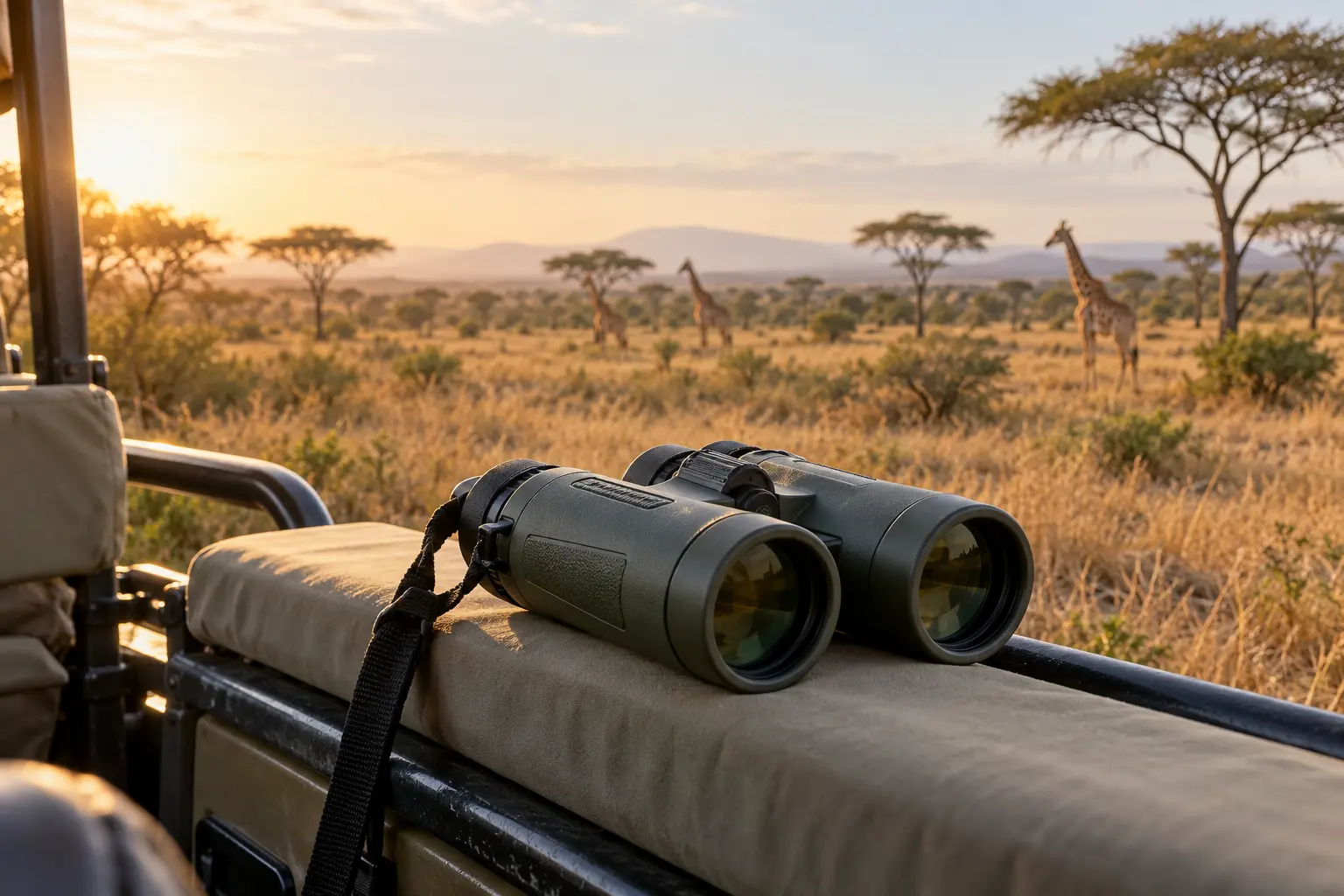
The best binoculars for safari need to work across a varied day: a moving animal near the vehicle, a distant shape on open ground and a brief bird sighting before the group moves on. A compact body is easier to pack, while larger objectives may be more useful during shaded or early-morning observation. Extra magnification can help with distant subjects but also makes vehicle movement and hand shake more apparent. This guide compares five travel and wildlife models with different balances of field of view, size, eye relief and buying options. We explain when a pocket pair is a sensible choice and when a full-size binocular deserves the luggage space. Use the quick verdict as a starting point, then choose for your itinerary, usual viewing conditions and comfort with the glasses or sunglasses you wear outdoors.
Affiliate Disclosure: We may earn a commission at no extra cost to you when you make a qualifying purchase through affiliate links in this guide. Buying buttons open Amazon.com. Read our full affiliate disclosure.
Best Binoculars for Safari: quick comparison
On smaller screens, swipe across the table to compare all features and buying options.
| Image | Model | Field / 1,000 yd | Weight | Travel advantage | Where to buy |
|---|---|---|---|---|---|
 | Nikon MONARCH M7 8×30 | 435 ft | 16.4 oz | Wide-field lightweight day safari | Check PriceAmazon |
 | Celestron TrailSeeker ED 8×32 | 410 ft | 17.6 oz | Balanced compact waterproof 8×32 | Check PriceAmazon |
 | ZEISS Terra ED Pocket 8×25 | 357 ft | 10.9 oz | Smallest carry-anywhere option | Check PriceAmazon |
 | Vortex Diamondback HD 10×42 | 330 ft | 21.3 oz | Distant animals in open savannah | Check PriceAmazon |
 | Athlon Midas G2 UHD 8×42 | 426 ft | 23.3 oz | Full-size comfort and versatile viewing | Check PriceAmazon |
Open Amazon for the current price and availability. Confirm the exact model, condition and package contents, including any separately required eyepiece, tripod or accessories. Tax and shipping may affect the total.
How we chose these models
Safari combines travel constraints with changing viewing distances. The M7 and TrailSeeker provide compact general-purpose formats, the Terra Pocket prioritizes small-bag convenience, and the two 42 mm choices represent broader wildlife use or more distant subjects. The shortlist therefore includes different ways to balance a vehicle outing, a walking activity and luggage space.
- Check operator baggage and activity rules separately from optical specifications.
- Compare 8x and 10x against the steadiness of your normal viewing position.
- Match objective size and weather claims to the conditions of the actual trip.
These comparisons use manufacturer documentation and published model specifications. We have not conducted hands-on product tests. See how we review optics for the research and correction process.
01 / Wide-field lightweight day safari
Nikon MONARCH M7 8×30
Nikon MONARCH M7 8×30 is a persuasive day-safari choice because it offers an unusually broad published 435-foot field at 1,000 yards in a 16.4-ounce body. Its eight-times magnification can make it easier to locate movement among grasses and trees than a higher-power instrument with a narrow field. Nikon lists 15.1 mm eye relief, 6.6-foot close focus and nitrogen-filled waterproof construction. The 30 mm objectives keep the package shorter than a typical full-size 8×42, a practical advantage in a limited luggage allowance.
Amazon.com
Product image: Nikon.On a vehicle-based outing, an animal may appear quickly on the left side of the route, cross in front and disappear into cover. A broad field helps you locate the subject and keep surrounding landmarks visible. The relatively low mass can also reduce fatigue during repeated short observation stops. Nikon’s specified ED glass and prism coatings are real construction features, but their presence does not establish a measurable superiority over every other model on this list.
The 30 mm objective produces a nominal exit pupil of only 3.75 mm at eight-times magnification. That may be less forgiving in weak light than an equivalent 8×42 with a 5.25 mm exit pupil. Its published 15.1 mm relief can also be restrictive for some spectacle wearers, depending on eyecup geometry. If your main interest is observing wildlife in the last usable minutes of twilight, a larger objective may be more appropriate despite added mass.
Consider the M7 8×30 when the safari involves varied habitats, quick sightings and frequent carrying between vehicles, accommodation and observation points. Check that the wide field is fully visible with your actual glasses. Verify Nikon product 16763, not the much heavier M7 8×42. Be sure that an exact retailer listing specifies 8×30 rather than the superficially similar 10×30.
Reasons to choose it
- ED glass and a 435 ft field at 1,000 yards.
- 465 g body with 6.6 ft close focus.
What to weigh up
- 15.1 mm eye relief needs careful fitting with glasses.
- A substantial price step above the PROSTAFF P7 8×30.
02 / Balanced compact waterproof 8×32
Celestron TrailSeeker ED 8×32
Celestron’s TrailSeeker ED 8×32 offers 410 feet of field at 1,000 yards, 15.6 mm eye relief, a 6.5-foot nearest focus and a 17.6-ounce published mass. The manufacturer describes ED objective glass, phase and dielectric prism coatings and fully broadband multicoated lenses. The product also carries an IPX7 water-resistance specification for a defined immersion test. Its 32 mm objectives give a calculated four-millimetre exit pupil, positioned between very small pocket optics and conventional 8×42 systems.
Amazon.com
Product image: Celestron.A safari traveller looking for one compact instrument that can also serve on a birdwalk after returning home may find this format practical. The field is broad enough on paper to aid wildlife acquisition, while the moderate size remains manageable in a day bag. The specified six-and-a-half-foot close focus offers additional usefulness for gardens and insects from safe viewing positions, even though close focus itself is usually not the primary safari requirement.
The IPX7 label is a defined test, not unlimited protection against dust, crushing, salt water or long-term immersion. Manufacturer optical coatings are not independent evidence that the ED model produces brighter images than every non-ED rival. Fifteen-point-six millimetres of eye relief should be checked personally with glasses. It is also important to choose the TrailSeeker ED model and not the older non-ED TrailSeeker 8×32, whose published specifications differ.
Choose this as an all-round travel alternative to Nikon’s wide-field 8×30, especially if weather resistance and continued use on normal birding walks matter. Before buying, compare actual grip, focus-wheel access and eyecup comfort from a seated position, and ensure the exact ED SKU is supplied.
Reasons to choose it
- Defined IPX7 protection: 1 m for 30 minutes.
- 32 mm ED objectives in a mid-size body.
What to weigh up
- 15.6 mm eye relief needs a glasses-on fit check.
- 499 g is more weight than a pocket model.
03 / Smallest carry-anywhere option
ZEISS Terra ED Pocket 8×25
ZEISS Terra ED Pocket 8×25 is the lightest entry in this shortlist at a manufacturer-listed 10.9 ounces, using foldable compact construction that fits easily into small luggage. Its 357-foot field at 1,000 yards, eight-times magnification, 16 mm eye relief and three-point-one-millimetre exit pupil identify a true pocket binocular rather than a full-size safari instrument. ZEISS markets the series as waterproof and nitrogen filled, with coatings intended to help keep external optical surfaces usable under different weather conditions.
Amazon.com
Product image: ZEISS.When the main challenge is packing for flights or keeping an instrument available during long travel days, a small binocular carried consistently can be more useful than a large optic left in the room. Eight-times power makes the image reasonably manageable, while the folding body has particular value in a small bag. The 357-foot field is narrower than the Nikon M7 8×30, so fast-moving wildlife in dense brush may require more careful targeting.
The small 25 mm objectives produce only about a 3.1 mm nominal exit pupil, which may be less comfortable in dim dawn conditions or with imperfect eye alignment than a 42 mm model. A light pocket instrument can also feel less stable in large hands. It should not be selected solely because the badge belongs to a premium optics brand. Check the exact Terra ED Pocket version: the 10×25 has different field and exit-pupil characteristics.
This is best for a traveller who needs optics in minimal luggage, watches predominantly in daytime and may use the binoculars for city sightseeing or hikes after the safari. Verify whether you can achieve a full field with spectacles and whether a pocket instrument remains comfortable during prolonged observation.
Reasons to choose it
- Folding 8×25 body for small pockets and bags.
- 16 mm eye relief and nitrogen-filled construction.
What to weigh up
- Small exit pupil changes dim-light flexibility.
- The grip and eyecup fit need checking in person.
04 / Distant animals in open savannah
Vortex Diamondback HD 10×42
Vortex Diamondback HD 10×42 introduces ten-times magnification for travellers who expect relatively distant animals in open landscapes. Vortex publishes a 330-foot field at 1,000 yards, 15.0 mm eye relief, a five-foot close focus and a 21.3-ounce mass. This is actually lighter than some conventional eight-times 42 mm competitors, so magnification does not automatically determine carrying weight. The binocular’s ten-times image scale can be useful when watching a stationary animal from a safely stopped vehicle or approved observation point.
Amazon.com
Product image: Vortex.The manufacturer specifies fully multicoated optics, dielectric and phase-corrected prisms, a waterproof gas-purged body and a lifetime warranty program subject to its current terms. What matters during an open-country stop is whether the traveller can hold 10x steadily enough to resolve features that were not clear at 8x.
A 330-foot field is substantially narrower than the two eight-times compact options above, so acquiring an animal emerging suddenly from cover can be slower. Ten-times magnification also makes hand shake and hot-air shimmer more visible. The published 15 mm eye relief can be less forgiving for some glasses users. Some safari encounters are very close from the vehicle, in which case extra power can make framing unnecessarily tight.
Consider this when open plains and medium-to-long distance sightings make up most of the itinerary and you can view from stable permitted positions. Verify Vortex Diamondback HD 10×42 SKU DB-215, not its 8×42 counterpart, and check that the warranty applies in the intended purchasing region.
Reasons to choose it
- 10x magnification for distant open-country subjects.
- 5 ft close focus in a 21.3 oz body.
What to weigh up
- 15 mm eye relief may restrict the field with glasses.
- 330 ft field is narrower than the wide-field 8×42 choices.
05 / Full-size comfort and versatile viewing
Athlon Midas G2 UHD 8×42
Athlon’s Midas G2 UHD 8×42 provides a broad 426-foot field at 1,000 yards, 17.2 mm eye relief and a 23.3-ounce body. The 42 mm front lenses produce a calculated 5.25 mm exit pupil, providing a different viewing geometry from the 8×25 and 8×30 models. For a traveller who expects dawn drives, late-afternoon observation and several days of mixed forest and savannah terrain, the full-size format is a serious consideration despite its extra luggage volume.
Amazon.com
Product image: Athlon.Athlon identifies UHD glass, dielectric prism coatings, a magnesium chassis, protective exterior lens coatings and argon purging. Its combination of eight-times magnification and a very broad field makes it a strong comparison candidate for finding moving wildlife while maintaining eye-position comfort. A travel harness or sufficiently wide neck strap may help distribute the load during longer outings.
At 23.3 ounces it is over twice the mass of the ZEISS Terra ED Pocket 8×25, and it occupies more space when packing. The larger exit pupil may help under some dim-light conditions but is not proof of greater real transmission than all smaller binoculars. Buyers should check whether the body width suits their interpupillary distance and whether the 17.2 mm eye relief works with actual spectacles. A case protects optics against vehicle dust but adds still more bulk.
Choose the Midas 8×42 when daytime portability is not the highest priority and you want a full-size field for repeated wildlife observation over several days. It is especially suitable for comparing mixed light and rapid subject acquisition with a smaller travel binocular before departure. Verify Athlon SKU 113009 and exact merchant stock.
Reasons to choose it
- 426 ft field and 6.5 ft minimum focus.
- 8×42 design with UHD glass and argon purging.
What to weigh up
- 23.3 oz is a full-size carrying load.
- 17.2 mm eye relief does not guarantee fit with every frame.
What to consider before buying
What safari binoculars must actually do
Safari viewing often occurs from a permitted vehicle, lodge platform or guided observation stop. Animals can appear unexpectedly at very different distances, and a good binocular must be easy to raise, focus and put away. Weight, field width, grip and eye placement therefore matter alongside nominal optical quality. Do not choose equipment solely from the maximum magnification printed on its body. Consider whether you are primarily watching large mammals on open plains, birds in dense brush or nearby animals from a stopped vehicle. These conditions produce different tradeoffs that a universal best-overall label obscures.
Safari rules vary by destination
A guided safari in one reserve may have very different vehicle, walking, night-drive and photography rules from another. Follow the instructions of authorized local guides, park personnel and vehicle operators. Never leave a vehicle in an area where it is prohibited, approach large animals to obtain a better view, or interfere with their behaviour. The National Park Service’s general wildlife guidance emphasizes optical observation from a safe distance, but its numerical park rules should not be copied as universal guidance for African reserves. Confirm local requirements before travelling.
Why eight-times is a sensible baseline
An eight-times model usually provides a manageable handheld view and often a wider real field than a comparable ten-times model. That helps when an animal crosses the road or a bird shifts between tree branches. Nikon M7 8×30’s 435-foot field is a meaningful advantage for rapid acquisition, while Athlon Midas 8×42 offers a similar broad scene in a larger body. Higher power can reveal useful apparent detail on distant stationary animals, but hand shake and narrower framing should be considered. Practice lifting the binoculars directly toward a landmark before departure.
When ten-times has an advantage
For open savannah viewing from a safely stopped vehicle, ten-times can make distant mammal outlines appear larger without moving closer. The Diamondback HD 10×42 serves that specific role. But higher power does not defeat atmospheric shimmer above sun-warmed grass, and it may magnify vibration from vehicle movement. Wait until the vehicle has stopped properly before using binoculars. Compare the same distant stationary subject at eight-times and ten-times to see whether additional scale actually reveals recognizable features. If the image merely becomes larger and harder to hold, lower power may be more useful.
Packing weight matters across a whole itinerary
Flights, internal transfers, day bags and repeated vehicle entries all change how convenient a binocular feels. A 10.9-ounce folding pocket model can stay available even when luggage is restricted, while a 23.3-ounce full-size optic offers a different viewing experience. Calculate the mass of the binoculars plus case, caps and harness. A heavy case can cancel some of the savings from a light body. Check your airline’s actual baggage requirements instead of assuming all safaris have the same allowances. Protect optics in hand luggage according to the carrier’s current rules.
Small objectives in bright versus dim conditions
A pocket 8×25 provides a calculated exit pupil around 3.1 mm, while an 8×42 provides about 5.25 mm. This geometry can affect eye positioning and how much light can enter a dilated eye. Yet exit pupil does not measure actual transmission or sharpness. In strong midday light the observer’s pupil may be small enough that a compact optic works well. At first or last usable light, a larger objective may offer a more forgiving viewing experience. Our low-light guide explores this separate issue without promising night vision.
Dust is a practical concern
Dry tracks and open vehicle windows can expose optics to airborne dust. Keep lens caps or a protective case in place when the binoculars are not being used. Do not wipe visible grit across coated glass with a shirt; use the manufacturer’s approved blower or soft brush first. Avoid placing optical equipment on the vehicle floor, where fine dust and vibration may be more severe. After the outing, clean only when necessary and store the binoculars dry. Waterproof or fogproof claims do not guarantee an instrument is immune to every dust or impact problem.
Heat shimmer and long distances
In hot open landscapes, moving air can blur a distant subject. Extra magnification enlarges that distortion rather than revealing new markings. At a stable viewpoint, you may notice that an eight-times binocular shows a coherent animal outline while ten-times seems to produce a wavering view. The limitation is environmental, not necessarily a lens defect. Try waiting for a calmer moment, viewing from a different authorized angle or lowering magnification if the image is unstable. Do not approach potentially dangerous wildlife just to compensate for a poor optical path.
Viewing from a moving vehicle
Binoculars reduce your awareness of immediate surroundings, so they should never be used by a driver. Even as a passenger, try to observe when the vehicle is properly stopped and when the guide indicates it is safe to raise equipment. A sudden bump can cause the eyepieces to strike glasses or the face. Keep straps secured and lower the instrument when the vehicle resumes rough movement. Never lean far outside a window or stand where the vehicle operator has not permitted it. A wide field will not compensate for unsafe movement.
Eye relief and sunglasses
Safari travellers may wear prescription glasses or sunglasses for extended periods. Eye relief and eyecup design affect whether the full view is visible while wearing them. ZEISS Pocket 8×25’s published 16 mm relief differs from Nikon M7 8×30’s 15.1 mm and Athlon’s 17.2 mm, but fit is still personal. Test using the eyewear you intend to wear on actual drives, including any frame differences between glasses and sunglasses. Retract eyecups where appropriate and check the complete circular field without forcing the instrument against lenses.
Choose waterproof claims carefully
Weather may change during a safari, particularly where rain or humidity occurs seasonally. Manufacturer seals and nitrogen or argon filling can help protect internal optics, but every product has limits. Celestron publishes a defined IPX7 test for TrailSeeker ED; other makers use different descriptions. Dry the exterior after wet outings, keep the case clean and inspect straps before carrying optics on another drive. Warranty terms can vary by purchasing country.
Long viewing sessions and fatigue
A full-size 8×42 can feel comfortable when held briefly but tiring after a long observation. A pocket instrument can be lighter while sometimes more difficult to grip steadily with large hands. Try holding shortlisted models for several minutes and assess the focus wheel, eyecups and balance. A chest harness can help with carrying, but it does not eliminate hand shake once the binoculars are raised. For extended stationary mammal observation, a safe supported position may be useful. The right model is one you will actually use repeatedly throughout the trip.
What to take besides binoculars
A protective case, securely fitted strap and suitable lens cloth are straightforward accessories. Bring a safe method to remove dust before wiping optical glass, and consider a short notebook for animal observations. Phone photography should be planned separately rather than assuming that a phone held behind binoculars will always work. If an adapter is used, confirm its compatibility before departure and avoid attempting intricate setup while wildlife is close or the vehicle is moving. The most useful accessory is often a carrying arrangement that keeps both optics and hands secure.
The meaning of ED and HD labels
ED, HD, dielectric and phase-coated describe different aspects of optical design. They may influence correction of colour fringing, light reflection or perceived contrast, but cannot independently prove that one binocular outperforms another. At safari destinations the observer may view animals under harsh backlighting or shifting shade, so contrast matters. Yet a controlled side-by-side test of the exact models would be necessary to rank them.
Check local service and warranty
If binoculars are purchased before an international trip, verify that the authorized dealer and manufacturer’s warranty cover the actual item. An imported model may have different service terms even if the optical specifications appear identical. Save purchase documentation and know how to obtain support if a focus wheel or eyecup fails. Confirm current U.S. prices and exact product codes before ordering. A suggested retail price is not proof that an Amazon seller has a matching new product in stock.
A simple safari viewing routine
Keep the binoculars protected while the vehicle is moving. At a permitted stop, first locate wildlife with unaided vision and choose a landmark. Raise the instrument calmly, focus without pressing it against your face and scan only within the guide’s approved viewing area. Lower it frequently to remain aware of other animals, visitors and vehicle activity. If the animal reacts or starts moving toward people, follow the guide’s instructions rather than remaining fixed on magnified viewing. Record broad features and behaviour rather than forcing an uncertain identification.
Buying recommendation by traveller type
For a traveller prioritizing a compact wide field, investigate Nikon MONARCH M7 8×30 or Celestron TrailSeeker ED 8×32. If small luggage is the overriding constraint, ZEISS Terra ED Pocket 8×25 is a distinct option. For open long-distance subjects, compare Vortex Diamondback HD 10×42 with steadiness and eye relief in mind. If mixed light and full-size viewing comfort matter more than minimum weight, Athlon Midas G2 UHD 8×42 deserves consideration. No winner is based on firsthand testing, and the best fit depends on the itinerary.
Final decision checklist
Confirm exact model and magnification, eye-relief fit with your travel eyewear, weight including accessories, current stock and regional warranty. Ask the safari operator about typical observation distances, whether vehicles allow stable viewing and any restrictions around wildlife. Compare actual field widths and how steadily you can hold eight-times versus ten-times binoculars. Bring a protective case and clean optics according to manufacturer guidance. Choose a binocular that supports responsible observation over the entire journey rather than trying to maximize a single impressive specification.
Before you choose
Frequently asked questions
Is 8x or 10x better for safari?
Eight-times is a useful default for mixed viewing and situations where steadiness matters. Ten-times can help enlarge distant animals in open terrain, but also magnifies movement. Consider whether most of your observation happens from a stationary position or a vehicle, and compare the field you can use comfortably.
Are pocket binoculars enough for a safari trip?
They can be convenient for bright daytime outings and a wider travel itinerary, especially if luggage space is limited. They offer a different grip and smaller exit pupil than full-size models. If dawn, dusk and extended wildlife viewing are central to the trip, compare a larger format before choosing purely for packability.
Can I use binoculars while the safari vehicle is moving?
Movement can make the image difficult to hold and may distract from safe travel. Follow your guide's instructions and use a stable, permitted viewing position. Waiting for a safe stop often gives a more useful view than trying to compensate for vehicle movement with extra magnification.
What should I check when using sunglasses?
Try the binoculars with your actual sunglasses before departure. Frame curvature and lens thickness can change eye placement and how much field you see. Retract or adjust eyecups as directed and check for blackouts. Keep in mind that dark lenses can be a disadvantage when the light becomes weak.
How should I handle dust during a safari?
Keep lens protection available and use the exact model's cleaning instructions. Remove loose grit before wiping glass, and avoid rubbing dust into the lenses with clothing. Check that the carrying case and covers are convenient enough to use between sightings rather than leaving the binoculars exposed unnecessarily.
Are there special binocular rules for every safari destination?
Requirements and wildlife-viewing rules vary by destination, operator and activity. Check your operator's current guidance before travel, including luggage limits and permitted behavior around animals. Choose optics that support observation from the required distance and follow the guide's instructions during the outing.
Sources and buying information
Product details come from manufacturer documentation for the models listed. Use the Amazon buying links for the current offer, seller, condition and package contents.
Related practical guides
About the author
Simon Jack
Simon Jack is the named author of FieldLens Guide's research-based binocular, spotting scope and wildlife observation articles. His published editorial approach focuses on verifying model-specific manufacturer specifications, explaining optical tradeoffs in plain language, and matching equipment to real birdwatching, hiking and nature-observation needs. These articles do not claim hands-on product tests unless explicitly documented.