

8×42 vs 10×42 binoculars is one of the most useful comparisons for birdwatchers and wildlife observers. Both have 42 mm objective lenses, but the 8×42 magnifies eight times and the 10×42 magnifies ten times. In general, 8x is easier to hold steady and often gives a wider field of view; 10x makes distant details appear larger but can magnify hand shake too. Neither is automatically better for every observer. Once you have chosen the 8×42 format, our 8×42 birdwatching comparison lays out the practical differences between specific models. If shake is limiting the extra detail, try these ways to hold binoculars steady before moving to greater magnification.
8×42 vs 10×42 at a glance
| Characteristic | 8×42 binoculars | 10×42 binoculars |
|---|---|---|
| Magnification | 8x | 10x |
| Objective diameter | 42 mm | 42 mm |
| Calculated exit pupil | 5.25 mm | 4.2 mm |
| Field of view | Often wider; compare individual models | Often narrower; compare individual models |
| Handheld steadiness | Usually easier | More sensitive to shake |
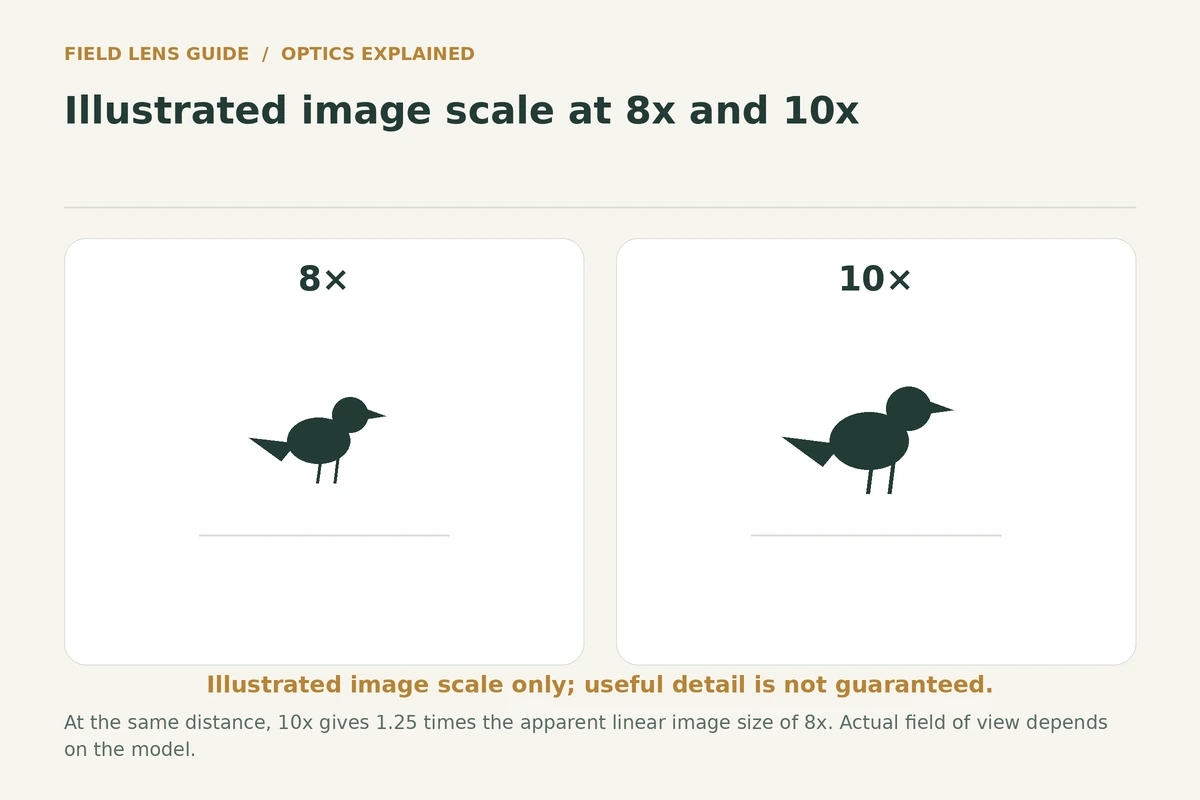
| Distant subject size | Smaller apparent image | Larger apparent image |
| Best starting use | Woodlands, tracking moving birds, general birding | Open landscapes, distant waterbirds, detail at range |
These are format-level tendencies, not side-by-side measurements of specific products. Optical design, coating, eyepiece construction, eye relief and ergonomics can outweigh a simple magnification comparison.
What does the 42 mean?
The second number gives the diameter in millimetres of each objective lens. Both formats have 42 mm objectives, but that does not make their perceived brightness identical. Magnification changes exit-pupil diameter: dividing 42 by 8 gives 5.25 mm; dividing 42 by 10 gives 4.2 mm. In suitable low-light conditions, and when your eye pupil is large enough, a larger exit pupil can make eye positioning more forgiving. Actual image brightness also depends on transmission, coatings and viewing conditions.
Field of view and finding moving birds
Field of view describes how much of the landscape appears through the binoculars at a stated distance. Because higher magnification commonly comes with a narrower field, an 8×42 may help you locate a small bird among branches and keep a flying bird in view. Cornell Lab’s birding guidance emphasizes how useful a wide field can be for beginners. Compare the published feet-at-1,000-yards figure for the exact models you are choosing; not all 8x binoculars beat all 10x binoculars on this specification.
Which magnification is steadier?
Hand movements are more noticeable at higher magnification. That is why 8x binoculars tend to offer a more relaxed handheld view, especially during long walks, when observing from an awkward stance, or when following movement. If you primarily watch stationary birds from an observation platform, a stable 10×42 can be appealing. Try both if possible: grip, balance and your own steadiness matter.
Choose 8×42 when…
- You observe songbirds in woodlands or dense gardens.
- You want to pick up moving birds quickly and follow them in flight.
- You prefer relaxed handheld viewing and a potentially wider field.
- You are purchasing one versatile pair for general birding.
Choose 10×42 when…
- You regularly view distant, relatively stationary wildlife in open country.
- You watch waterbirds across lakes or shorelines and want a larger apparent image.
- You can hold 10x steadily enough for comfortable viewing.
- The particular 10x model fits your eyes and hands better than your 8x alternatives.
What if you wear glasses?
Eye relief is a separate specification and must be checked on the actual model. If you keep glasses on, look for enough usable eye relief and fully retractable eyecups to see the entire circular image. Our guide to eye relief for glasses wearers explains how to verify comfort.
What about 8×32 binoculars?
If carrying weight is your main concern, 8×32 binoculars are worth considering. Their smaller objectives generally allow a more compact design, though exit pupil is 4 mm rather than 5.25 mm for 8×42. An excellent 8×32 can be a better practical hiking choice than a heavy 8×42 that stays in your bag.
Common buying mistakes
- Assuming every 10x model has a narrower field than every 8x model.
- Confusing calculated exit pupil with measured transmission or image quality.
- Buying for magnification alone without checking weight and eye relief.
- Comparing marketing terms such as “HD” without looking at actual specifications and evidence.
How observation distance changes the choice
A binocular’s magnification does not specify the distance at which it becomes useful. At a backyard feeder, eight-times magnification may already reveal substantial detail, and keeping the subject centred can be easier with a wider field. On an open estuary, ten-times magnification gives a larger apparent image of a distant waterbird, which can help identify some markings. That benefit depends on atmospheric conditions and the quality of the binoculars, however. Heat shimmer, mist, and poor light can reduce useful detail at either magnification. Decide based on the places where you actually observe rather than assuming that more power is always preferable.
Understanding the limits of the exit-pupil comparison
The 5.25 mm exit pupil of 8×42 and 4.2 mm exit pupil of 10×42 are simple mathematical results. A larger exit pupil can make eye placement more forgiving and potentially deliver more light when the observer’s eye pupil is sufficiently wide. It does not establish the total transmission of either instrument. Optical coatings, internal reflections, and individual eye adaptation affect perceived brightness. Under bright daylight, when the observer’s pupil contracts, both configurations may deliver more light than the eye can accept. It is therefore misleading to promise a fixed percentage difference in brightness based on exit pupil alone.
What to examine in two actual product listings
Compare manufacturer-listed linear field of view with matching units, then inspect eye relief, close-focus distance, weight, and water-resistance information. Two binoculars labelled 8×42 may vary appreciably in each characteristic, so category-wide claims should not replace a model-level comparison. Read the warranty terms carefully, including whether impact damage or accidental breakage is excluded. Check the dimensions and mass of the exact version sold; similarly named product generations can differ. Ideally view the same scene through each binocular with your normal glasses and take note of how quickly you locate the subject and how relaxed the view feels.
Handholding techniques worth trying
Even excellent optics cannot eliminate involuntary hand motion. Support the binoculars with both hands, keep your elbows relatively close to your body, and lean against a tree or railing when appropriate. Sitting down or resting your forearms can improve steadiness. A supportive neck strap or harness makes an instrument easier to carry but will not directly stabilize the image when you hold it to your eyes. If you struggle to hold a 10x model steadily after a long walk, the apparent benefit of additional magnification can disappear because fine detail keeps moving across the view. Try binoculars after some walking, not only while seated indoors.

Looking at field of view fairly
A field-of-view measurement describes the width of the visible scene at a defined distance, not how bright or sharp it looks. Some manufacturers list angular field of view in degrees, while others give feet at 1,000 yards or metres at 1,000 metres. Compare equivalent measurements when evaluating two candidates. An 8x model will often have a broader true field, but eyepiece design can alter the result, and a particular 10x can outperform a particular 8x on this specification. For moving birds, think about the ease of acquiring a subject and keeping it within view. For stationary distant wildlife, image scale may matter more.
A practical choice for your first purchase
Start with your principal observation setting: dense woodland, mixed parks, coastal wetlands, or open plains. Then decide how much time you typically spend looking through binoculars without a rest. If you value fast subject acquisition and relaxed scanning, shortlist 8×42 models. If you can handle more noticeable movement and often need greater apparent image size, shortlist 10×42. Eliminate any models that do not fit your eyes comfortably, and choose between the survivors on image quality, actual field, weight, and service terms. A careful comparison of two specific instruments is far more informative than a general rule that one magnification is universally best.
Our recommendation
For a first pair of general-purpose birdwatching binoculars, 8×42 is a sensible starting point. Choose 10×42 when the benefit of a larger distant image outweighs the narrower view and extra sensitivity to shake for you. The final choice should come down to the actual model’s field of view, optical performance, fit, weight and warranty—not just its two headline numbers.
Sources
- Nikon USA: Binoculars for Bird or Wildlife Watching
- Nikon: Choosing Binoculars by Specifications
- Cornell Lab of Ornithology: Field of View and Close Focus
About the author
Simon Jack
Simon Jack is the named author of FieldLens Guide's research-based binocular, spotting scope and wildlife observation articles. His published editorial approach focuses on verifying model-specific manufacturer specifications, explaining optical tradeoffs in plain language, and matching equipment to real birdwatching, hiking and nature-observation needs. These articles do not claim hands-on product tests unless explicitly documented.