

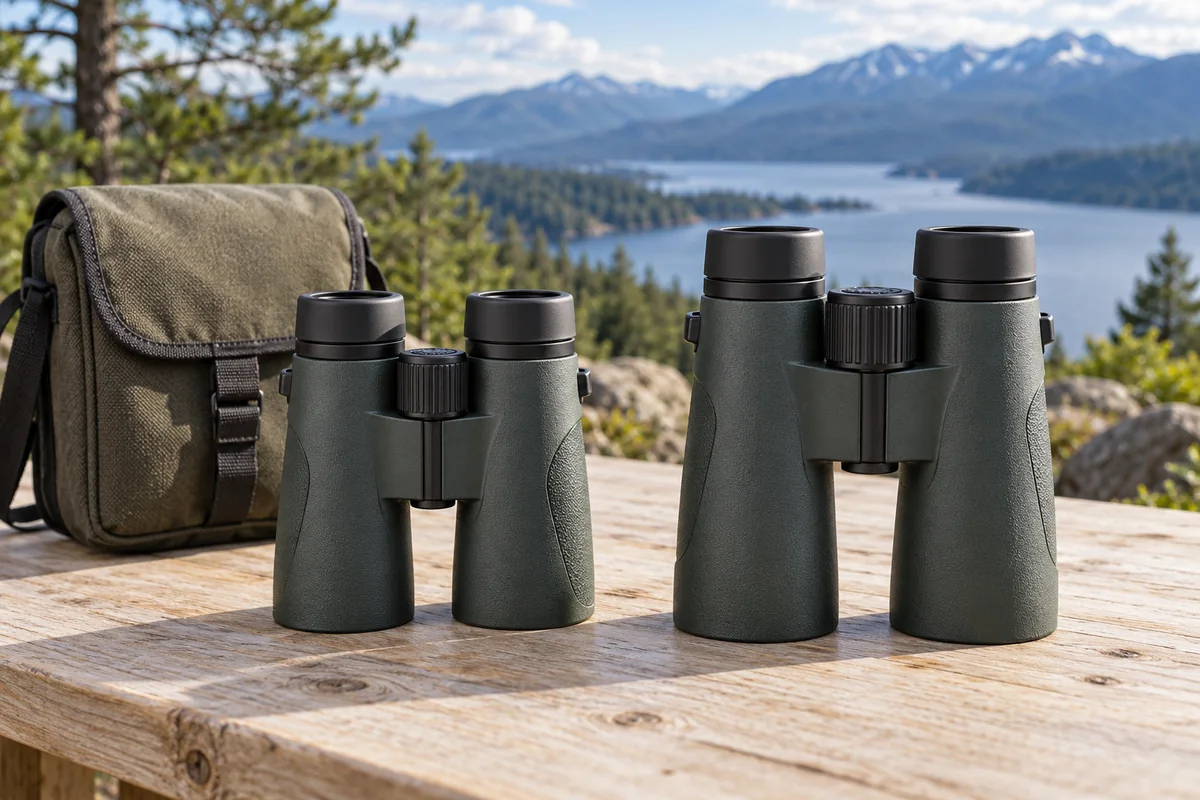
If you are deciding between 8×32 vs 8×42 binoculars, both formats offer the same eight-times magnification but use different objective lens diameters. The larger 42 mm objective generally requires a bigger body, while the 32 mm format is often easier to carry. Neither size is automatically sharper; optical design and quality matter more than objective diameter alone. For the larger format, our 8×42 birdwatching comparison keeps the comparison focused on actual model differences.
The specification differences
An 8×32 uses a 32 mm objective and an 8×42 uses a 42 mm objective. Using objective diameter divided by magnification, the calculated exit pupils are 4 mm and 5.25 mm respectively. This is a geometric comparison rather than a measurement of image brightness or optical transmission.
Why the 8×32 appeals to hikers
For active hiking and travel, compactness often decides whether binoculars are carried or left behind. Compared within the same product family, an 8×32 model is commonly lighter and smaller than its 8×42 counterpart. Check actual weights and external dimensions rather than assuming every 8×32 beats every 8×42.
When the 8×42 is worth the size
A larger exit pupil can be more forgiving of slight eye-position changes and may help in dim conditions when the observer’s pupils have dilated sufficiently. This does not guarantee that a particular 8×42 looks brighter than a premium 8×32: lens coatings, transmission, glare control and quality can all affect the view.
Field of view does not follow diameter alone
Both options are 8x, so objective diameter does not determine the field-of-view specification. Eyepiece design is important. Compare each manufacturer’s field of view in feet at 1,000 yards or metres at 1,000 metres, rather than assuming the larger instrument necessarily shows more of the scene.
Glasses wearers need to check eye relief
Eye relief is not fixed by the 8×32 or 8×42 format. Wearing glasses makes usable eye relief and eyecup design particularly important. Test whether you can see the complete circle while wearing your usual frames. See our eye-relief guide for the practical fitting process.
Which is right for birdwatching?
For daylight hikes, travel and a lightweight kit, a comfortable 8×32 is a strong option. For longer stationary viewing, dawn or dusk observation, or those who prioritize a forgiving eyepiece position, an 8×42 may be worthwhile. Hands-on comfort and the exact model’s optical performance should settle close decisions.
Questions to ask before purchase
Check actual mass, eye relief, field of view, closest focusing distance, waterproofing claims, warranty terms and the included carrying system. Compare like-priced models as well as matching product families. Do not assume the optical performance is identical just because both are 8x.
Why weight differences matter over a full day
Binoculars are frequently carried for hours but used for only short intervals. A modest weight difference may therefore matter more on a demanding trail than during a brief backyard session. Check the actual mass listed for the exact models rather than treating all 32 mm models as identically light. A well-designed carrying harness can distribute weight more comfortably than a narrow neck strap, but the size of the body still affects storage and handling. If the binoculars are cumbersome enough that you leave them in the car, their theoretical optical advantages have little practical value. If carrying size is your priority, compare the compact birdwatching binocular comparison against the full-size alternatives.
What changes at dawn and dusk
When natural light fades, your eye pupil can widen, although the degree differs with age, individual physiology and environmental lighting. A 5.25 mm exit pupil may deliver a more forgiving view than a 4 mm pupil in conditions where the observer can make use of that extra diameter. This is one reason many wildlife observers appreciate 42 mm objectives. Nevertheless, light transmission, glare, contrast and the actual quality of the lenses remain important. A high-quality 8×32 can outperform a poorly built 8×42 in meaningful ways; objective size alone cannot settle the comparison.

Close focus, eye relief, and field of view
Neither format automatically wins on minimum focusing distance, usable eye relief or field of view. Those characteristics depend on each optical design. A butterfly observer should compare closest focusing distance; someone wearing glasses should confirm a complete circular field of view at a comfortable eye position. A woodland birder may care most about how readily a moving bird can be located. Collect all three specifications before deciding. In particular, do not assume that a physically larger 8×42 instrument necessarily shows a wider view than a particular 8×32.
How to compare binoculars from the same series
The clearest comparison often comes from looking at the 8×32 and 8×42 versions of one manufacturer’s product family, as this reduces some differences in design and construction. Even then, the optical layouts and eyepieces may not be identical. Compare published weight, dimensions, field of view, eye relief and closest focus side by side. If the larger model costs more, ask what specific advantage that additional cost buys for your actual conditions. A compact binocular may be better for regular travel, while a somewhat larger model could be more comfortable for long stationary sessions.
Fit and hand placement
An instrument’s balance changes the way it feels, not just the number on a scale. People with larger hands sometimes appreciate the extra barrel area of a 42 mm binocular, while those with smaller hands may prefer a slimmer 32 mm body. Hinge position, focus-wheel reach and the texture of the armour all affect how securely you can hold it. Ideally evaluate the grip with gloves if you often observe in cold weather. If you wear glasses, adjust the eyecups and see whether you can keep the field visible while holding the binoculars naturally, not with an awkward posture.
A decision checklist for hiking and birding
Start with the time you spend carrying versus viewing. For day hikes in good light, an 8×32 often gives an appealing balance of portability and usefulness. For extended stationary observation or variable lighting, try 8×42. Next shortlist models that offer suitable eye relief, a comfortable grip, and a field of view matched to your subjects. Check minimum focus if you enjoy garden insects or nearby birds. Finally compare warranties and return policies. Do not overpay for a theoretical advantage that is not noticeable to you when viewing the same scene.
How optical quality can outweigh objective size
Objective diameter describes the entrance lens, not the complete viewing experience. Lens coatings, prism construction, optical alignment and control of reflections can vary widely, even between binoculars with identical numbers in their names. A well-made 8×32 might provide a more satisfying view than an inexpensive 8×42 under many conditions. Compare specific products using credible evidence instead of concluding that the larger number guarantees a clearer image. If evaluating several models in a store, observe one bright high-contrast scene and one shaded scene, and note differences in comfort and detail rather than relying solely on a spec sheet.
Travel and packing considerations
For airline travel or backpacking, the shape of the case and the space it occupies can be just as important as its weight. A smaller 8×32 may fit within an accessible pack pocket, while some 8×42 models require a bulkier protective pouch. Check the complete dimensions of the binoculars with eyecups retracted and consider how securely they will be stored. A harness can improve comfort for either size but adds its own bulk. Travellers who primarily observe in daylight may prefer portability, while people spending dawn hours in a fixed hide may reasonably favour the larger format.
Care and longevity
Whatever format you select, basic care protects the investment. Keep lens caps on during dusty travel, remove loose grit with an appropriate blower or soft brush before wiping, and store binoculars dry according to the maker’s guidance. A more portable model that you use regularly and maintain carefully can provide better practical value than a bulkier instrument that rarely leaves its case.
Conclusion
If reduced weight is your top priority, start with 8×32. If low-light potential and viewing comfort matter more than size, start with 8×42. The best choice is the one you are comfortable carrying and can use steadily in your typical conditions.
References
- Nikon: Choosing binoculars by specifications
- Nikon: Exit pupil explained
- Audubon: How to choose binoculars
About the author
Simon Jack
Simon Jack is the named author of FieldLens Guide's research-based binocular, spotting scope and wildlife observation articles. His published editorial approach focuses on verifying model-specific manufacturer specifications, explaining optical tradeoffs in plain language, and matching equipment to real birdwatching, hiking and nature-observation needs. These articles do not claim hands-on product tests unless explicitly documented.