
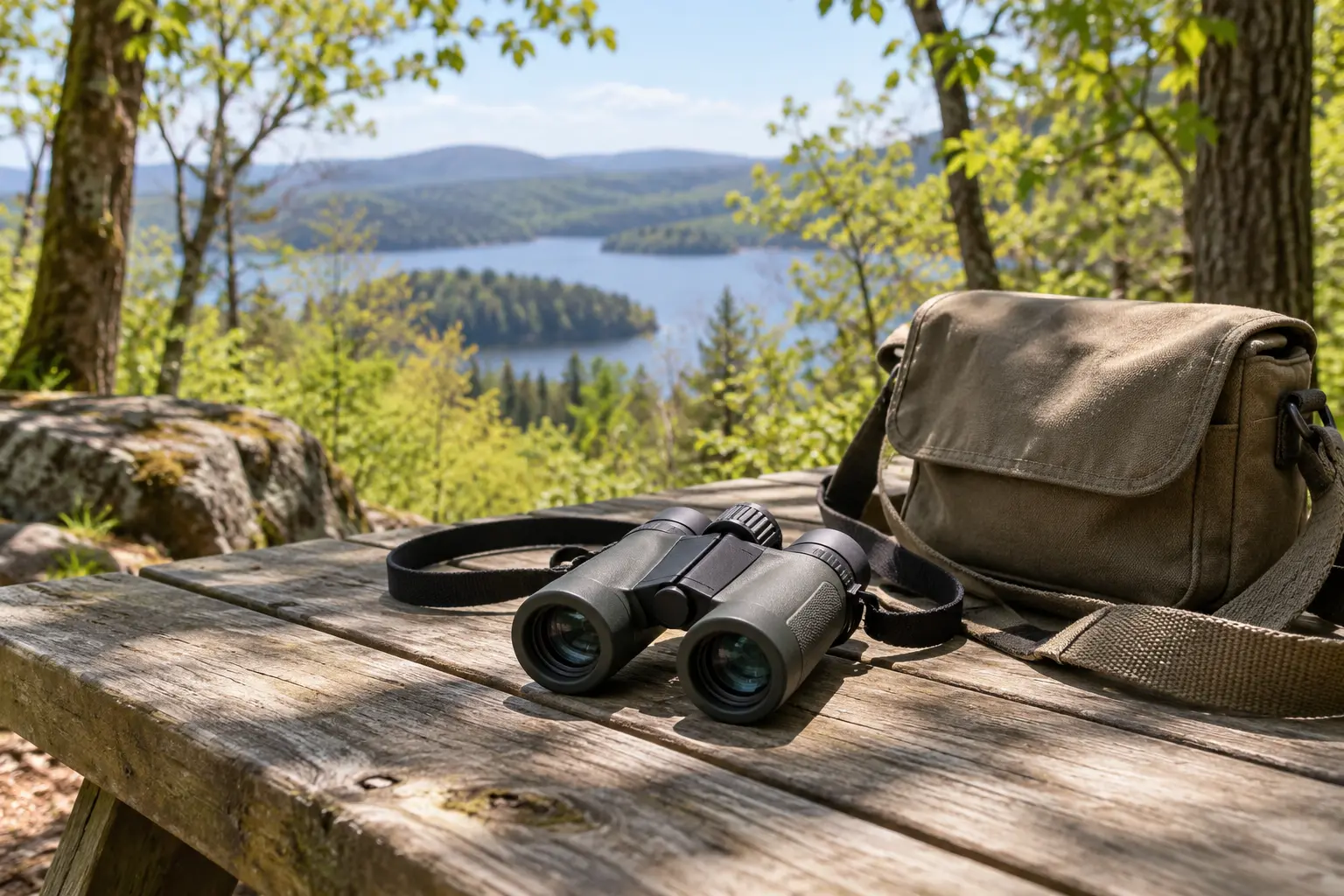
The best compact binoculars for bird watching save carrying space without making quick sightings unnecessarily difficult. A small body is valuable on a long walk, but field of view, eye placement and focus control still determine how easily you find a bird before it moves. Mid-size 8×30 and 8×32 models offer a different balance from a folding 8×25, especially in shaded woodland or when you wear glasses. This guide compares five compact options across those formats, with attention to weight, field width, close focus, weather protection and buying options. We explain which compromises make sense for everyday birding, lighter hiking kits and a truly pocketable pair. Use the quick verdict to identify a likely fit, then compare the table and product sections against the light conditions and carrying habits that matter to you.
Affiliate Disclosure: We may earn a commission at no extra cost to you when you make a qualifying purchase through affiliate links in this guide. Buying buttons open Amazon.com. Read our full affiliate disclosure.
Best Compact Binoculars for Bird Watching: quick comparison
On smaller screens, swipe across the table to compare all features and buying options.
| Image | Model | Field | Weight | Best role | Where to buy |
|---|---|---|---|---|---|
 | Nikon MONARCH M7 8×30 | 435 ft | 16.4 oz | Wide-field small-body birdwatching | Check PriceAmazon |
 | Nikon PROSTAFF P7 8×30 | 456 ft | 17.1 oz | Exceptionally wide field at moderate weight | Check PriceAmazon |
 | Opticron Traveller BGA ED 8×32 | 429 ft at 1,000 yd | 452 g | Long eye relief in a compact 32 mm format | Check PriceAmazon model search |
 | Celestron TrailSeeker ED 8×32 | 410 ft | 17.6 oz | Weather-ready compact for nearby and distant birds | Check PriceAmazon |
 | ZEISS Victory Pocket 8×25 | 390 ft | 290 g | Small premium binocular carried every day | Check PriceAmazon |
Open Amazon for the current price and availability. Confirm the exact model, condition and package contents, including any separately required eyepiece, tripod or accessories. Tax and shipping may affect the total.
How we chose these models
This compact birding comparison concentrates on 8x instruments with 25–32 mm objectives. The P7 and M7 show two approaches within 8×30, the Celestron and Opticron provide 8×32 alternatives, and the Victory Pocket establishes what a smaller folding body changes. That range is narrow enough to compare carrying convenience without turning the guide into a general full-size binocular list.
- Compare field width and close focus for locating birds.
- Check whether the smaller exit pupil is suitable for the light you use.
- Give glasses fit and the folded carrying shape their own checks.
These comparisons use manufacturer documentation and published model specifications. We have not conducted hands-on product tests. See how we review optics for the research and correction process.
01 / Wide-field small-body birdwatching
Nikon MONARCH M7 8×30
The Nikon MONARCH M7 8×30 is a useful birdwatching example of a compact body that does not need a narrow field. Nikon’s official data lists 435 feet of scene width at 1,000 yards, 15.1 mm eye relief, 6.6-foot close focus and 16.4 ounces of mass. The 30 mm objectives deliver a nominal 3.75 mm exit pupil. That is smaller than an 8×42’s 5.25 mm, but the carrying difference can make a 30 mm binocular much easier to keep ready on a long daytime trail.
Amazon.com
Product image: Nikon.The M7’s distinguishing role is finding and tracking woodland birds in a packable body. A broad field helps a viewer locate the bird near a familiar branch and maintain context as it moves. Handling, focus-wheel access and edge performance remain matters for a fair physical comparison.
Its 15.1 mm eye relief can be less forgiving for some prescription-glasses wearers than the 19 mm listed for Opticron Traveller. A 30 mm objective may also feel less comfortable in fading light than a full-size 42 mm alternative at the same magnification. Choose M7 when wide-field bird acquisition is the main priority and the eyecups fit you. Do not substitute data from the 8×42 M7, which is a materially heavier binocular with different relief.
Reasons to choose it
- ED glass and a 435 ft field at 1,000 yards.
- 465 g body with 6.6 ft close focus.
What to weigh up
- 15.1 mm eye relief needs careful fitting with glasses.
- A substantial price step above the PROSTAFF P7 8×30.
02 / Exceptionally wide field at moderate weight
Nikon PROSTAFF P7 8×30
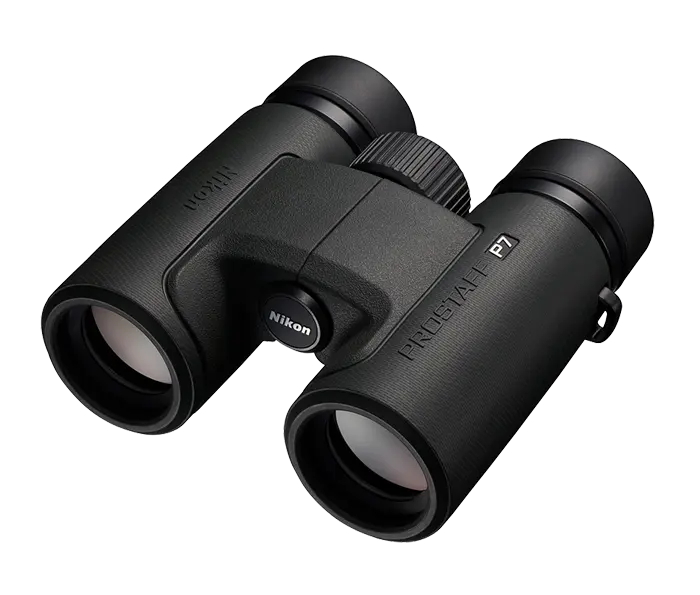
Nikon PROSTAFF P7 8×30 provides a manufacturer-reported 456-foot field at 1,000 yards, the largest nominal width in this shortlist. It weighs 17.1 ounces, lists 15.4 mm eye relief and focuses as near as 8.2 feet. The binocular measures about 4.9 inches long and includes a locking diopter and outdoor waterproof/fogproof construction as documented by Nikon. The field figure offers a reason to consider it for small birds disappearing among leaves, but cannot reveal edge sharpness on its own.
Amazon.com
Product image: Nikon.A buyer comparing P7 with M7 should not simply assume the wider figure wins. The M7 has a shorter close-focus specification and different optical construction, while the P7 has slightly more body weight despite sharing 30 mm objectives. The focusing feel and how easily an observer can see the entire field with their glasses may decide the result. A 456-foot image cut off at the edges is less useful than a fully visible and comfortable narrower one.
The P7 is a balanced option when you want a smaller body but still need rapid subject acquisition in wooded parks. Its short eye relief needs checking for thick frames, and the 8.2-foot minimum focus is not specialized for butterflies resting just inches away. Nikon has offered different PROSTAFF generations; verify product 16770, not an older PROSTAFF 7S or a 10×30 variant. A backorder on Nikon’s own store does not establish current Amazon stock.
Reasons to choose it
- Wide 456 ft field at 1,000 yards.
- Compact 8×30 format with a locking diopter.
What to weigh up
- 15.4 mm eye relief may be restrictive with some glasses.
- 8.2 ft close focus is not an insect-specialist distance.
03 / Long eye relief in a compact 32 mm format
Opticron Traveller BGA ED 8×32
Opticron Traveller BGA ED 8×32 combines an approximately 119 mm body length with a manufacturer weight of 452 g. Its 143-metre field at 1,000 metres is broadly comparable to premium wide-view compact birding optics, and the 19 mm eye relief is notable for someone who wears glasses. The maker lists an unusually short 1.8-metre close focus and an interpupillary range starting at 51 mm. These dimensions help explain why the model suits a broad range of faces and observation distances.
Opens an Amazon search for this model.
Product image: Opticron.The Traveller has a specific role between folding pocket instruments and full-size 8×42 binoculars. Its four-millimetre nominal exit pupil is more generous than an 8×25, yet it remains small enough for routine walking. Close focus can help with a butterfly or feeder bird from a normal path without changing equipment.
Check the exact 8×32 configuration and regional warranty coverage with the seller, particularly when choosing between U.S. and imported offers. The 452 g specification should be compared with included strap and case weight separately. This may be the most interesting candidate for a glasses-wearing birder who wants a compact body, but its actual eyecup fit and seller support still need verification.
Reasons to choose it
- 19 mm eye relief and four-stage eyecups.
- 452 g body with 1.8 m close focus.
What to weigh up
- The complete body and grip should suit your carrying kit.
- A stated 3 m water depth is not a published IPX7 test.
04 / Weather-ready compact for nearby and distant birds
Celestron TrailSeeker ED 8×32
Celestron TrailSeeker ED 8×32 is an 8×32 roof-prism model with a 410-foot published field, 6.5-foot close focus, 15.6 mm eye relief and 17.6-ounce mass. The maker lists ED objectives, phase- and dielectric-coated prisms, fully broadband multicoated lenses and a defined IPX7 water-resistance test. That makes it a useful option for a birder whose daylight routes include damp woodland, garden feeders and occasional rainy observation days.
Amazon.com
Product image: Celestron.The model is slightly heavier than several other compact contenders, but its field is broad enough for moving subjects and its nearest focus offers additional garden usefulness. The published IPX7 test describes temporary immersion under specific conditions, not unrestricted submersion or impact resistance. Even well-sealed optics need proper drying and storage after a wet outing. Celestron includes a soft case and carrying options, although current bundle details should be checked before purchasing.
Compare the TrailSeeker ED directly with Opticron Traveller if glasses are important: the 15.6 mm nominal relief may feel different from 19 mm even when both provide sharp central images. A buyer should also verify the ED model rather than the ordinary TrailSeeker 8×32, which is a different product. The strongest use case is active all-round birdwatching where weather exposure and close-focus versatility matter more than having the smallest possible folded body.
Reasons to choose it
- Defined IPX7 protection: 1 m for 30 minutes.
- 32 mm ED objectives in a mid-size body.
What to weigh up
- 15.6 mm eye relief needs a glasses-on fit check.
- 499 g is more weight than a pocket model.
05 / Small premium binocular carried every day
ZEISS Victory Pocket 8×25
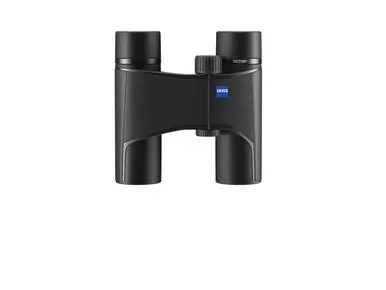
ZEISS Victory Pocket 8×25 introduces a true pocket form to the compact birdwatching comparison. The maker specifies approximately 290 g mass, 16.5 mm eye relief, a 1.9-metre near focus and 130 metres of field at 1,000 metres. Its asymmetric folding arrangement supports easy transport in a small travel bag. The 25 mm objective yields about a 3.1 mm exit pupil, which differs meaningfully from an 8×32 or 8×42 under some viewing conditions.
Amazon.com
Product image: ZEISS.A premium pocket design can suit someone who values having binoculars ready during ordinary city walks, short nature-trail visits or travel days. Its reported broad field gives an opportunity to follow moving birds despite small dimensions. ZEISS publishes a 91 percent transmission figure for the Victory Pocket range, but that company-specific value cannot be used as a percentage superiority claim against brands that do not publish identical testing data.
The primary compromises are small-grip ergonomics, price and a less forgiving nominal exit pupil in weak ambient light. A true pocket design should be tested for stable eye placement, especially with glasses, rather than purchased solely because it folds small. If binoculars are used for many continuous minutes in a fixed hide, a 32 or 42 mm body could prove more comfortable. Choose this when regular availability and minimal packed volume justify its premium cost.
Reasons to choose it
- 290 g body with a compact asymmetric fold.
- 390 ft field and 1.9 m close focus.
What to weigh up
- Premium pocket construction may exceed an occasional-use budget.
- 3.1 mm exit pupil favors daylight portability.
What to consider before buying
What compact means for actual birding
Compact birdwatching binoculars are often 8×25, 8×30 or 8×32 models, but the term has no single universal standard. A folded pocket binocular can be much smaller than an 8×32 roof-prism design even when both are marketed as compact. Compare actual weight, length and folded width, then consider whether the focus and eyecups suit your hands. The goal is not simply to minimize lens diameter but to carry a useful instrument on the outings you actually make.
Why we prefer eight-times in this shortlist
A moving bird is easier to acquire through a reasonably broad, steady eight-times view than through some narrow high-power configurations. Eight-times also makes ordinary hand movement less apparent than ten-times. There are exceptions depending on individual eyepiece designs and observer technique, so the magnification alone does not guarantee a wide field. All five candidates use eight-times power to keep the comparison focused on field, size, near focus and eyeglass fit rather than mixing fundamentally different observation styles.
Compact optics can have impressive field width
Nikon’s PROSTAFF P7 8×30 lists 456 feet at 1,000 yards, while MONARCH M7 8×30 lists 435 feet and Celestron TrailSeeker ED 8×32 lists 410. These are meaningful scene widths for observing small birds in woodland, even though the bodies are smaller than standard 42 mm models. Opticron’s field is expressed metrically and should be converted before direct comparison. Field figures do not provide edge sharpness or contrast measurements, so a broad nominal view should still be tested personally.
Weight is only one part of comfort
A 290 g pocket binocular and a 499 g 8×32 can feel substantially different over a long walk, but hand size and grip shape complicate the comparison. An extremely small hinge may be hard for large hands to hold steady, while a slightly heavier body may offer better control. Try repeatedly raising each binocular toward the same target. Check focus-wheel reach, strap comfort and how readily the eyecups can be adjusted with gloves. The best instrument is one you actually keep with you rather than leaving at home.
Why objective diameter changes light potential
At eight-times magnification, an 8×25 has a nominal exit pupil near 3.1 mm, an 8×30 around 3.75 mm and an 8×32 four millimetres. An 8×42 gives 5.25 mm but usually requires a larger body. In bright daylight, a small exit pupil may be sufficient; in shade or when eye alignment is imperfect, a larger beam may be more forgiving. A premium pocket model is not automatically a substitute for full-size optics during prolonged twilight viewing.
Eye relief is the hidden travel compromise
Some compact models achieve small dimensions with eyepieces that may be awkward for spectacle wearers. The Nikon 8×30 options offer about 15 mm eye relief, while Opticron Traveller lists 19 mm. The difference could matter greatly for thick glasses, but actual usable clearance also depends on eyecup depth and lens recess. Retract the eyecups and check whether you can see the complete circle with the same glasses worn outdoors. Do not assume a wide field number is useful if much of it is hidden.
How near focus fits birdwatching
Close focus is relevant to backyard feeders, shrubs, insects and flowers as well as distant birds. Opticron Traveller focuses to about 1.8 m, ZEISS Victory Pocket around 1.9 m, and Celestron TrailSeeker ED around two metres. Nikon P7 8×30 focuses farther at about 2.5 m. None should be confused with a specialist half-metre butterfly binocular. Choose based on usual safe viewing distances rather than approaching wildlife just to take advantage of a short minimum-focus figure.
Waterproofing and environmental differences
The TrailSeeker ED specifies IPX7 protection, while Nikon documents defined immersion limits for the P7 and M7 families. ZEISS and Opticron publish other water-resistance descriptions. These statements should not be treated as identical or as proof the optics survive unlimited immersion and falls. After a wet outing, dry the exterior and case according to manufacturer instructions, and never rub sand across optical coatings. A compact binocular can be rugged, but small dimensions do not by themselves guarantee environmental sealing.
A good woodland acquisition test
First find a branch with unaided eyes, then raise each binocular while keeping your gaze fixed on the same point. A broad field may help you locate the target without sweeping through leaves. Next change focus to another branch farther away, noting the wheel’s ease of operation. Repeat with your usual glasses. A controlled practical test reveals comfort and usefulness beyond the spec table, although it does not establish laboratory sharpness or transmission rankings.
Why the 8×25 belongs in a separate role
ZEISS Victory Pocket is more compact than the 30 and 32 mm options and is worth comparing for short walks and travel. However, its smaller objective and grip geometry have different strengths and limits. The pocket-travel guide will examine minimum packed volume, daily luggage and foldability more deeply. Here its role is to show whether a very light binocular can still be useful for birdwatching, not to declare that the smallest body always wins for prolonged field observation.
Coatings do not solve bad fit
ED glass, dielectric prism coatings and phase correction describe different parts of the optical design. They can contribute to colour correction and transmission, but none makes an uncomfortable eyepiece usable. The exact manufacturer terms should be checked for each model. A stable image that the user can see fully is more valuable than an expensive set of optical labels paired with poor grip or insufficient eye relief. Independent tests would be needed to rank contrast and edge performance scientifically.
Carrying on a hike
For routine woodland trails, a secure strap, case and accessible pack compartment can matter more than a small change in theoretical resolution. Keep binoculars from swinging into trees and rocks, and lower them before walking across uneven terrain. Do not leave them loose with metal accessories that can scratch the optics. A chest harness can spread carrying weight but should not interfere with backpack straps. Choose the whole carrying system that lets you view wildlife safely and quickly.
What a shop cannot prove
A store can help you assess eye relief, control placement, image comfort and apparent weight. It usually cannot verify waterproof seals, long-term durability or controlled transmission differences. Read manufacturer documents for those claims and consider independent tests with clearly explained methods. Use the guide as a practical shortlist grounded in model specifications and intended habitats.
Prices and product generations
Check exact model identifiers before ordering. Nikon PROSTAFF P7 8×30 is different from the old PROSTAFF 7S 8×30. Celestron TrailSeeker ED is different from its non-ED counterpart, and ZEISS Victory Pocket 8×25 differs from the 10×25. U.S. Amazon stock can change even while the maker’s catalogue remains available. Match the magnification, objective size, package and condition to the item you intend to buy. Check current warranty and return conditions as well.
Who benefits from 8×30 or 8×32
A mid-size eight-times body is often attractive when the observer spends substantial time birding yet walks too far to enjoy the mass of full-size 8×42 optics. The larger objective compared with a pocket 8×25 may make eye placement easier, while the format remains easy to pack. Among these candidates, Nikon emphasizes wide field, Opticron long eye relief and Celestron documented weather protection and close focus. Those are distinct needs rather than a numerical overall winner.
A use-case recommendation
For fast-moving woodland birds, compare PROSTAFF P7 8×30 and MONARCH M7 8×30 for their broad fields. If eyeglasses and compact body size dominate, evaluate Opticron Traveller 8×32 carefully. Celestron TrailSeeker ED 8×32 fits mixed wet-weather and near-focus outings. ZEISS Victory Pocket 8×25 is a different choice for someone who values tiny packed size and regular availability. The best fit depends on your eyes, habitat and carrying routine rather than a single specification.
Final buying checklist
Confirm the correct 8×25, 8×30 or 8×32 model, field units, published mass, eye relief and nearest focus. Check the genuine warranty and U.S. product listing before adding purchase links. If possible, compare the full field with normal glasses, focus between near and far branches and carry each binocular for several minutes. A compact birding model should make observation easier without adding unnecessary burden; a premium badge alone cannot show that it will.
Related binocular buying guides
For the larger objective and exit-pupil tradeoffs, read our compact versus full-size comparison. Travellers who prioritize folded pocket dimensions rather than extended birdwatching can consult the separate pocket binoculars for travel guide. For field tests before committing to a purchase, use our hands-on comparison checklist.
Before you choose
Frequently asked questions
Are compact binoculars good enough for regular birdwatching?
They can be, especially when a lighter pair means you carry it more often. Choose a model whose field, grip and eye placement remain comfortable during repeated sightings. Consider a larger format if your regular birding involves long sessions in dim woodland or if a small body is difficult to hold.
What is the difference between 8×25 and 8×32?
Both magnify eight times, but the larger objectives give the 8×32 a larger calculated exit pupil and usually a different body size. The 8×25 can save more packing space; the mid-size pair may offer more comfortable eye placement for some users. Compare actual models rather than assuming size alone settles image quality.
Why can a compact model have a wider field than an 8×42?
Field of view depends on the optical and eyepiece design, not objective diameter alone. A compact model can therefore publish a broader field than a larger binocular. Check the units and distance used for the figures, and confirm that the view remains usable with your eyewear.
Are compact binoculars harder to use with glasses?
Some compact designs have shorter eye relief or small eyecups that are less forgiving for particular frames. Others provide a generous eyepoint. Try the exact model with your normal glasses and check the whole field; a category label is less useful than the actual fit.
Do I lose useful birding detail by choosing a smaller objective?
The result depends on light, optical design, eye placement and steadiness as well as objective size. A compact pair can be very useful in daylight, but changes low-light flexibility. Compare it in the conditions you expect instead of assuming a smaller lens creates a fixed loss of detail in every situation.
Should I choose a folding pocket pair or a fixed mid-size body?
Choose the folding format when storage space is the main constraint. A mid-size body may provide a more familiar grip and easier repeated handling. Try opening, focusing and putting away the binoculars several times, because convenience across a full outing matters more than folded dimensions alone.
Sources and buying information
Product details come from manufacturer documentation for the models listed. Use the Amazon buying links for the current offer, seller, condition and package contents.
About the author
Simon Jack
Simon Jack is the named author of FieldLens Guide's research-based binocular, spotting scope and wildlife observation articles. His published editorial approach focuses on verifying model-specific manufacturer specifications, explaining optical tradeoffs in plain language, and matching equipment to real birdwatching, hiking and nature-observation needs. These articles do not claim hands-on product tests unless explicitly documented.