
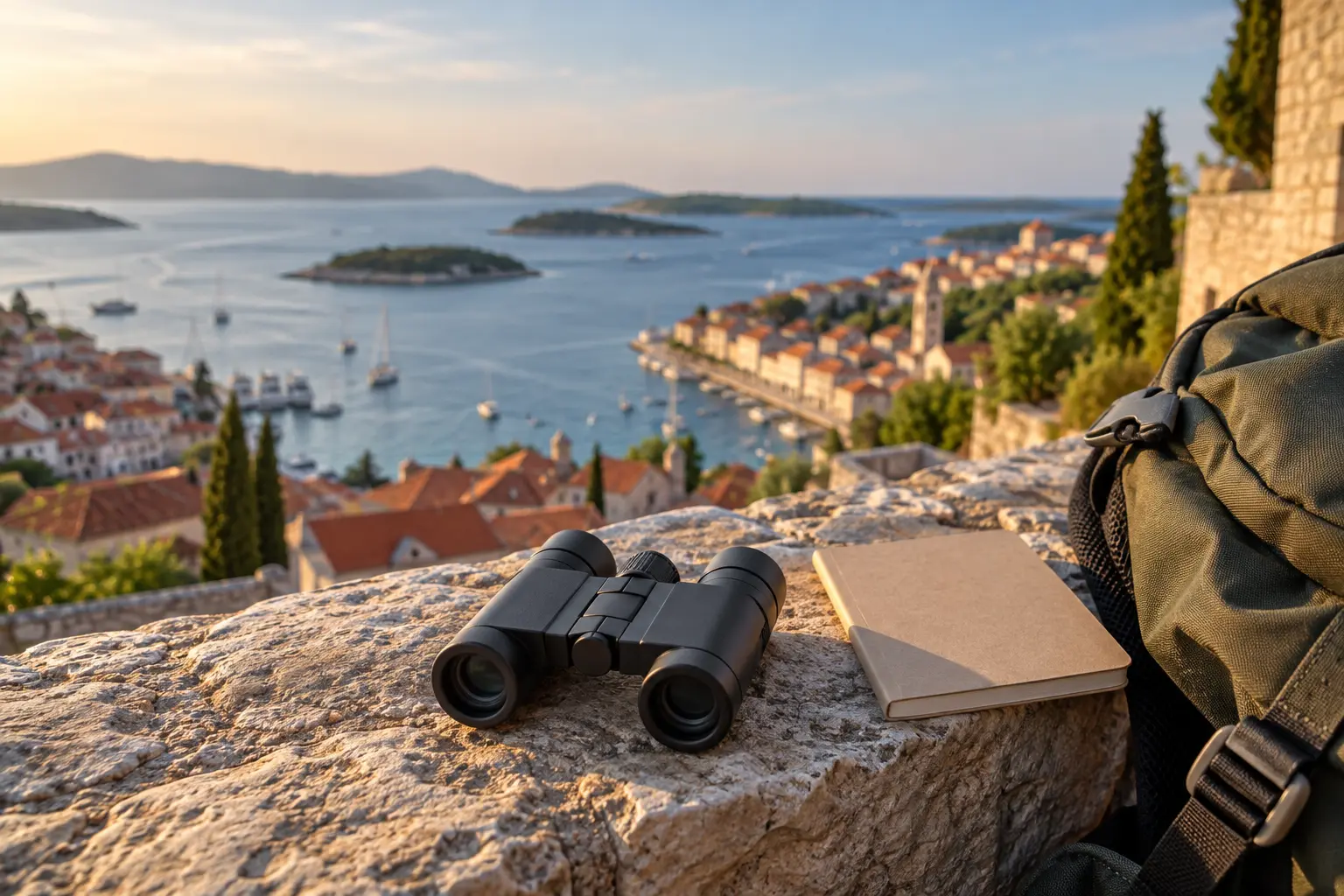
The best pocket binoculars for travel are small enough to bring along without sacrificing the comfort needed for a useful view. A folding body can disappear into a jacket pocket, but short eye relief, a tight grip or higher magnification can make a tiny pair less convenient once you raise it to your eyes. The right choice also changes between bright sightseeing, wildlife stops and occasional views from a train or coastal path. This guide compares five 25 mm models with different priorities in field of view, folding design, eye relief, weather protection and buying options. We separate everyday travel practicality from premium features and explain the compromises of the smallest formats. Begin with the quick verdict, then compare the table against your usual eyewear, available pocket space and the light conditions in which you expect to observe.
Affiliate Disclosure: We may earn a commission at no extra cost to you when you make a qualifying purchase through affiliate links in this guide. Buying buttons open Amazon.com. Read our full affiliate disclosure.
Best Pocket Binoculars for Travel: quick comparison
On smaller screens, swipe across the table to compare all features and buying options.
| Image | Model | Field | Eye relief | Travel role | Where to buy |
|---|---|---|---|---|---|
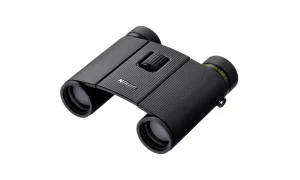 | Nikon Trailblazer II 8×25 | 8.3 degrees | 10 mm | New broad-field folding travel model | Check PriceAmazon |
 | ZEISS Terra ED Pocket 8×25 | 357 ft at 1,000 yd | 16 mm | Compact premium travel baseline | Check PriceAmazon |
 | ZEISS Victory Pocket 8×25 | 390 ft at 1,000 yd | 16.5 mm | Higher-end pocket optics and close focus | Check PriceAmazon |
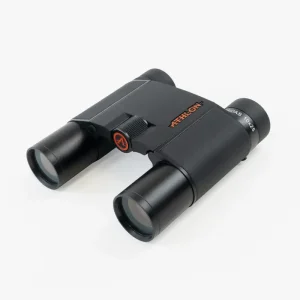 | Athlon Midas G2 UHD 10×25 | 285 ft at 1,000 yd | 15.5 mm | Tiny high-power distant travel view | Check PriceAmazon |
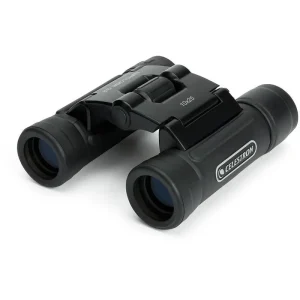 | Celestron UpClose G2 10×25 Roof | 300 ft at 1,000 yd | 11 mm | Low-cost occasional travel alternative | Check PriceAmazon |
Open Amazon for the current price and availability. Confirm the exact model, condition and package contents, including any separately required eyepiece, tripod or accessories. Tax and shipping may affect the total.
How we chose these models
Every choice uses 25 mm objectives because this guide is about optics that can realistically compete for pocket or small-bag space. Three 8x models and two 10x alternatives show how extra magnification changes the same basic travel format. We distinguish premium folding construction, simpler entry-level options and the control of a small handheld body.
- Check folded dimensions and shape, not just the word compact.
- Compare field width and steadiness before choosing 10x.
- Treat daylight portability and low-light suitability as separate decisions.
These comparisons use manufacturer documentation and published model specifications. We have not conducted hands-on product tests. See how we review optics for the research and correction process.
01 / New broad-field folding travel model
Nikon Trailblazer II 8×25
Nikon introduced the Trailblazer II series in February 2026 with 8×25 and 10×25 versions. The eight-times model has a published 8.3-degree real field, 10 mm eye relief and approximately 310 g mass. The body folds to a notably compact width, and Nikon describes waterproof outdoor construction. For a traveller who wants a light pair readily available during walks or sightseeing, the broad angle is a meaningful feature rather than an unsupported promise about optical sharpness.

Amazon.com
Product image: Nikon.The eight-times view is generally easier to keep steady than ten-times during quick observation from a safe stop, and the relatively wide angle can help find landmarks without searching across a narrow image. Nikon’s announcement describes the redesigned grip and fold-up housing as improvements over the original Trailblazer. This is a current generation and should not be mixed with the older Trailblazer ATB specifications, even when retailers place both on similar product pages.
The substantial caution is 10 mm eye relief, which may cut off the field for many people wearing glasses. A traveller who relies on prescription frames should not assume the widest listed angular field will be fully visible. The small objectives also have a roughly 3.1 mm nominal exit pupil, making this a daylight convenience option rather than a full-size low-light instrument. Confirm the exact Trailblazer II 8×25 rather than 10×25 before ordering.
Reasons to choose it
- Broad 8.3° real field in an 8×25 format.
- Folding design for a small travel kit.
What to weigh up
- 10 mm eye relief is restrictive for many glasses wearers.
- Check that the listing is the Trailblazer II generation.
02 / Compact premium travel baseline
ZEISS Terra ED Pocket 8×25
ZEISS Terra ED Pocket 8×25 is a folding, lightweight binocular with a maker-listed 10.9-ounce mass, 357-foot field at 1,000 yards and 16 mm eye relief. ZEISS identifies waterproof, nitrogen-filled construction and a hydrophobic exterior coating. The larger nominal eye-relief figure than Nikon Trailblazer II is a reason to investigate the fit with prescription glasses.

Amazon.com
Product image: ZEISS.For ordinary travel sightseeing and short daylight nature walks, the ability to keep optics in a small bag can be worth more than theoretical full-size performance. The Terra’s eight-times magnification balances image scale with manageable apparent hand movement. The published 3.1 mm exit pupil reflects the same basic 8×25 geometry as other pocket models, so any claim that it is substantially brighter than a rival would need matched transmission evidence rather than a premium brand assumption.
The real field is narrower than Nikon’s Trailblazer II, which can change how quickly a small bird is located. Folded dimensions and hinge geometry should be tested with the actual bag you carry. A waterproof label also does not mean the lenses cannot collect external fog or that the binocular can be dropped without damage. Check the correct Terra ED Pocket 8×25 model and authorized seller terms, particularly when ordering from outside the intended market.
Reasons to choose it
- Folding 8×25 body for small pockets and bags.
- 16 mm eye relief and nitrogen-filled construction.
What to weigh up
- Small exit pupil changes dim-light flexibility.
- The grip and eyecup fit need checking in person.
03 / Higher-end pocket optics and close focus
ZEISS Victory Pocket 8×25
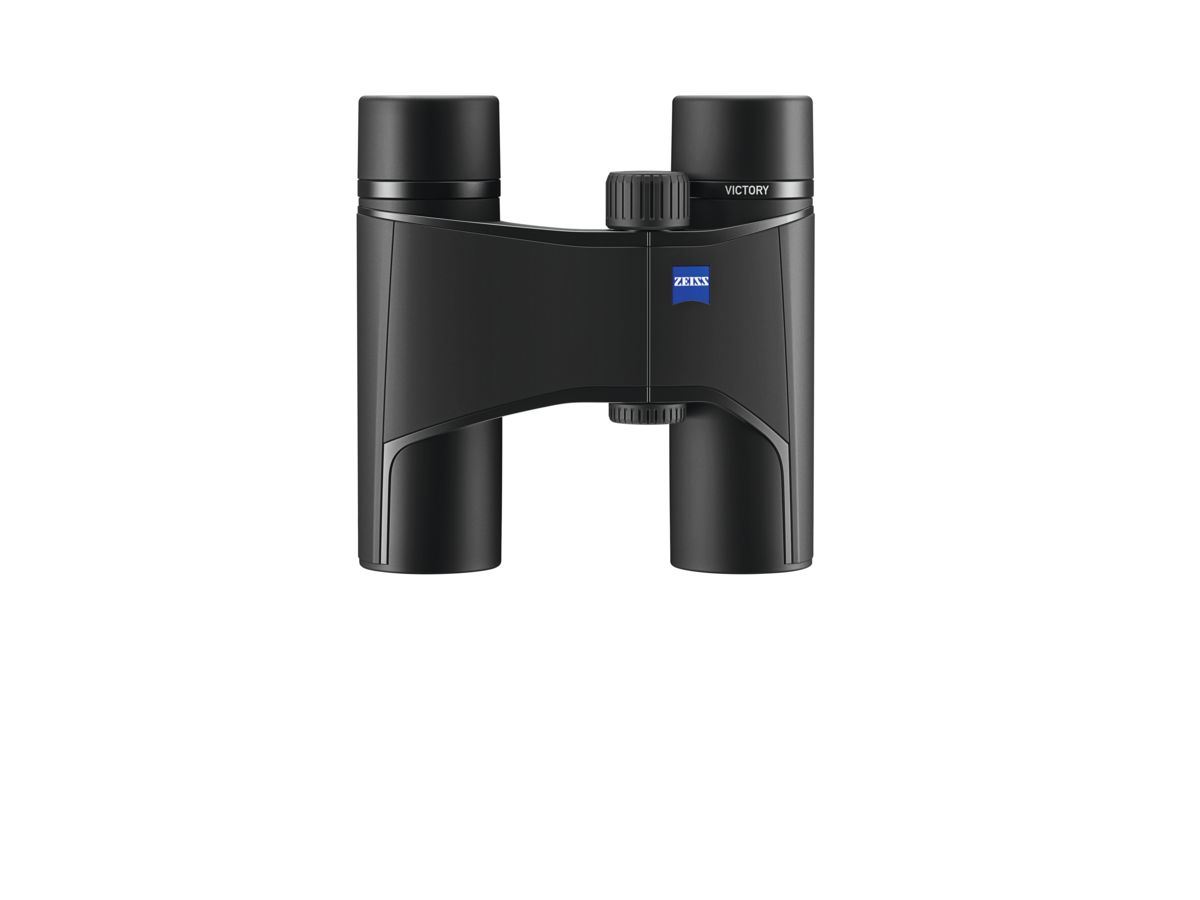
ZEISS Victory Pocket 8×25 has a documented 130-metre field at 1,000 metres, equivalent to the manufacturer’s stated 390-foot figure at 1,000 yards, a 1.9-metre nearest focus and 16.5 mm eye relief. Weight is about 290 g, and the asymmetric folding design is specifically intended for compact daily carrying. ZEISS publishes a 91 percent transmission figure for the model line, which can be cited as a manufacturer statement but not used as a percentage advantage over competitors lacking matched results.
Amazon.com
Product image: ZEISS.The Victory Pocket is a premium candidate for travellers who use optics frequently instead of occasionally. Its wider field than the Terra Pocket and relatively short close focus can help during short urban nature walks, botanical gardens and ordinary sightseeing. The low body mass also reduces the temptation to leave binoculars in the hotel. These qualities are distinct from maximum magnification or a rugged-looking exterior and must be evaluated against the considerably higher price.
Very small binoculars can be difficult to grip securely with large hands, especially while operating their tiny focus wheels. The nominal exit pupil is still only about 3.1 mm despite the price, so this is not a replacement for a full-size low-light optic. Do not copy specifications from the Victory Pocket 10×25, whose field and exit pupil are narrower. Verify that the user can hold the instrument steady and see the whole field before spending heavily.
Reasons to choose it
- 290 g body with a compact asymmetric fold.
- 390 ft field and 1.9 m close focus.
What to weigh up
- Premium pocket construction may exceed an occasional-use budget.
- 3.1 mm exit pupil favors daylight portability.
04 / Tiny high-power distant travel view
Athlon Midas G2 UHD 10×25
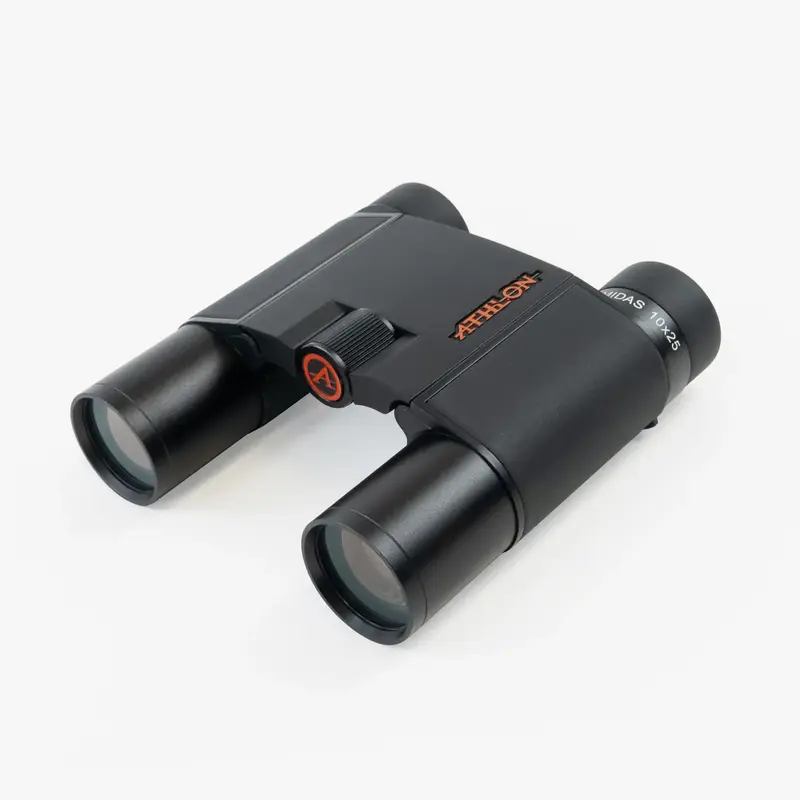
Athlon’s Midas G2 UHD 10×25 is a distinct option for someone who wants ten-times magnification in an unusually small body. Athlon’s published catalogue lists approximately 8.3 ounces, a 285-foot field at 1,000 yards and 15.5 mm eye relief, with about 5.2-foot nearest focus. Its magnesium chassis, coatings and gas purging are described as part of the Midas G2 family. Because catalogue generations can differ, confirm SKU 113010 and current product status before promoting it as available.
Amazon.com
Product image: Athlon.Ten-times magnification may make a distant building detail or stationary wildlife subject appear larger, but the narrow field and greater apparent hand movement can frustrate quick observation. The 25 mm objective at ten-times produces a nominal exit pupil of just 2.5 mm. That is a clear geometric limitation for dim conditions or imperfect eye placement, even if the finished optical design has good coatings. This is a specialized compact option, not a universally superior travel binocular.
Someone who wears glasses should test the 15.5 mm relief with their actual frames. A light and small body may still be hard to keep steady at ten-times if its grip does not suit the hands. At low light, a wider-exit-pupil eight-times alternative may be more comfortable. Verify that any marketplace product labelled Midas G2 UHD 10×25 truly matches this generation rather than an older compact model.
Reasons to choose it
- 10x magnification in a compact 25 mm format.
- 15.5 mm eye relief with an argon-purged body.
What to weigh up
- 2.5 mm exit pupil makes eye placement less forgiving.
- 285 ft field offers less scene width than the 8x pocket choices.
05 / Low-cost occasional travel alternative
Celestron UpClose G2 10×25 Roof
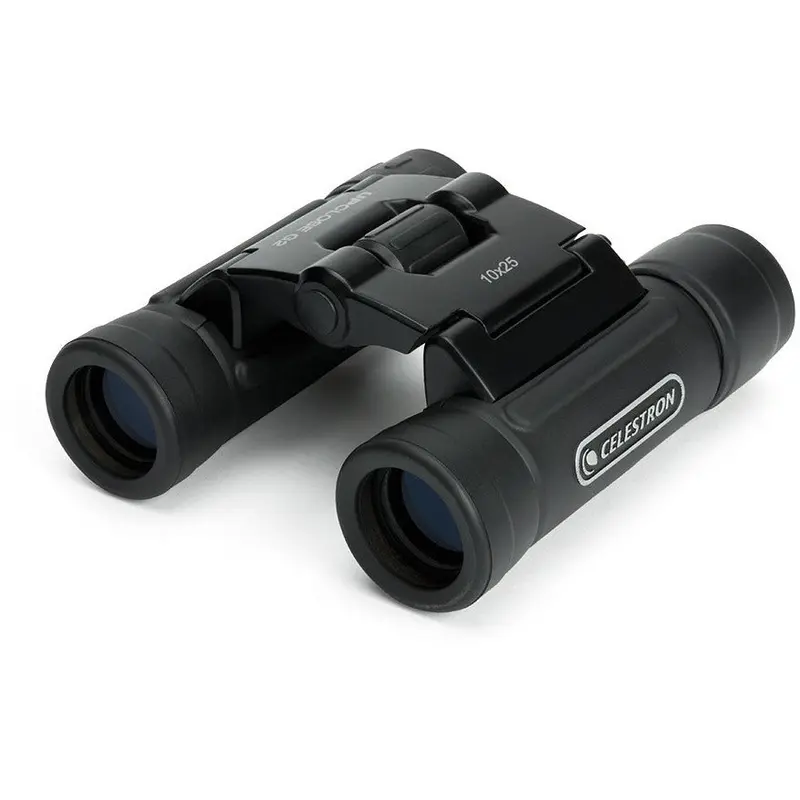
Celestron UpClose G2 10×25 is a lower-cost roof-prism model with an official 300-foot field at 1,000 yards, 11 mm eye relief, 15-foot nearest focus and 11-ounce mass. Celestron calls the body water resistant rather than waterproof and lists no nitrogen filling. Those distinctions are important because a compact case and rubber covering can look outdoorsy without meeting a defined immersion specification. The model represents a different budget tier from ZEISS Victory Pocket rather than a directly equivalent optical construction.
Amazon.com
Product image: Celestron.For an occasional short holiday, a basic compact binocular may be entirely useful in bright light if the owner’s eyes and hands fit the device. Ten-times power can enlarge distant signs or stationary subjects, while a carrying case makes it easier to keep the lenses protected in luggage. However, the narrow field and small nominal 2.5 mm exit pupil can complicate moving-bird observation. This is not an appropriate model to describe as fully waterproof or fogproof.
The 11 mm eye relief is a serious reservation for spectacle users, who may lose much of the outer image. The 15-foot nearest focus makes it less suitable for observing garden insects than more specialized travel optics. A low purchase price does not guarantee good long-term value if the binocular is uncomfortable to use. It is most defensible as a budget daylight occasional-use alternative when the exact current U.S. product is available.
Reasons to choose it
- Light 11 oz body for occasional travel.
- Small folding 10×25 roof-prism format.
What to weigh up
- 11 mm eye relief is limited with glasses.
- Water resistance should not be treated as an immersion rating.
What to consider before buying
What makes a binocular truly pocket-sized
Pocket travel binoculars are judged primarily by folded width, mass, lens protection and how quickly they can be reached from everyday luggage. They commonly use objectives around 21–25 mm, although a product label alone does not guarantee that it fits a jacket pocket. Folding double-hinge or asymmetric constructions may pack differently. Compare actual dimensions with the bag you carry, including objective caps and case. A short binocular that requires a bulky rigid case may consume more usable space than a slightly longer model in a slim soft pouch.
Why travel requires a different shortlist
Birding-specific compact binoculars may prioritize a very wide field and easy prolonged focus, while a pocket travel pair is often used for unpredictable short observations between flights, walks and sightseeing. The goal is a binocular convenient enough to have on hand, not a substitute for every full-size wildlife optic. This guide therefore emphasizes foldability, body weight, eyepiece access and daylight usefulness. An expensive 8×42 may be optically attractive but too burdensome for someone carrying only a tiny day bag.
Eight-times versus ten-times in a tiny body
An eight-times pocket model often provides a broader field and more forgiving apparent hand movement than a comparable ten-times version. The ten-times option can make distant stationary features appear larger, but its real view may be narrower and its 25 mm objective creates a smaller exit pupil. Athlon and Celestron both provide 10×25 alternatives for specific use cases, while Nikon and ZEISS offer eight-times formats. Avoid choosing higher power simply because the number seems more impressive; consider the kinds of subjects normally encountered during travel.
Understanding 3.1 mm versus 2.5 mm
A nominal 8×25 exit pupil is approximately 25 divided by eight, or 3.1 mm. The 10×25 equivalent is 2.5 mm. This influences how easily the observer can align their eyes and potentially use the instrument in weak light. It does not describe actual transmission or measured image quality. In bright daylight a pocket optic can perform usefully, while dusk may reveal its limitations compared with an 8×42. A pocket format is a conscious portability choice rather than a promise of full-size low-light performance.
Eye relief is particularly important
The 10 mm relief on Nikon Trailblazer II and 11 mm on Celestron UpClose G2 can be difficult for prescription-glasses wearers. ZEISS Terra Pocket lists 16 mm and Victory Pocket 16.5 mm, making them worth testing when glasses are normally worn. These numbers do not guarantee comfortable fit because eyecup depth and individual frames matter. A shopper should retract eyecups and check the entire image circle while wearing actual travel spectacles or sunglasses. A wide nominal field that is mostly hidden provides little practical advantage.
Field width helps locate unexpected sights
A broad field makes it easier to aim toward a moving bird or a landmark seen during a short stop. Nikon Trailblazer II 8×25 lists an 8.3-degree real field, which is wide on paper for a pocket design. ZEISS Victory Pocket lists 390 feet at 1,000 yards, Terra 357 feet and the ten-times models smaller widths. These values should be compared in common units. They do not establish edge sharpness or comfort, so a traveller should practise aiming at a known sign or tree rather than choosing by the largest number alone.
Folded width versus body weight
A 290 g ZEISS Victory Pocket and a roughly 310 g Nikon Trailblazer II are light, but their hinges and cases may take different volumes in luggage. Athlon’s published 8.3-ounce 10×25 is very light, though its optical and ergonomic compromises differ. Check case dimensions, not merely the weight of the bare binocular. A weight saving of a few ounces may not matter if the focusing wheel is difficult to reach or the instrument is constantly kept out of sight in a hard-to-open pouch.
Handling with larger hands
Pocket binoculars may be too small for some users to stabilize comfortably despite their low mass. Test both hands on the body and see whether the focus wheel can be turned without disturbing the view. A very narrow hinge can shift eye position whenever you adjust grip. Someone planning to observe birds for long periods may prefer a larger 8×30 or 8×32. This is why the compact birding guide uses a different set of priorities rather than treating every small model as interchangeable.
What near focus contributes to travel
Close focus is useful for botanical gardens, urban parks and insects, but many travellers mainly view distant landmarks. ZEISS Victory Pocket has a documented 1.9-metre nearest focus, while Celestron’s UpClose G2 lists 15 feet. That difference changes whether nearby butterflies or garden birds can be sharpened. A tiny binocular should not be assumed to focus closely simply because the objective is small. Choose according to genuine observation distances from public paths, without approaching wildlife or entering protected planting beds.
Weather protection may vary dramatically
Nikon Trailblazer II and ZEISS pocket models have waterproof descriptions, while Celestron UpClose G2 is explicitly water resistant and not nitrogen filled. The labels do not imply identical immersion ratings or protection against drops. Read exact manufacturer terms and avoid translating an outdoor rubber finish into waterproof performance. After rain, dry the binocular and case properly before storage. Exterior fog can occur even on a well-sealed model when cold optics meet humid air, so gas purging is not an all-purpose anti-fog treatment.
Carry it safely on a train or vehicle
Keep the binocular in a protective pouch rather than loose against keys, chargers or metal items. In moving vehicles, avoid leaving it where sudden braking could send it toward passengers. Never use binoculars while driving, and lower them before walking or crossing crowded paths. A secure short strap can help during an observation stop but may catch on luggage handles if left dangling. Compactness should make responsible carrying easier, not encourage viewing while navigating unsafe ground.
Avoid misleading transmission rankings
ZEISS publishes a 91 percent transmission figure for Victory Pocket, but this cannot be compared quantitatively with models that do not report data under the same testing method. An ED, UHD or dielectric label also does not establish superior brightness as a matter of fact. The complete optical design, coatings, observer’s pupil and lighting contribute to the perceived image.
What a higher price could buy
Premium pocket optics may provide refined mechanical construction, longer usable eye relief, specialized coatings or better service arrangements. The benefit is worthwhile only when it improves the owner’s actual observations and handling. An occasional holiday user may find a modest model adequate in bright light, while someone using binoculars daily could appreciate superior comfort and reliability. Check warranty region, return period and current U.S. stock before purchasing. Expensive optics should not be assumed objectively better simply because of a prestigious brand badge.
A travel-day test
Pack each shortlisted pair with its actual case into the bag you normally carry. See how easily it can be reached after stopping safely, then raise it toward the same landmark and focus. Check whether the body feels secure and whether eyecups remain in the correct position. Repeat with glasses or sunglasses and note the visible field. Carry the bag for a realistic walk, not just a short showroom moment. These exercises reveal portability and handling better than reading bare dimensions alone.
Product generations and exact identity
Nikon Trailblazer ATB and Trailblazer II are different generations; their sizes, field and body specifications should not be mixed. ZEISS Terra ED Pocket and Victory Pocket are different lines, while Athlon Midas G2 UHD 10×25 must be distinguished from larger Midas models. Some Amazon listings combine magnifications or seller conditions. Confirm the exact model code, lens size, included case, current condition and warranty before ordering. Confirm that the selected offer matches the model described here.
Who should choose which
Nikon Trailblazer II 8×25 offers a broad real field and new folding design, but its short eye relief limits some users. ZEISS Terra ED Pocket is a premium alternative with longer relief, while Victory Pocket adds a broader field and shorter focus at higher cost. Athlon Midas 10×25 appeals to those who deliberately want a lighter ten-times body; Celestron UpClose G2 serves an occasional low-cost use case. Match the choice to eyewear, budget and frequency of use.
Final pocket travel recommendation
Prioritize the ability to carry the instrument comfortably, access it safely and see a complete image. Compare folded dimensions, weight, eight-times versus ten-times power, field, eye relief and actual weather protection. Do not buy a pocket model to replace full-size low-light equipment without understanding its smaller exit pupil. Verify current seller availability and the precise generation, then test eye alignment before committing. A useful travel binocular is one that comes along naturally instead of adding more inconvenience to the journey.
Before you choose
Frequently asked questions
Will pocket binoculars fit in every jacket pocket?
No. Folded width, length and thickness vary, and the case can change the packed size substantially. Compare dimensions with the actual pocket or small bag you plan to use. Also check that retrieving and unfolding the binoculars is convenient enough for the unexpected sights you want to observe.
Is 8x or 10x better in a pocket binocular?
Eight-times is a useful travel default because hand movement is less apparent and the exit pupil is larger than in a comparable 10×25. Ten-times can suit distant subjects if you can hold it steadily. Try the actual small body, since grip can change how usable the extra magnification feels.
Can I use pocket binoculars in dim museums or at dusk?
They may be usable while enough light remains, but small objectives and exit pupils change the low-light experience. Do not choose a tiny daytime travel pair on the assumption that it will replace a larger format for every indoor or evening setting. Check close focus for exhibits and follow venue rules.
Why does eye relief matter so much for travel?
You may alternate between prescription glasses and sunglasses while moving between settings. Short eye relief can make a full view difficult with particular frames, even when the binocular is easy to pack. Check the exact model with the eyewear you expect to use instead of relying on pocket size alone.
Can I leave pocket binoculars loose in a bag?
Use suitable protection so keys, grit or other equipment do not rub against lenses and controls. Keep covers or a case convenient enough to use between sightings, and avoid packing the binoculars away wet. A small body still needs the cleaning and storage care described in its manual.
Does a premium pocket model replace a full-size birding pair?
It can be a very convenient daylight companion, but the formats have different grips, exit pupils and carrying priorities. A premium price does not remove those physical differences. Choose a pocket model for portability, and compare a larger pair if regular low-light or extended birding sessions are the main purpose.
Sources and buying information
Product details come from manufacturer documentation for the models listed. Use the Amazon buying links for the current offer, seller, condition and package contents.
Related practical guides
About the author
Simon Jack
Simon Jack is the named author of FieldLens Guide's research-based binocular, spotting scope and wildlife observation articles. His published editorial approach focuses on verifying model-specific manufacturer specifications, explaining optical tradeoffs in plain language, and matching equipment to real birdwatching, hiking and nature-observation needs. These articles do not claim hands-on product tests unless explicitly documented.