

The best spotting scope phone adapters match your eyepiece and phone closely enough to keep the camera aligned while you focus and take a picture. A universal label does not settle that fit: eyepiece diameter, taper, phone width, case thickness and camera position can all change which mount works. A three-axis adapter offers a different adjustment experience from a simpler two-axis clamp or a compression-ring system. This guide compares five adapters for those practical situations, with attention to supported dimensions, adjustment methods, weight and buying options. We also explain why a firm mount cannot correct vibration, atmospheric shimmer or an unsuitable camera-to-eyepiece distance. Measure your own equipment first, then use the quick verdict and table to find the most promising design before checking the exact variant and included fittings.
Affiliate Disclosure: We may earn a commission at no extra cost to you when you make a qualifying purchase through affiliate links in this guide. Buying buttons open Amazon.com. Read our full affiliate disclosure.
Best Spotting Scope Phone Adapters: quick comparison
On smaller screens, swipe across the table to compare all features and buying options.
| Image | Adapter | Best suited to | Important limitation | Where to buy |
|---|---|---|---|---|
 | Celestron NexYZ 3-Axis Universal Smartphone Adapter | Most flexible three-axis beginner adjustment | 283 g mount adds weight behind the eyepiece. | Check PriceAmazon |
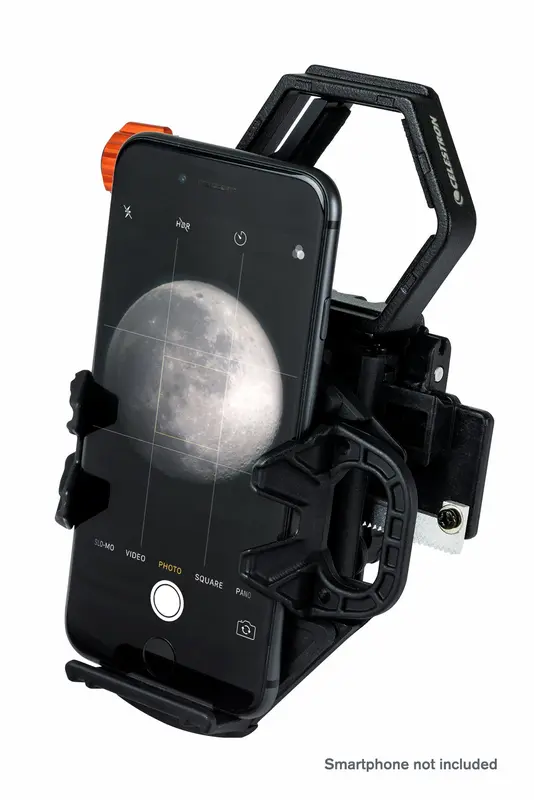 | Celestron NexGO Universal Smartphone Adapter | Lower-cost two-axis scope adapter | 25.4–44.45 mm eyepiece range excludes larger oculars. | Check PriceAmazon |
 | SVBONY SV214 Pro 3-Axis Smartphone Adapter | Metal XYZ mount with alternate clamp sizes | Choose W9176A or W9176B from measured eyepiece size. | Check PriceAmazon |
 | Novagrade Double Gripper Phone Adapter | Premium two-point phone grip | Higher cost than entry-level clamp adapters. | Check PriceAmazon |
 | Novagrade Single Gripper Phone Adapter | Metal adapter for repeatable personal equipment | Smaller eyepieces may need optional compression rings. | Check PriceAmazon |
Open Amazon for the current price and availability. Confirm the exact model, condition and package contents, including any separately required eyepiece, tripod or accessories. Tax and shipping may affect the total.
How we chose these accessories
The shortlist separates alignment mechanisms from phone-holding arrangements. The Celestron adapters offer different adjustment approaches, the SVBONY adds a three-axis alternative, and Novagrade provides single- and double-gripper configurations. Inclusion is based on the documented mounting and adjustment design, not a promise that any phone and case will fit every eyepiece.
- Measure eyepiece diameter and the phone or case before buying.
- Check access to the intended camera lens and the available alignment travel.
- Consider whether repeated alignment, phone weight or grip security is the main problem to solve.
These comparisons use manufacturer documentation and published model specifications. We have not conducted hands-on product tests. See how we review optics for the research and correction process.
01 / Most flexible three-axis beginner adjustment
Celestron NexYZ 3-Axis Universal Smartphone Adapter
Celestron’s NexYZ uses independent X, Y and Z adjustment knobs, making it possible to move a camera left, right, vertically and toward or away from the eyepiece without repeatedly unclamping the phone. The maker specifies a normal eyepiece grip of 35–60 mm, with included adapters for eyepieces down to roughly 25 mm. Phone width support is 65–90 mm, and its stated mass is 283 g.
Amazon.com
Product image: Celestron.For a birder who frequently changes between a spotting scope and binoculars, the depth adjustment is a real functional advantage: it may be easier to reduce the dark circular border without disturbing the horizontal camera position. The spring-assisted phone mount can also help when several people share one scope on an outing. Manufacturer documentation identifies metal and reinforced-polymer construction with a lockable optical clamp.
A mixed-use observer who wants fine alignment control and anticipates changing phones or scopes over time.
This is not a tiny travel accessory: the 283 g mount adds weight behind the eyepiece, potentially requiring the tripod head to be rebalanced. Phones wider than the specified 90 mm range or very thick battery cases may not fit. The eyepiece range must be measured on the actual ocular, not guessed from scope objective diameter. A three-axis knob system is useful but does not guarantee sharper photographs.
Measure both the eyepiece outer diameter and phone width including any case, then verify that the scope’s zoom ring remains accessible when the mount is attached.
Reasons to choose it
- Independent X, Y and Z camera alignment controls.
- 35–60 mm eyepiece grip, with supplied smaller-diameter adapters.
What to weigh up
- 283 g mount adds weight behind the eyepiece.
- 65–90 mm phone-width range must fit your handset.
02 / Lower-cost two-axis scope adapter
Celestron NexGO Universal Smartphone Adapter
NexGO has X and Y fine adjustment rather than the NexYZ’s additional depth axis. Celestron specifies an eyepiece clamp range of 25.4–44.45 mm and a relatively wide phone-clamp range of 58–103 mm. Its foldable design is intended to save space between sessions. Manufacturer-listed mass is about 363 g, so the simpler adjustment mechanism does not mean this accessory is lighter than NexYZ.
Amazon.com
Product image: Celestron.This model is worth considering when the actual scope eyepiece sits within the narrower supported diameter range and the buyer values affordability over fine three-axis control. The spring-loaded phone platform and rack-and-pinion X/Y knobs allow careful alignment without the elaborate compression-ring fittings used by premium metal adapters.
A beginner who already measured a relatively narrow eyepiece and wants a straightforward accessory for occasional bird photographs.
It is unsuitable when the eyepiece exceeds its maximum published clamp diameter. The lack of a dedicated Z adjustment may make depth alignment less convenient when camera vignetting persists. The nominal phone-width range does not mean every large protective case or camera bump fits. Since the mount has moving arms, confirm that it does not obstruct the scope’s focus mechanism or your tripod controls.
Check the eyepiece at the exact point where the clamp will grip and see whether the optics are still operable after attachment.
Reasons to choose it
- X/Y fine adjustment with a simple folding mount.
- 58–103 mm phone-width range and a folding design.
What to weigh up
- 25.4–44.45 mm eyepiece range excludes larger oculars.
- No independent depth axis, and the mount weighs about 363 g.
03 / Metal XYZ mount with alternate clamp sizes
SVBONY SV214 Pro 3-Axis Smartphone Adapter
SVBONY sells two SV214 Pro versions rather than one fully universal diameter. The W9176A fits 28–48 mm eyepieces and weighs around 250 g; the W9176B fits 44–64 mm and weighs around 320 g. Both are specified for phones 55–105 mm wide with X, Y and Z adjustment. The maker describes aluminium-alloy construction and EVA pads intended to protect gripping surfaces.
Amazon.com
Product image: SVBONY.The two versions make this model useful for buyers prepared to measure the precise eyepiece diameter before ordering. Choosing the correct clamp avoids attempting to force a 62 mm eyepiece into the smaller unit. Three-axis positioning is especially practical for a smartphone whose camera lens sits close to one corner. The fully metal construction may appeal to people who prioritize rigid mounting over the lowest accessory weight.
An observer with a measured eyepiece between 28 and 64 mm who wants fine camera-position control and knows which clamp version is required.
The exact SKU must match the eyepiece. A retailer listing that simply says SV214 Pro without identifying W9176A or W9176B could lead to an unusable purchase. There is no reason to assume that the heavier large-clamp version performs better optically; the adapter contains no image-forming lens. Installation on a very small scope can change balance, and thick cases still require careful clearance checks.
Write down the manufacturer’s SKU, the measured clamp location and phone width before adding the model to an Amazon cart.
Reasons to choose it
- Three-axis adjustment with a metal construction.
- Separate clamp versions cover different eyepiece diameters.
What to weigh up
- Choose W9176A or W9176B from measured eyepiece size.
- Mount weight and clamp fit vary with the selected version.
04 / Premium two-point phone grip
Novagrade Double Gripper Phone Adapter
Novagrade’s Double Gripper is a metal universal adapter designed to hold a smartphone on two phone-contact points. The manufacturer describes accommodation of many phones, with or without a case, and mounting onto round eyepieces. The double-grip system is a genuine mechanical distinction for a user concerned about device movement in challenging field conditions.
Amazon.com
Product image: Novagrade.A repeated digiscoper who changes location often may value phone retention and a precisely adjusted eyepiece connection more than the lowest entry price. The double-gripper layout also separates it from simple spring platforms where a single phone clamp does most of the work.
A frequent field observer who values secure retention of a changing smartphone setup and is willing to spend more for construction rather than extra optical magnification.
The metal body, compression-ring mount and double phone grip are the main reasons to consider it alongside simpler clamp adapters. Its adjustment method differs from X/Y/Z knob designs, so new users may need more care during initial alignment. The published broad compatibility claim is not a substitute for confirming ring size and exact phone dimensions.
Ask Novagrade to confirm compatibility with the exact eyepiece and phone, particularly when the ocular is tapered or has a large twist-up cup.
Reasons to choose it
- Two-point phone grip for a secure mounting arrangement.
- Adjustable metal system for compatible round eyepieces.
What to weigh up
- Higher cost than entry-level clamp adapters.
- Round-eyepiece fit still needs checking for your equipment.
05 / Metal adapter for repeatable personal equipment
Novagrade Single Gripper Phone Adapter
The Novagrade Single Gripper is a separate product from the Double Gripper. Manufacturer specifications list a maximum phone or small-tablet width of about 110 mm and a set of compression rings for eyepieces between 39 and 60.75 mm. Optional smaller compression rings are sold separately. The aluminium construction and repositionable soft-touch gripping components distinguish it from inexpensive basic clamps.
Amazon.com
Product image: Novagrade.This configuration can make sense for a birder who owns one suitable spotting scope, values a metal connection and wants to reuse the mount when changing phones. Its compression-ring system can be selected to match a measured ocular diameter, which may help create a predictable grip once set up. The wider published phone allowance is also relevant when conventional spring mounts are too narrow for a large handset.
An observer who wants a durable metal adapter for one regularly used scope and does not need the Double Gripper’s additional phone-retention contact.
Eyepieces smaller than the supplied range may require separately purchased rings. Although it costs less than the Double Gripper, it remains a premium-priced accessory compared with conventional Celestron mounts. Its one-gripper configuration should not be presented as automatically less stable or worse without an actual comparative test. Check the ring kit included in the seller’s offer and the case thickness before ordering.
Verify compression ring selection, eyepiece shape and the phone’s actual width; do not rely on a generic statement that the adapter accepts most optics.
Reasons to choose it
- Metal adapter with a compression-ring eyepiece connection.
- Published phone allowance extends to about 110 mm.
What to weigh up
- Smaller eyepieces may need optional compression rings.
- Costs more than the basic two- and three-axis clamps.
What to consider before buying
Why compatibility is more important than a bestseller badge
A phone adapter can be highly rated and still fail on your scope. The gripping interface is the outside of the eyepiece, not the objective-lens diameter. Measure exactly where the adapter attaches, accounting for a tapered body or twist-up eyecup. Compare that diameter against the maker’s explicit supported range. Phones should be measured with the protective case you plan to keep on. A mount that technically accepts the width can still cover camera buttons or block focus.
Two axes versus three axes
A two-axis mount generally moves the smartphone lens horizontally and vertically. A three-axis mount adds a forward/backward depth adjustment, which can help align the camera entrance pupil with the eyepiece’s exit pupil. That may make it easier to reduce vignetting while maintaining the centred position. However, three-axis mechanisms can be bulkier or more complicated than simple mounts. A two-axis adapter can still work well when depth is naturally suitable. Choose based on how difficult your particular phone and eyepiece are to align, not the number of adjustment knobs alone.
Why eyepiece shape matters
An adapter may have the correct measured diameter but still grip poorly if the eyecup is steeply tapered or covered by a soft movable rubber ring. Manufacturers usually design clamps to secure around a suitably rigid circular surface. Gripping a loose twist-up cup may rotate the eyepiece or make the phone sag. Check the maker’s instructions for whether the eyecup should be removed or retracted; do not improvise disassembly. If the optical body has no safe clamp position, a model-specific adapter may be more appropriate than forcing a universal mount.
Multi-camera smartphones complicate setup
Modern phone cameras can change lenses between wide, telephoto and macro views, sometimes automatically. An adapter aligned with the main camera may produce a black or offset image if the software switches to another lens. Establish which lens is being used in the phone’s camera app and choose a mode that allows reliable control where available. Avoid promising an exact menu path because features vary across devices and software updates. A clamp that permits enough positioning range around an off-centre camera module is valuable, but mechanical compatibility must be checked before purchase.
Vignetting is not necessarily an adapter defect
A black circular border often appears when the phone camera sees the edges of the image projected by the scope eyepiece. First centre the camera lens precisely, then adjust the spacing where your mount supports it. Some digital cropping may remove the remaining border, but heavy digital zoom does not create optical detail. If the dark area remains uneven, inspect alignment and whether the camera app changed lenses. Before blaming a product, test the setup at the scope’s lowest useful magnification and with a stationary well-lit subject.
Balance becomes more important with heavier adapters
A phone, case and adapter can add several hundred grams behind a spotting-scope eyepiece. This can shift the centre of gravity and make a lightly tensioned head drift upward or downward. Some mounts are more compact than others, but none should be assumed weightless. Before leaving the scope unattended, confirm that the tripod quick-release is secured and the head remains stable through the intended viewing angles. Never attach a heavy phone to an unsupported eyepiece or carry the scope long distances with the adapter dangling from it.
A remote shutter helps, but not everything
Pressing a phone screen can introduce vibration that becomes visible through a highly magnified scope. A short self-timer or compatible Bluetooth remote may help reduce the effect of that touch. A remote does not compensate for a bird in motion, an unbalanced head or thermal shimmer over water. The Celestron NexYZ DX kit includes a shutter accessory, but the base NexYZ discussed here should not be described as automatically including every DX component. Check product packages and distinguish the chosen variant before ordering.
Why a rigid mount does not guarantee sharper optics
The adapter’s mechanical function is to hold the phone lens in alignment with an eyepiece. Its material and clamping mechanism can affect movement, convenience and durability. It does not itself add a better objective lens or increase the spotting scope’s true resolving power. Evaluate the underlying scope, tripod, phone camera and atmospheric conditions before assigning image quality to the phone clamp.
Consider field use rather than a desk demonstration
An adapter that is easy to mount indoors may still be frustrating in cold weather or when a bird moves before adjustments are complete. Observe how many knobs require adjustment, whether the phone can be removed without losing its setting, and whether the scope’s focus wheel remains accessible. Those are practical ergonomics worth paying for. A frequent birding guide may value secure repeated changes between phones, while a solo observer using one handset could prefer simpler equipment. Avoid buying complexity for a scenario that rarely occurs.
How to test compatibility at home
Begin with the scope on a stable support and a stationary distant target. Measure the eyepiece, fit the adapter without forcing it, then check that the phone is held securely. Open the camera preview and centre the active lens over the eyepiece. Inspect vignetting, zoom control clearance and the mount’s effect on tripod balance. Take several photographs using a timer and review at normal screen size. If alignment cannot be maintained, check the manufacturer’s setup instructions and returns policy before modifying the product.
What changes with thick protective cases
Many adapter manufacturers say their products work with phones in ordinary cases, but a large rugged or wallet case can exceed a clamp range or interfere with the camera aperture. A case may also add extra distance between the lens and eyepiece, increasing the chance of vignetting. Determine whether removing the case is acceptable to you during field use. If not, choose a mount with genuinely adequate depth and width clearance, including room for camera bumps. Avoid assuming that a product claiming universal support includes every phone and accessory combination.
Cost versus intended frequency
Celestron’s lower-priced models suit occasional digiscoping when dimensions match, while Novagrade’s metal products are aimed at more frequent or demanding use. A premium phone clamp cannot compensate for a poor tripod or low-quality optical view. If your total budget is limited, better support and a suitable scope may produce more visible benefits than upgrading only the adapter. Consider borrowing a compatible mount on a bird walk before spending heavily. Use the extra money only if the mechanical benefits address a problem you actually experience.
Wildlife ethics apply to digiscoping
A spotting scope lets you photograph distant wildlife without walking into sensitive habitat. Maintain an appropriate distance and avoid disrupting nesting or feeding behaviour merely to fill the phone screen. Stay within permitted observation areas and do not create tripping hazards with tripod legs on busy paths. A bird that repeatedly leaves its activity or signals distress should not be pursued for another frame. Responsible practice is more important than obtaining a particular photograph, and an adapter should support observation from a safe distance.
Check the precise Amazon variant
Retailers may combine multiple sizes, different generations or separate accessories within one listing. SVBONY’s SV214 Pro has small and large eyepiece-clamp SKUs; NexYZ and NexYZ DX are not the same package. Novagrade Single and Double Gripper differ in phone retention, while compression rings may be separate items. Before ordering, reconcile the exact model code, included parts and U.S. checkout availability. Check the product name and package contents carefully when choosing an offer.
Who should buy which
Choose NexYZ when depth and lens alignment adjustments are the primary challenge. Consider NexGO for a compatible narrower eyepiece when lower cost matters. Compare the two SV214 Pro versions if you want a metal XYZ design and can measure the clamp diameter carefully. Novagrade Double Gripper is for more intensive repeated field use, while Single Gripper may suit a stable personal setup with appropriate compression rings. None is a verified universal winner, and these use cases require a fit check with the actual phone and eyepiece.
Final buying checklist
Before purchasing, measure eyepiece outer diameter, phone width with case, location of the active camera and available rigid clamping surface. Confirm the exact adapter version and whether extra rings or remotes are included. Consider assembled mass, tripod balance and whether focus and zoom controls remain accessible. Check warranty and return conditions, since compatibility can be difficult to guarantee from online specifications alone. A mount that fits securely and is easy to align is the right one, regardless of how many brands it claims to work with.
Before you choose
Frequently asked questions
Will a universal phone adapter fit every spotting scope?
No. Measure the outside diameter where the adapter will grip and compare the exact clamp range. Eyecup taper, rotating parts and available gripping area can matter as much as diameter. Also check phone width, case thickness and camera position before assuming a universal description establishes compatibility.
What does the third adjustment axis do?
Horizontal and vertical adjustments center the camera over the eyepiece. The depth axis changes how far the phone sits from it, helping you find a useful camera-to-eyepiece distance without disturbing the other settings. It adds control, but it does not guarantee that every phone or eyepiece combination will work.
Why is there a black circle around my image?
The camera may not be centered or positioned at a suitable distance behind the eyepiece. Start with the scope at low power, align the intended phone camera and adjust the distance carefully. Some circular framing can remain with a particular combination; extra zoom does not automatically restore lost image detail.
Which camera should I use on a multi-lens phone?
Begin with the camera you intend to align and check that the phone is actually using that lens. Some phones switch lenses automatically as settings or light change. Keep the selected camera centered over the eyepiece, and recheck alignment if the phone changes its active lens or shooting mode.
Can I leave my phone case on?
Only if the adapter's dimensions and gripping arrangement accommodate it securely. A thick or irregular case can shift the camera position or prevent the clamp from seating properly. Check retention with the equipment supported and stationary before using it outdoors, and follow the adapter's instructions for the phone grip.
Will a remote shutter fix blurry digiscoping photos?
It can reduce movement caused by tapping the phone, but other causes remain: scope vibration, inaccurate focus, moving wildlife, poor light and atmospheric distortion. Stabilize and balance the full setup first, then check focus and camera alignment. An adapter is one part of the system rather than a complete image-quality solution.
Should I carry the scope with the phone still attached?
Follow the instructions for the exact scope and adapter, and avoid assuming the phone mount is intended to serve as a carrying connection. A phone behind the eyepiece changes balance and can catch on objects while moving. Secure or remove accessories as directed before relocating the setup, then check the mounting and alignment again at the next viewing position.
Sources and buying information
Product details come from manufacturer documentation for the models listed. Use the Amazon buying links for the current offer, seller, condition and package contents.
Related practical guides
About the author
Simon Jack
Simon Jack is the named author of FieldLens Guide's research-based binocular, spotting scope and wildlife observation articles. His published editorial approach focuses on verifying model-specific manufacturer specifications, explaining optical tradeoffs in plain language, and matching equipment to real birdwatching, hiking and nature-observation needs. These articles do not claim hands-on product tests unless explicitly documented.