
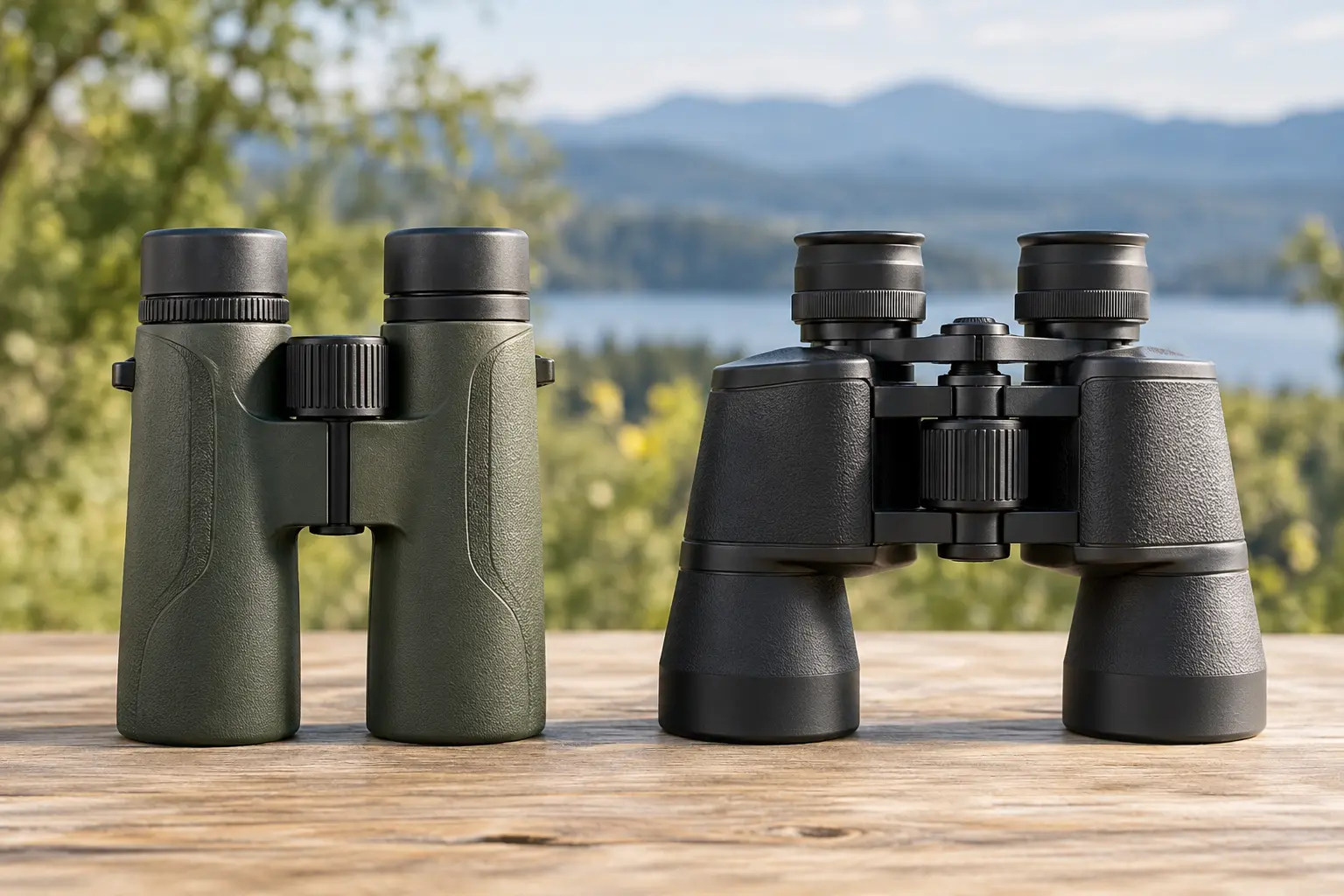
Roof prism vs Porro prism binoculars describes two ways of arranging prisms to orient the image within the instrument. Roof models often have slim, nearly straight barrels, while Porro models commonly have the recognizable offset shape. Neither prism layout guarantees sharpness, brightness, durability or comfort. A practical buying decision needs to account for the exact model’s manufacturing quality, optical coatings, weight, eyepieces and price. The best design for a birder who walks all day may be different from the best for someone observing stationary subjects from a window. If you are choosing a first pair, the beginner binocular shortlist applies these design differences to practical options.
Why binoculars use prisms
The objective lenses produce images that require correction before they can be viewed naturally through the eyepieces. The prism assemblies turn the image upright and redirect the optical path into a convenient body. Nikon identifies roof and Porro as two major arrangements used in consumer binoculars. The choice changes internal reflections and the shape of the housing. However, the prism architecture does not specify whether the binocular has eight-times or ten-times magnification, nor does it set the objective diameter. Those are separate specifications that should be compared independently.
How the Porro system works
A conventional Porro arrangement bends the path of light in an offset, often described as Z-shaped, route. That commonly places the objective lenses farther apart than the eyepieces and gives the binocular its stepped profile. Nikon notes that the relevant Porro reflective surfaces rely on total internal reflection, unlike some roof configurations requiring additional reflective coatings. This can help simplify certain aspects of production, but it does not remove the need for precise optical assembly. A poorly aligned or cheaply constructed Porro can still produce a disappointing view.
How roof prism construction works
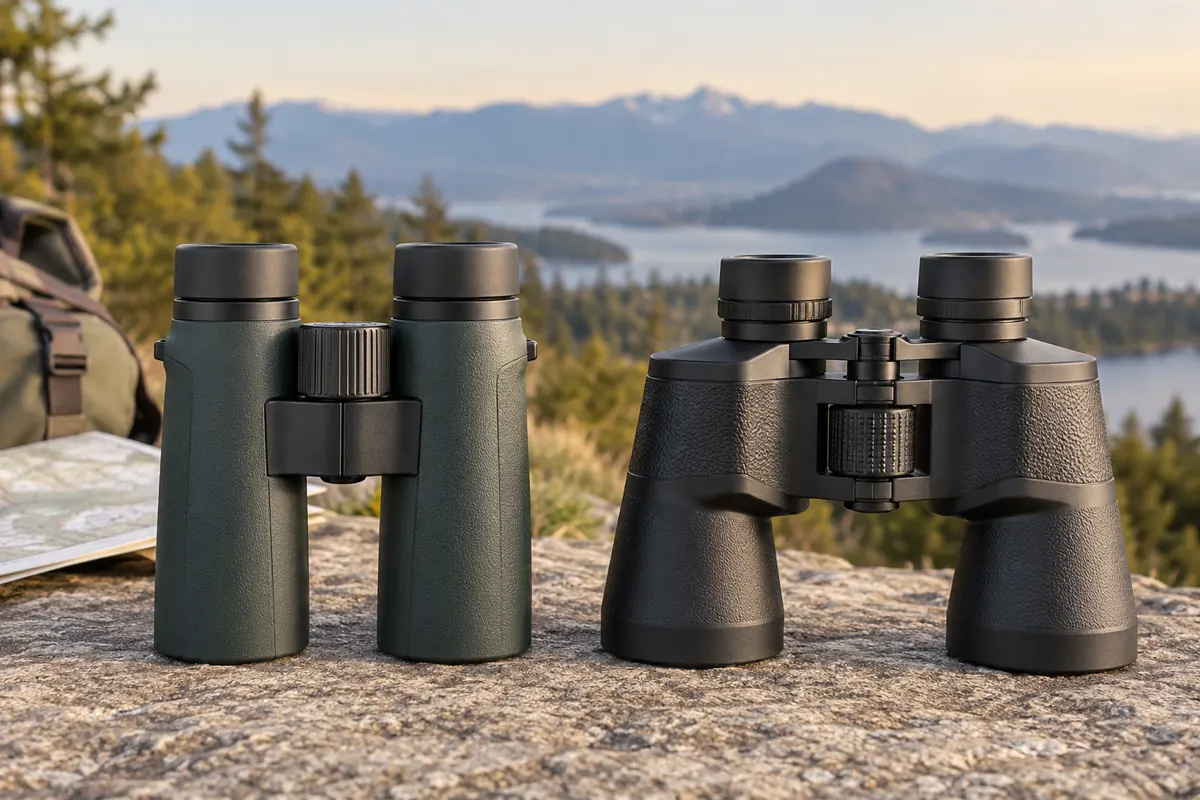
Roof prism arrangements allow front lenses and eyepieces to sit in a relatively straight-looking body, often preferred by hikers who value a narrow packing profile. The light does not travel straight through the housing; it undergoes carefully controlled internal reflections. Manufacturers must accurately construct the roof edges and may need specialized mirror and phase-correcting coatings. Nikon explains that phase differences can degrade resolution and contrast if not properly addressed. The apparent simplicity of a straight barrel should therefore not be mistaken for simpler optical production.
Reflective coatings and phase correction are different
A reflective coating improves reflectance at a prism surface that cannot rely solely on total internal reflection. Phase-correction coatings address phase shifts arising from reflections across roof surfaces. These are different technical problems and should not be described as interchangeable. Manufacturers may use metallic or dielectric reflective technologies, and the quality of a finished optical system depends on many additional elements. When one binocular advertises advanced prism coating, examine the specific terminology and whether the manufacturer provides evidence. Avoid ranking two entire product lines based on a single attractive phrase. Keep prism layout separate from what ED glass changes; they describe different parts of the optical design.
Why Porro bodies are typically wider
The offset optical path in many classic Porro designs produces a wider body. That shape can be less convenient to fit inside a narrow jacket pocket but may feel stable and easy to hold for some observers. There is no universal ergonomic winner. A person’s hand size, centre of balance, armour texture and focus-wheel position change how the instrument handles. A roof model can also be heavy if equipped with large objectives or substantial protective housing. Compare actual weights and dimensions of shortlisted models rather than drawing conclusions from drawings of prism arrangements.
Image brightness is more complicated than prisms
It is inaccurate to claim that every Porro binocular must be brighter than every roof binocular, or vice versa. Perceived brightness depends on objective diameter, magnification, lens and prism coatings, internal light control, transmission and the observer’s own eye pupil. Nikon specifically cautions that prism-coating reflectance is only one element determining brightness. A good comparison should consider the complete optical system and similar viewing conditions. Without independent side-by-side tests, it is best to describe technical differences without pretending they establish a product’s visible superiority.
Stereoscopic depth and objective separation
The wider spacing between objective lenses on many Porro models can create a stronger stereoscopic impression at some relatively near distances. That effect is sometimes appealing for viewing branches or textured natural objects. Nevertheless, the impression varies with observation distance, the viewer’s eyes and the design of the binoculars. It is not a guaranteed benefit for all people, and very close targets can be uncomfortable to fuse into one view. A buyer interested in butterfly observation should check the actual minimum focusing distance and comfort of binocular vision rather than choosing purely by prism type.

Field of view is not dictated by the prism label
Field of view describes the width of the visible scene at a given distance or angle. It is useful for locating fast-moving birds, but eyepiece design and magnification strongly affect the final figure. A roof model is not guaranteed to have a narrower field than a Porro model, or the reverse. Read official figures expressed in comparable units, then evaluate whether the full circle is visible through the eyepieces. Width also does not measure edge sharpness. A generously advertised field may have soft edges or be partly obscured when using glasses.
What glasses wearers should check
Both prism formats can be designed with long eye relief, and both can fit glasses wearers badly if the usable eyepiece distance is insufficient. Retract the eyecups, adjust barrel spacing, and check whether the entire circular view remains visible with your normal frames. Some eyepiece lenses are recessed, reducing practical clearance even when a listed specification looks generous. Since facial geometry differs, try the actual instrument where possible. Read our eye-relief guide to understand the fitting procedure before assuming the roof-versus-Porro choice answers this question.
Focus mechanism and observation speed
When a bird changes position rapidly, the feel and travel of the focus wheel can matter more than the prism arrangement. Some binoculars are easy to focus from near to far with one finger, while others require a more deliberate motion. Neither roof nor Porro automatically wins. Try following a stationary nearby target and then a distant sign, noting whether your grip remains comfortable. Make sure the diopter control is appropriately positioned and not easily moved accidentally. A binocular that fits the hand and responds predictably is a better practical tool than a model selected only for its optical diagram.
Weatherproofing is a model-level feature
Waterproof, nitrogen-filled and fog-resistant claims describe specific construction choices and test conditions, not the type of prism inside. Both layouts can appear in rugged outdoor binoculars, and neither should be assumed impervious to impact or immersion. Read the maker’s actual limitations and follow storage and cleaning instructions. If rain or dew reaches the housing, dry the exterior before long-term storage. Avoid rubbing grit against glass coatings. A secure carrying strap, protective case and accessible warranty service can contribute more to long-term value than the perceived modernity of the body.
What about price and value
Porro designs can offer competitive optical value because some reflective arrangements are less costly to implement, but a fixed cost advantage cannot be assumed in today’s market. Manufacturing quality, optical elements, branding, service support and distribution also shape selling price. Compare similarly priced instruments with comparable objective sizes and magnification rather than a premium roof model against a very inexpensive Porro. If one pair feels comfortable, remains sharp under your normal viewing conditions and has dependable support, those practical strengths may justify choosing it regardless of prism category.
A useful side-by-side store test
Choose a roof and a Porro binocular in roughly the same price class. Adjust eyecups, hinge width and diopter for each before drawing conclusions. Observe the same detailed stationary subject, then an object near the edge of the field. Compare how quickly you acquire a moving target, whether one view feels easier with glasses and how comfortable each body is to hold. Check the mass and folded dimensions rather than judging from a brief glance. If one appears noticeably brighter, repeat the comparison under consistent lighting before assuming the prism type caused the difference.
Which design for birdwatching or hiking
A compact roof prism model often suits birdwatchers who walk for long periods, travel frequently and prefer an easy-to-pack shape. A Porro model may appeal to someone comfortable with a wider housing or looking for good value in stationary nature observation. For either use, check eye relief, field of view, focusing feel, waterproofing and carrying comfort. If you primarily watch nearby insects, compare close focus too. There is no reason to restrict your shortlist to one layout if several models meet your practical requirements and budget.
Final buying decision
The roof-versus-Porro question is a useful way to understand construction, but it is only the beginning of choosing binoculars. Treat model-specific optical quality and fit as more important than broad assertions about architecture. Look for verifiable specifications, independent comparisons with clear test methods, and trustworthy warranty arrangements. Avoid assuming labels such as HD, ED or dielectric settle the outcome; each term addresses a different aspect of the design. Choose the pair you can use comfortably and regularly in your own observation conditions, and remember that an untested model cannot be fairly crowned the overall winner.
References
About the author
Simon Jack
Simon Jack is the named author of FieldLens Guide's research-based binocular, spotting scope and wildlife observation articles. His published editorial approach focuses on verifying model-specific manufacturer specifications, explaining optical tradeoffs in plain language, and matching equipment to real birdwatching, hiking and nature-observation needs. These articles do not claim hands-on product tests unless explicitly documented.