
What is field of view in binoculars? It is the span of scenery you can see without shifting the instrument. It can be expressed as an angle or a width at a specified distance. A wide field is especially valuable when you are learning to locate moving birds, because more surrounding branches and landmarks remain visible. However, field width is not a measurement of sharpness, brightness or overall optical quality. A binocular with a larger stated field may still feel awkward to use if its eyecups prevent your eyes from reaching the correct viewing position. Compare real specifications and comfort together.
A wide field helps find a subject, but it does not set the farthest distance at which that subject can be recognized. Our binocular viewing-distance guide distinguishes detection, recognition and identification under changing atmospheric conditions.
Understanding real angular field
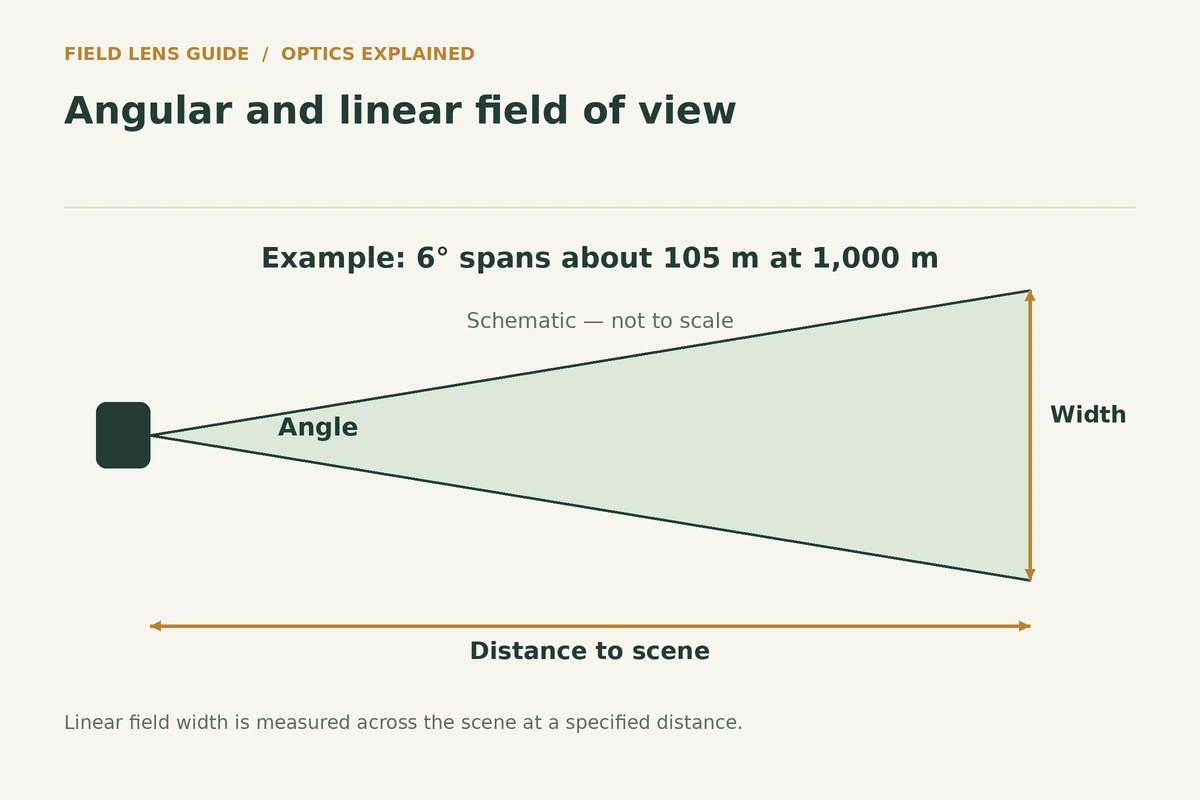
The real angular field is the angle formed by the two outer boundaries of the visible scene from the binocular’s viewpoint. Manufacturers typically express it in degrees. An eight-degree real field covers more scenery than a six-degree field at the same distance. Nikon’s technical guide identifies this as useful for locating moving wildlife. Do not confuse it with apparent field, which describes how expansive the magnified image looks to the viewer. Also remember that a bigger real angle does not guarantee uniformly sharp edges or less distortion during panning.
Understanding linear field measurements
In the United States, binocular specifications often state field width in feet at 1,000 yards. Elsewhere manufacturers may use metres at 1,000 metres. These are widths of the visible landscape at a reference distance, not claims that the binocular can focus only that far away. A figure of 400 feet at 1,000 yards encompasses more scenery than 330 feet at the same distance. Always check the units before comparing products, especially when one website lists imperial measurements and another lists metric values. Numbers copied without units can be misleading.
Converting an angular field into width
A real field angle relates geometrically to linear scene width. At a reference distance D, width is approximately two multiplied by D multiplied by the tangent of half the full real angle. Nikon provides an example: a seven-degree real field spans around 122 metres at 1,000 metres. This is a useful way to understand why even a small difference in degrees changes the amount of scenery visible. It does not represent image resolution or optical quality. For shopping, prefer the maker’s officially listed value rather than performing unnecessary conversions from imprecise marketing descriptions.
Apparent field is a separate specification
Apparent field of view describes the angular size of the magnified picture as experienced through the eyepiece. An older simplified formula multiplied real field by magnification; Nikon now documents a trigonometric approach associated with ISO 14132-1. For eight-times binoculars with a seven-degree real field, Nikon’s worked example gives about 52.1 degrees apparent field. This illustrates why real and apparent angles cannot be compared as though they were the same measurement. Before choosing between two models, confirm which figure each manufacturer is actually quoting.
What a wide field changes in woodland birding
Small woodland birds frequently move before you can raise binoculars and obtain focus. A generous real field gives you more surrounding context, making it easier to identify the branch and follow the bird to the next perch. Good technique remains essential. Look directly at the bird without magnification, then raise the binoculars while keeping your gaze fixed on the same location. Avoid sweeping randomly through the canopy. This approach can be especially rewarding with a steady eight-times instrument, but it also works with other suitable binoculars.
Magnification and the field tradeoff
A ten-times binocular typically makes a distant bird appear larger than an eight-times model at the same distance, but often offers a narrower real field and reveals more hand movement. Different eyepieces can alter this relationship, so you should not assume all eight-times binoculars have wider fields than all ten-times binoculars. Compare exact model specifications, not just magnification labels. For an open wetland with relatively stationary distant birds, extra magnification can be useful. For fast-moving forest birds, the ease of finding a subject may matter more.

Why glasses wearers can lose usable field
A published field-of-view figure describes the optical instrument, not necessarily the portion visible to every person wearing glasses. Spectacle frames can keep the pupils farther from the eyepieces, potentially hiding the circular border. Retract the eyecups and confirm the full image while wearing the actual glasses used outdoors. If the edges remain cut off despite proper adjustment, usable eye relief may be insufficient. This is different from poor focus. See our eye relief guide for practical fitting advice.
Field width and edge sharpness are not identical
A product can have an exceptionally wide nominal field and still show softer detail or distracting distortion toward the edge. Those characteristics depend on the broader eyepiece and optical design. A field measurement does not quantify distortion or resolution. When testing a pair, focus on a detailed stationary scene and inspect objects at the centre and near the edge without refocusing. Compare the same scene in similar lighting through candidate models. Record what you actually observe rather than assuming a larger manufacturer number establishes better image quality.
Field of view does not determine close focus
Field of view tells you how much landscape fits into the image, while minimum close focus tells you how near a subject can be brought into sharp focus. A butterfly watcher may need a close-focusing instrument even if the field is only moderately wide. A woodland birder may care more about field width than whether the binocular can focus on a flower just a few feet away. Both measurements should appear in a serious comparison table, but they should never be treated as interchangeable. Our close-focus guide explains the second specification.
Why exact product variants matter
A brand may sell binoculars of several magnifications and objective sizes under nearly identical family names. A retailer page can mix review text and specifications across those variants. Before copying a field-of-view number, check the model identifier and confirm that the figure belongs to the exact 8×32, 8×42 or 10×42 version being discussed. Units and reference distances also need to match. A comparison table that blends different variants can mislead readers even when every individual number appears somewhere on the manufacturer’s website.
An easy in-store field comparison
Stand in a stable position facing a scene with two recognizable objects near the sides. Adjust each binocular’s hinge, eyecups, diopter and focus. Without moving the instrument, note how much of the scene appears in each one. Look for the full circular image rather than pressing your eyes into the eyepieces. Next practise raising each model toward a familiar branch. A wider field can help acquisition, but comfort and focus speed also matter. This simple comparison provides useful evidence without pretending to measure optical performance in a laboratory.
When a narrower field is acceptable
The widest field is not always the priority. Someone viewing relatively stationary distant wildlife from a protected observation platform may prefer an instrument with comfortable higher magnification, excellent central detail and a narrower real view. Meanwhile, a beginner following unpredictable birds on a woodland trail may value rapid subject acquisition much more. Decide based on actual observation distances, movement and eye comfort. Avoid paying more simply because a manufacturer emphasizes wide angle in promotional language without showing the exact numerical specification.
Practical buying conclusion
When choosing binoculars, compare real field of view in consistent units and pair it with magnification, eye relief, minimum focus and weight. For rapidly moving birds, a comfortably usable broad field deserves particular attention. For stationary long-distance viewing, balance field against image scale and optical quality. Confirm that your eyewear allows you to see the full circle and that the manufacturer’s figures apply to the correct model generation. A dependable buying decision combines verifiable specifications with direct use or carefully described independent tests, rather than relying on one impressive number.
References
About the author
Simon Jack
Simon Jack is the named author of FieldLens Guide's research-based binocular, spotting scope and wildlife observation articles. His published editorial approach focuses on verifying model-specific manufacturer specifications, explaining optical tradeoffs in plain language, and matching equipment to real birdwatching, hiking and nature-observation needs. These articles do not claim hands-on product tests unless explicitly documented.