
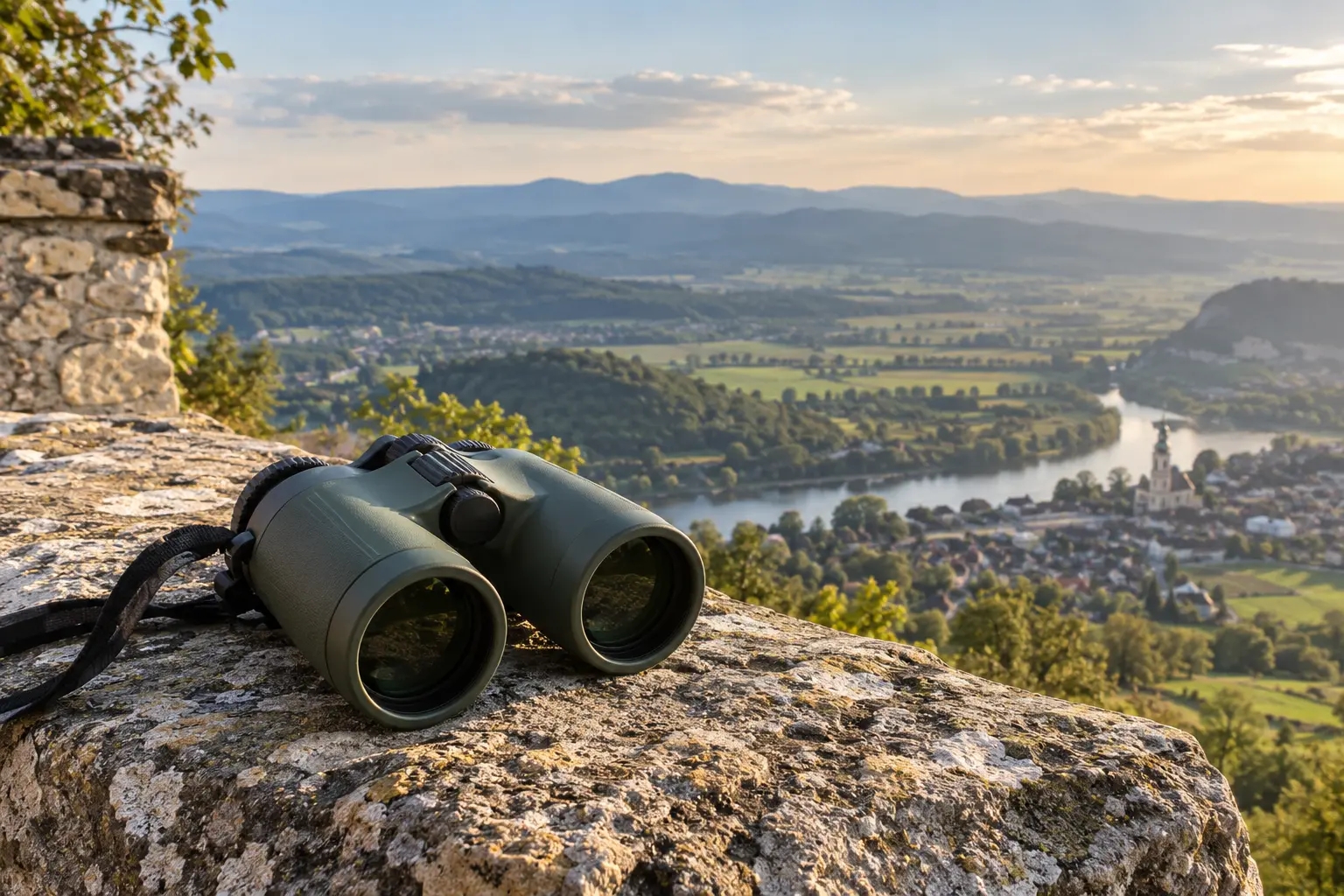
How far you can see with binoculars has no single maximum distance. Binoculars do not stop magnifying beyond a fixed range: a distant object can be visible or invisible depending on its size, contrast, atmosphere, lighting and whether it is above the horizon. Magnification changes apparent angular size, but it does not create missing detail.
Why binoculars lack a fixed viewing distance
Binoculars are optical magnifiers, not devices with a preset maximum range. A mountain many kilometres away can be visible through an eight-times binocular on a clear day, while a tiny bird only a few hundred metres away may remain impossible to identify confidently. Manufacturers typically publish magnification, field of view and minimum close focus rather than a farthest distance for good reason. Whether a subject can be detected depends on its angular size, contrast, lighting and the condition of the air between the viewer and target. Avoid marketing claims that a particular binocular simply sees a fixed number of miles.
Magnification versus recognition
Eight-times magnification means the subject’s angular size appears approximately eight times larger than with unaided vision, provided the instrument is used correctly. That is not equivalent to physically moving eight times closer, because atmospheric haze, obstructions, illumination and depth cues remain unchanged. A distant animal may appear larger without revealing enough feather or fur markings for identification. Ten-times power can add scale but magnifies hand movement too. The practical test is whether you can recognize new features, not whether the subject occupies more of the image.
Detection, recognition and identification
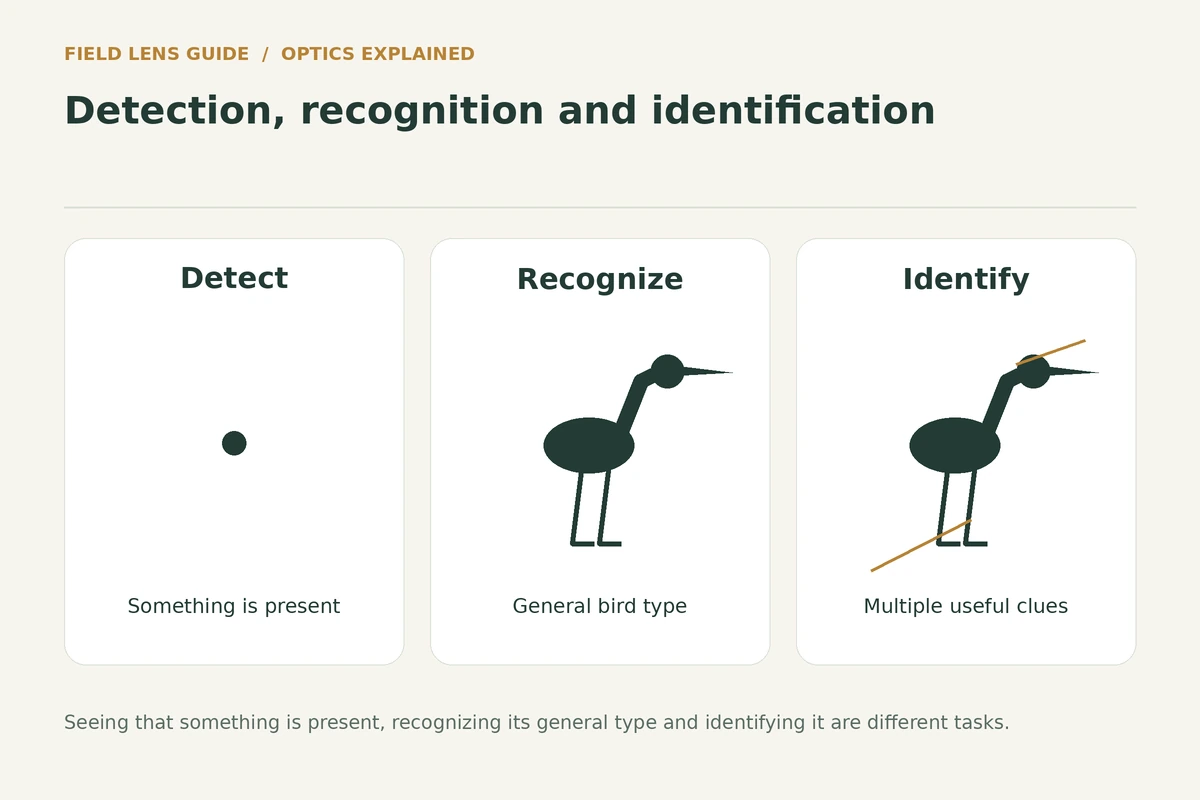
Seeing that something is present is different from recognizing it as a bird and different again from identifying its species. A dark moving silhouette can be detected against a bright sky even when no plumage detail is resolved. Knowing that it is a bird may be possible from wing shape or flight pattern. Assigning a species often requires much more detail and context. Binocular marketing rarely separates these tasks, which leads to unrealistic range expectations. State which level of observation you mean before comparing instruments or deciding to upgrade.
Why subject size matters
A large deer in an open meadow subtends a much greater angle than a small songbird at the same distance. The deer may remain recognizable after the songbird has become an indistinct speck. A tall building and a detailed license plate provide an even more extreme comparison. This is why a universal maximum distance in feet or miles is misleading. Rather than promising a certain range, choose magnification for the angular size and movement of the subjects you normally observe. Keep wildlife safety and privacy in mind while doing so. The wildlife binocular comparison puts those distance and steadiness compromises alongside actual model specifications.
Atmospheric haze and heat shimmer
The path of light through air can become less clear over distance. Haze scatters light and reduces contrast, while temperature differences can cause visible shimmer and distortion. These effects are especially obvious across sun-warmed ground, roads or mudflats. Increasing magnification enlarges the disturbance without recovering lost detail. A premium binocular cannot eliminate every environmental limit. On a hot day, a moderate magnification may provide a more useful stable outline than very high power. Early or cooler observation periods can sometimes improve conditions, but weather remains unpredictable.

The horizon limits what is visible
Earth’s curvature can conceal objects beyond the geometric horizon, depending on viewing and subject heights. Binoculars cannot magnify a target into view if it is entirely hidden below the horizon or behind terrain. Refraction and atmospheric effects can modify appearances, but they do not create a reliable unlimited line of sight. At coastal viewpoints, elevation can increase the visible horizon distance, but safe access matters more than obtaining a few extra kilometres. Avoid claiming any optic can see through hills, buildings or other opaque barriers.
Field of view changes target acquisition
At distant viewing ranges, locating a small subject can be the main challenge. A wider field provides more surrounding landscape and helps orient the observer among rocks, branches or shoreline patterns. Higher magnification often narrows that field, although eyepiece design creates exceptions. For moving birds, an eight-times binocular may acquire the subject more reliably than an unstable higher-power optic. Read the maker’s real-field measurement in degrees or width at a fixed distance, and do not confuse that with how far away you can see.
Lens diameter does not create zoom
The 42 in 8×42 indicates objective lens diameter in millimetres, not a forty-two-times zoom or a viewing distance. A larger objective can admit more light when other conditions match, but does not automatically magnify more. Eight-times models with 25 mm and 42 mm objectives make a subject appear at approximately the same scale. They can differ in comfort, brightness potential and carry weight. Comparing their claimed maximum viewing range is therefore the wrong way to assess the objective size.
Focus near versus focus far
Minimum close focus describes the nearest distance at which the binoculars can bring an object into focus. It does not impose a maximum distance. Many consumer binoculars can focus on distant objects effectively at or near their infinity setting. A close-focus measurement of six feet does not mean the instrument is limited to objects within six feet. If a distant view remains blurry after correct diopter setup, check eyesight, atmospheric conditions and the instrument rather than assuming it has reached a specified far-distance limit. Use our field-of-view guide to distinguish how much scenery is visible from how far away a subject can be recognized.
How eye resolution changes the result
The observer’s eyesight affects recognition. Prescription correction, pupil size, visual acuity and the ability to maintain a comfortable viewing position all influence what can be resolved. Eyeglass wearers may lose part of the field if usable eye relief is insufficient. A narrow or shaky high-power view can also prevent the eye from examining fine details. Two people using the same binocular may legitimately report different identification distances. Published optical numbers do not guarantee the same visual result for everyone.
Examples without invented promises
From a lakeside, binoculars may clearly reveal the presence of a large waterbird across the shore but not the detail necessary to distinguish similar species. From a mountain lookout, a distant peak can be visually obvious, while a small mammal on the same slope is hard to locate. In a garden, a nearby bird may show detailed feather edges even with basic eight-times equipment. These scenarios demonstrate scale and contrast, not fixed range thresholds. Avoid unverified estimates such as every 10x binocular identifying birds at one kilometre.
When a spotting scope helps
A spotting scope on a stable tripod can make a relatively stationary distant bird appear much larger than through eight-times binoculars. It may therefore help distinguish shorebird field marks at an accessible wetland viewpoint. It also has a narrower high-power field, greater carrying burden and increased sensitivity to atmospheric shimmer. The scope cannot produce detail absent from the optical and environmental conditions. Our binoculars-versus-spotting-scope guide explains when the additional setup is worthwhile.
A safe field range test
Find a detailed stationary object at a known safe observation point, such as a distant trail sign or rock formation. Look with unaided eyes, then use binoculars at a comfortable steady posture. Note which specific details become recognizable, not only whether the image appears larger. Repeat with another target of different size or contrast. Never aim the instrument toward the sun, and avoid viewing private residences or people in ways that compromise privacy. This simple experiment teaches more about useful observation limits than an ungrounded manufacturer range claim.
Making a sensible purchase choice
Decide whether you need to follow moving birds, see distant stationary mammals or travel with minimal load. Choose field width, magnification and objective size accordingly, then assess eyecup comfort, focus feel and actual weight. Eight-times is often suitable for general observation, while ten-times can offer more apparent scale in open settings when held steadily. Beyond that, a tripod-mounted scope may be a better tool. Any claimed viewing distance should specify the subject, lighting, distance and level of recognition, not a universal number. When the missing detail calls for a different instrument, compare useful spotting scope magnification with what you can comfortably use handheld.
The key answer
Binoculars can show objects far beyond the distance at which fine details are identifiable. There is no meaningful single maximum range because visibility depends on what you look at and the environment. Magnification enlarges apparent angular size; objective diameter affects potential light collection; field width helps acquire subjects; and the atmosphere limits clarity. Use the instrument to observe safely and set realistic expectations. A clear, comfortable view of an identifiable nearby subject is more valuable than a marketing promise of extreme distance.
References
Read the primary manufacturer explanation
About the author
Simon Jack
Simon Jack is the named author of FieldLens Guide's research-based binocular, spotting scope and wildlife observation articles. His published editorial approach focuses on verifying model-specific manufacturer specifications, explaining optical tradeoffs in plain language, and matching equipment to real birdwatching, hiking and nature-observation needs. These articles do not claim hands-on product tests unless explicitly documented.