
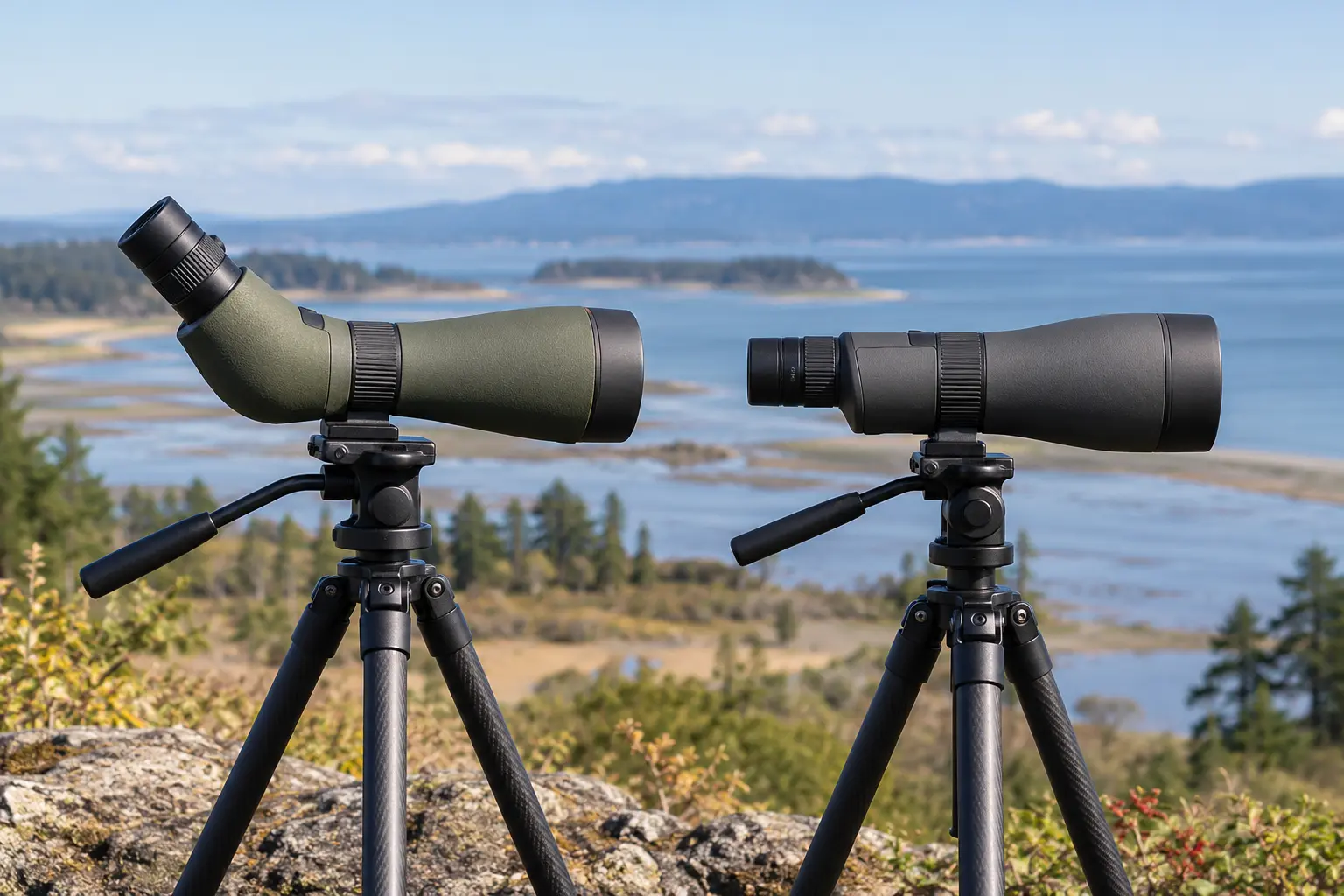
Angled vs straight spotting scopes differ chiefly in the direction the eyepiece points. A straight scope keeps the eyepiece aligned with the optical tube; an angled scope positions it upward, commonly at around 45 degrees. That design choice changes how you aim and how you stand or sit at the tripod. It does not inherently change resolution, coatings, objective diameter, or image brightness. Decide from your typical viewpoint and viewing posture rather than expecting one configuration to produce better optical performance simply because of its shape.
When choosing between an angled and straight body, the tripod and viewing position are as important as the eyepiece orientation. Compare actual supports in our birdwatching tripod guide, then review the beginner scope shortlist for complete packages and different viewing needs.
Direct aiming through straight models
A straight scope can feel intuitive to aim because the user looks along much the same direction as the barrel. Nikon notes that its geometry can help when acquiring flying birds or pointing through a car window or between bushes. However, a spotting scope’s high magnification and narrower field still make fast-moving birds difficult to follow. Practice centring a landmark on the lowest zoom setting and only then increasing power. The body geometry may assist orientation, but technique and the quality of the tripod head remain important.

Looking upward with an angled scope
For a bird perched high in a tree, a straight eyepiece can require uncomfortable neck extension or a tall tripod. An angled scope often allows the observer to look downward even while the objective points toward an elevated subject. Nikon specifically identifies this as a useful arrangement for looking upward. Comfort varies with individual height and mobility, and an angled instrument should not be presumed accessible to every viewer. Test the same elevated subject from a stable standing or seated posture and note whether prolonged viewing causes discomfort.
Sharing one scope across a group
When several people of different heights view a stationary bird, an angled eyepiece may need fewer tripod-height changes. A shorter viewer can often approach the eyepiece from above rather than waiting for another adjustment. That can save time during group birding, although young children may still need an appropriately safe position. Avoid stools that wobble or placing the tripod near a drop. Straight scopes can still work for groups, especially with quick-adjustable supports, but repeated height changes may be less convenient for extended shared observation.
Lower tripod height and wind
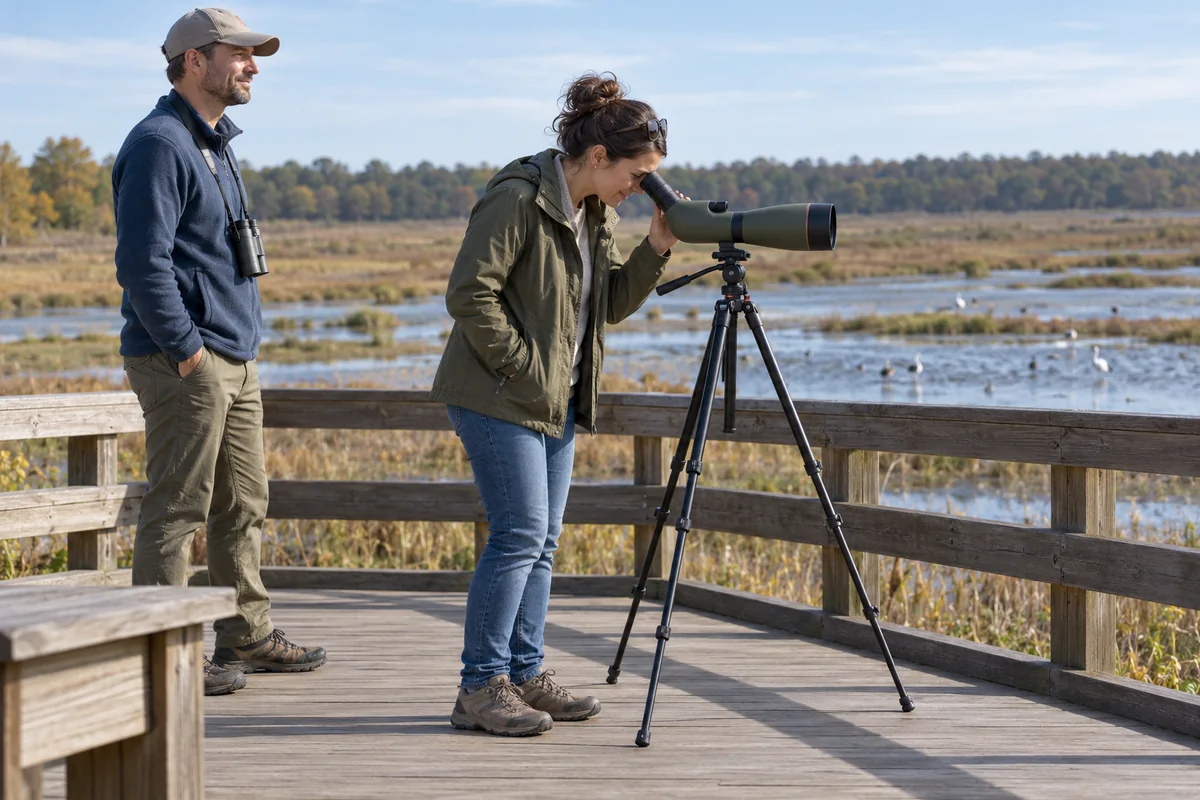
Because an angled eyepiece can be approached from above, the instrument may be set lower on its tripod than a straight scope used by the same person. A lower support generally offers a more favourable starting point in breezy conditions, but stability depends on leg stiffness, the head, load and ground surface. Extending thin leg segments to their maximum can introduce vibration. If a low setup forces an awkward back position, adjust it rather than tolerating discomfort. A badly supported angled scope will not be steadier than a carefully mounted straight model.
Observing through restricted openings
A straight eyepiece is convenient in some observation hides, window openings and vehicle viewing situations because the eyepiece and barrel occupy an aligned line. Angled versions may require more vertical clearance or a different sitting position. Before choosing, consider the actual geometry of your favourite bird hide or balcony. A tall open window may suit both designs, while a low horizontal slot can make the angled body frustrating. Always position tripods so they do not obstruct passage or put the equipment at risk of falling.
Digiscoping ergonomics
Using a smartphone adapter behind the eyepiece changes how the equipment is operated. An angled scope may bring the screen into a convenient viewing position from above, while a straight scope may feel more intuitive when aiming the lens along the subject line. Adapter compatibility, phone-camera alignment and weight balance are substantially more important than a blanket body-style preference. Heavy phones can cause the head to drift downward. Confirm the eyepiece model and actual adapter clamp dimensions before purchasing accessories. Do not assume every generic phone holder will fit.
Eye relief is determined separately
People who wear glasses need a comfortable viewing distance behind the eyepiece. That property depends on the eyepiece optics, not simply whether the scope is angled or straight. Some zoom eyepieces change their apparent field and eye comfort as magnification changes. Check the full circular view at both ends of the range while wearing your normal eyewear. If the view is cut off, adjust the eyecup before blaming the body design. A suitable eyepiece can outweigh an otherwise preferred scope shape.
Tracking versus stationary study
Fast flight is challenging through either style at high power. Binoculars often remain the better tool for quickly following a moving animal. Spotting scopes excel when you can locate a distant subject and study it patiently from a stable platform. When a bird changes position, zoom down first, reacquire the subject and then increase magnification. A straight body may make this sequence feel natural to some users, while a person accustomed to angled scopes may work just as effectively. There is no universal winner independent of practice.
Packing and carrying
An angled eyepiece may project upward and require a differently shaped case; a straight model can occupy a more elongated profile. The total weight depends on objective size, construction, eyepiece and tripod rather than eyepiece direction alone. If you hike between several observation points, test how quickly each instrument can be mounted and packed. Ensure that protective cases accommodate the actual eyepiece, caps and any adapter. A slightly lighter scope body may still require a heavy tripod, so compare complete kits.
A fair side-by-side test
Place an angled and a straight scope of similar optical specification on stable tripods. Start with a distant stationary bird or sign and compare how quickly you can centre the subject. Test the same elevated target, a low viewing opening, and both seated and standing positions. If you share equipment, let another user try the setup without unsafe improvisation. Record how much tripod adjustment is needed and whether you can focus comfortably. Do not interpret the different body shapes as proof of optical performance unless the actual glass has also been compared.
Cost and included accessories
Manufacturers sometimes sell one body type in a kit and the other as a body-only item, creating misleading price comparisons. Check whether the eyepiece, tripod plate and carrying case are included. Confirm that the zoom and eye relief match the version you intend to purchase. If buying used, examine mount security and eyepiece condition before concluding that a low price is a bargain. A scope with an unsuitable support system may cost more to make usable than a seemingly higher-priced complete kit.
Who should choose straight
Consider a straight scope if most outings involve quick changes between stationary targets, use from a vehicle or narrow hide window, or a personal preference for direct pointing. It can be especially convenient when you do not routinely share with people of very different heights. Still, a straight instrument at eye level may require a taller tripod for comfortable standing use. Make sure the assembled system is sufficiently stable, and do not sacrifice appropriate eyepiece eye relief simply to retain a straight geometry.
Who should choose angled
Consider angled construction if you regularly share observations, often study elevated birds, or find a lower tripod and downward-looking posture more comfortable. It can work well during fixed wetland sessions where subjects remain in place. But the choice still needs a suitable tripod head, eye relief and manageable carrying system. Nikon’s comparison of both styles is useful because it highlights these practical scenarios without claiming the angle alone improves image quality. Choose the geometry that fits your observation routine, not the one that sounds more advanced.
Final buying decision
The most useful difference between angled and straight spotting scopes is ergonomic. It affects aiming, sight lines, tripod height and sharing, while magnification, lens size and optical quality depend on other components. If possible, compare equivalent bodies from the same product family to isolate how the eyepiece direction changes comfort. Test both at normal viewing height, then verify exact eyepiece compatibility and accessories. No amount of favourable marketing compensates for a posture that is uncomfortable or an instrument that cannot be aimed from your usual viewing point.
References
Nikon: Angled and straight fieldscope designs; Audubon: Spotting scope selection
About the author
Simon Jack
Simon Jack is the named author of FieldLens Guide's research-based binocular, spotting scope and wildlife observation articles. His published editorial approach focuses on verifying model-specific manufacturer specifications, explaining optical tradeoffs in plain language, and matching equipment to real birdwatching, hiking and nature-observation needs. These articles do not claim hands-on product tests unless explicitly documented.