
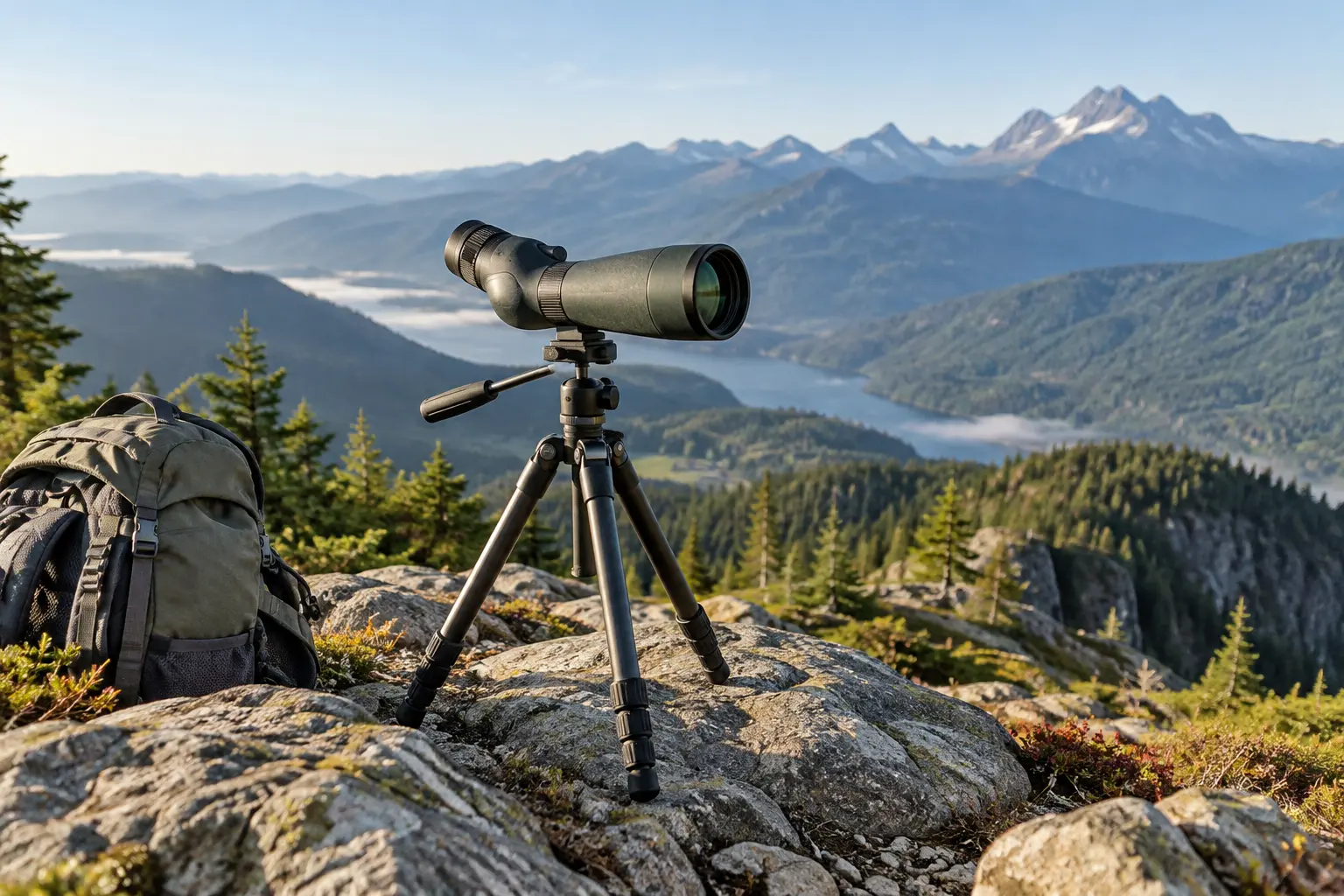
The best lightweight spotting scopes for hiking reduce the weight of the whole observation kit while retaining enough reach for the birds and wildlife you stop to watch. A very light scope body can lose its advantage if it needs a bulky tripod, a separate heavy eyepiece or an awkward carrying case. Before choosing, consider how often you actually stop, whether those stops happen in bright daylight or shaded valleys, and how much magnification is useful at your usual distances. This guide compares five scopes with different approaches to that balance, from a very light 50 mm model to more capable mid-size and premium alternatives. We distinguish body-only weights and prices from complete configurations so the comparison stays practical. Use the quick verdict to choose a likely format, then assess the scope together with the support you will carry. Also check eyepiece comfort at the zoom settings you expect to use most.
Affiliate Disclosure: We may earn a commission at no extra cost to you when you make a qualifying purchase through affiliate links in this guide. Buying buttons open Amazon.com. Read our full affiliate disclosure.
Best Lightweight Spotting Scopes for Hiking: quick comparison
On smaller screens, swipe across the table to compare all features and buying options.
| Image | Model | Trail use | Important caution | Where to buy |
|---|---|---|---|---|
 | Kowa TSN-502 20–40×50 Straight | Minimal body weight | 14–12.5 mm eye relief can limit the view with glasses. | Check PriceAmazon |
 | Nikon PROSTAFF 3 16–48×60 Outfit | One-package trekking introduction | 10 m minimum focus limits nearby nature viewing. | Check PriceAmazon |
 | Celestron Hummingbird 9–27×56 ED | Day hikes with mixed near and far subjects | 27x maximum is limited for very distant subjects. | Check PriceAmazon |
 | Opticron MM4 62 GA VHD/45 | Higher-capability short trail body | The stated body weight excludes the required eyepiece. | Check PriceAmazon model search |
 | Vortex Razor HD 13–39×56 Straight | Premium durable trail kit | Premium construction calls for a careful budget comparison. | Check PriceAmazon |
Open Amazon for the current price and availability. Confirm the exact model, condition and package contents, including any separately required eyepiece, tripod or accessories. Tax and shipping may affect the total.
How we chose these models
We selected five different ways to reduce the burden of a trail scope, from the small Kowa TSN-502 through Nikon’s starter outfit and Celestron’s low-power Hummingbird to the larger Opticron and premium Vortex alternatives. A scope body’s mass alone cannot settle the choice: a separate eyepiece, head and tripod may change the complete carrying load.
- Compare ready-to-view configurations rather than mixing body-only and kit weights.
- Check the lowest magnification for finding wildlife during short stops.
- Keep eye relief, working height and support needs alongside pack size.
These comparisons use manufacturer documentation and published model specifications. We have not conducted hands-on product tests. See how we review optics for the research and correction process.
01 / Minimal body weight
Kowa TSN-502 20–40×50 Straight
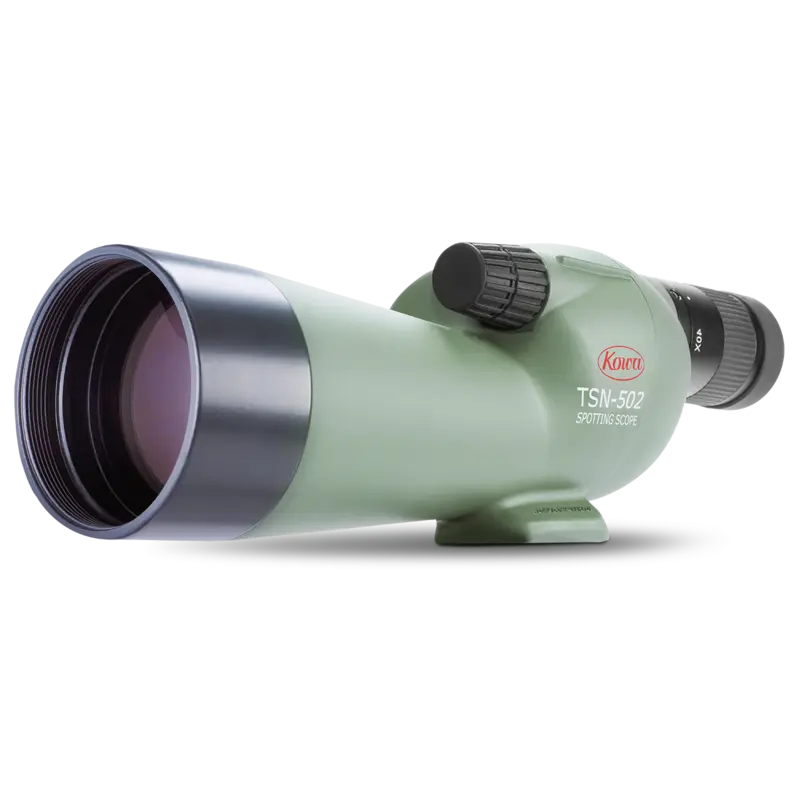
The maker lists 400 g, a 251 mm length, 50 mm objective and 2.5 m closest focus for the straight TSN-502. Its integrated 20–40x eyepiece shows 40–28 m of field at 1,000 m. The figures describe a small scope that can accompany a regular hike, not just a vehicle-based birding session.
Amazon.com
Product image: Kowa.With an integrated eyepiece, the body figure is easier to interpret than a separate modular scope without its ocular. It can be carried with a small compatible tripod and is suited to short to moderate observation stops in daylight. Straight viewing may be intuitive when pointing through open corridors between trees.
If you leave the house for a morning of woodland paths and occasional lake viewpoints, a short 400 g optic can be much easier to justify than a large 20–60×80 tube. The real challenge is choosing a sufficiently stable support that does not outweigh the benefit.
The published eye relief declines from 14 to 12.5 mm, which could be uncomfortable for glasses wearers. A 50 mm objective and 40x ceiling are not equivalent to an 80 mm fixed-site scope for distant dusk viewing. Confirm that the item is TSN-502, not the angled TSN-501, when checking a seller.
Reasons to choose it
- 400 g scope body with an integrated 20–40x eyepiece.
- Straight viewing and a compact 50 mm objective.
What to weigh up
- 14–12.5 mm eye relief can limit the view with glasses.
- The small objective and 40x ceiling suit a particular role.
02 / One-package trekking introduction
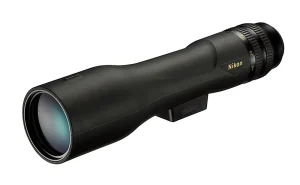
Nikon PROSTAFF 3 16–48×60 Outfit
Nikon lists a 60 mm objective, 16–48x integrated zoom, 620 g scope-body mass and 19 mm eye relief at 16x. Its described outfit comes with a compact tripod and case. The low-power field spans about 40 m at 1,000 m, giving a practical starting view for finding birds before increasing magnification.

Amazon.com
Product image: Nikon.The package reduces uncertainty about sourcing an initial eyepiece and tripod, an advantage for somebody beginning to travel with a scope. It offers a different balance than a micro 50 mm instrument: the larger objective has some light-collection potential while the body remains manageable compared with many 80 mm alternatives.
For a walker who visits observation points with benches or accessible platforms, a compact outfit can make sense. Evaluate the actual supplied tripod height and stability before planning an all-day remote hike around it.
The advertised body mass excludes the support that you actually carry, and the supplied compact tripod may be unsuitable for standing in grass or wind. Minimum focus is listed at 10 m, so this is not designed primarily for flowers or very nearby birds. Do not confuse the PROSTAFF 3 outfit with separately configured PROSTAFF 5 models.
Reasons to choose it
- Outfit includes a compact tripod and carrying case.
- 16x starting power and a 60 mm objective.
What to weigh up
- 10 m minimum focus limits nearby nature viewing.
- Included support may not suit your standing viewing height.
03 / Day hikes with mixed near and far subjects
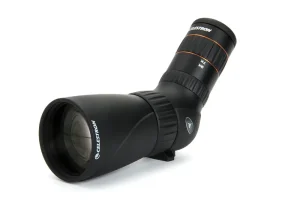
Celestron Hummingbird 9–27×56 ED
Celestron lists a 56 mm ED objective, 9–27x zoom, 20.8 ounces weight, 208 mm overall length and 9.8-foot close focus. A 216–98-foot published field at 1,000 yards and waterproof nitrogen-filled construction are among its documented features. The low nine-times setting distinguishes it from more conventional high-power scopes.

Amazon.com
Product image: Celestron.A hiker can find a bird at modest magnification and then zoom for extra detail without carrying an 80 mm tube. Its close focus allows observation of subjects encountered along the trail, not only those across distant water. Angled viewing may work well with a shorter tripod or fixed low support.
This option is appealing for hikes that involve changing subjects and frequent short stops: forest birds, near-garden wildlife, landscape features and occasional waterfowl at moderate distance.
The maximum 27x will not serve someone who frequently needs high-power observation of distant shorebirds. At 15 mm published eye relief, glasses fit must be checked carefully. A compact body does not make long handheld observation at 27x as steady as a proper tripod.
Reasons to choose it
- Unusually low 9x starting power for subject acquisition.
- ED design in a compact 56 mm angled scope.
What to weigh up
- 27x maximum is limited for very distant subjects.
- 15 mm eye relief needs checking with glasses.
04 / Higher-capability short trail body
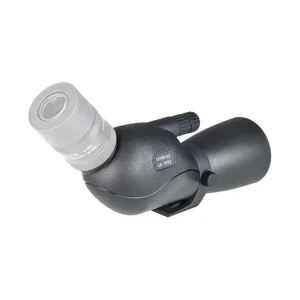
Opticron MM4 62 GA VHD/45
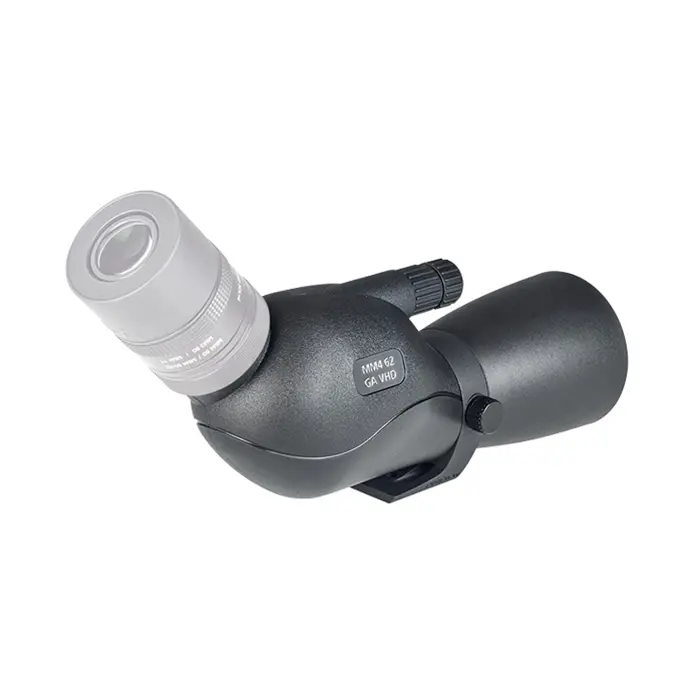
Opticron gives the angled 62 mm MM4 VHD body a length of 235 mm, weight of 788 g and close focus of 3.9 m. It uses a 62 mm ED-triplet optical design, dual focus, a rotating collar and nitrogen waterproofing. Suggested compatible eyepieces include HR3 16–48x and SDLv4 15–45x.
Opens an Amazon search for this model.
Product image: Opticron.The 62 mm objective provides an intermediate carrying category between micro scopes and conventional 80 mm instruments. A dual-speed focus mechanism can be valuable when studying fine distant plumage. The compact body shape may make it easier to fit beside hiking equipment than a long full-size scope.
Investigate this when you want an intermediate-aperture scope for serious wildlife observation but are unwilling to carry a large 80 mm system. The appropriate eyepiece and tripod need to be included in any honest comparison of trail weight.
The 788 g figure is for the body only; an eyepiece raises both working weight and cost. Opticron lists around 1,010 g for the 62 mm body with HR3 eyepiece, so quoting only the body figure would mislead a hiker. UK-market pricing should not be presented as verified U.S. Amazon availability.
Reasons to choose it
- 62 mm ED triplet objective in a short body.
- Dual-speed focus and a rotating tripod sleeve.
What to weigh up
- The stated body weight excludes the required eyepiece.
- The full working kit needs a separate weight and cost check.
05 / Premium durable trail kit
Vortex Razor HD 13–39×56 Straight
Vortex publishes a 56 mm objective, 13–39x zoom, 29.5-ounce weight, 11.1-inch length, 9.2-foot close focus and a 168–89-foot field at 1,000 yards. Its official listing also describes a gas-purged weather-resistant design and a helical focus system.

Amazon.com
Product image: Vortex.This model appeals to committed hikers who want a relatively short body while retaining greater maximum magnification than common micro scopes. A straight housing can be intuitive for aiming at a known landmark from a stable overlook. The manufacturer offers extensive published support information and a warranty programme.
Choose a scope of this kind only when the frequency of observation and your actual image-quality needs justify both purchase price and assembled equipment weight. A casual walker could be happier with a smaller, simpler alternative.
Despite the compact form, 29.5 ounces is noticeably heavier than Kowa’s 400 g option, and premium cost is a major consideration. A stable tripod is still necessary at 39x for critical detail.
Reasons to choose it
- 13–39x integrated zoom with a 56 mm objective.
- 9.2 ft close focus in a straight scope.
What to weigh up
- Premium construction calls for a careful budget comparison.
- 29.5 oz body still needs a suitable tripod and head.
What to consider before buying
Why total carried weight matters
A hiking spotting scope is a system rather than a single optical tube. The body, eyepiece, tripod, pan head, padded case, water protection and any phone adapter together determine how much you must carry. Comparing only bare scope weight is especially misleading when one model has an integrated zoom and another is sold body-only. Opticron illustrates this issue directly: the 62 mm body gains several hundred grams once a compatible eyepiece is installed. Plan your load using the actual components intended for the trip, not the lightest number in a brochure.
When a spotting scope is worth taking
If your typical hike involves small moving birds in dense woodland, binoculars often remain the best primary optical tool. A scope becomes more useful when the route passes a distant lake, coastal overlook or exposed valley where animals can be studied from a stable position. Think about the number of meaningful stationary observation stops rather than how often you would like to use 60x magnification. If you rarely need high power, the tripod weight and time spent setting up could outweigh the advantage of the scope.
Body mass versus packed length
An unusually light telescope can still be awkward to carry if the body or eyepiece projects beyond the dimensions of your pack. Check actual tube length, width and case size. Kowa’s small TSN-502 has different packing behaviour from the angled Hummingbird or modular Opticron. The straight shape may fit into a long narrow compartment, while an angled eyepiece can require extra vertical room. Do not choose entirely by grams if the result would need to be strapped dangerously outside a small daypack.
A suitable tripod for moving between viewpoints
On a trail, a tripod must be light enough to carry but stable enough that touching focus does not shake the bird out of view. Inspect folded length, weight, head type, plate attachment and height. A tabletop support works only when a suitable rigid platform is available, which is not guaranteed on mountain paths or wetlands. A small fluid head or controlled pan mechanism can improve tracking of walking wildlife. Mount the scope securely and avoid fully extending the thinnest leg sections when wind is strong.
Why a wider low-power view helps
Wildlife may appear unexpectedly on a ridge or shoreline. A scope beginning at nine or thirteen times magnification can often show more context than one beginning at twenty-times, making target acquisition more intuitive. The Hummingbird and Razor provide low-power flexibility, while Nikon PROSTAFF 3 begins at 16x. Exact fields still depend on eyepiece design, so compare manufacturer measurements at equivalent units. Locate a clear landmark with binoculars first, then raise the scope and increase magnification only after the subject is centred.
Magnification is not free on a windy ridge
Even a stable scope can be affected by gusts or ground vibration. At 39x or 48x those small movements become more visible, and atmospheric shimmer can distort distant features. A high advertised zoom maximum offers no advantage when the image fails to reveal additional detail. Start low, focus carefully and increase power gradually. If the bird’s markings seem to move or soften, reduce magnification. A portable setup used at 25x effectively is preferable to a more powerful instrument that constantly shakes.
Objective size and changing light
A larger objective offers greater potential light-collecting area but typically adds bulk. The 50, 56, 60 and 62 mm products here occupy useful intermediate classes for hiking. They cannot be ranked by aperture alone, since coatings, transmission, eyepiece and pupil size affect perceived brightness. If you walk mainly in strong daylight, portability may deserve higher priority than theoretical low-light gains. For dawn wildlife sessions, consider whether the additional body mass is justified before buying.
Close focus on hiking trails
An unusually short minimum focus is valuable when the hike includes butterflies, wildflowers or nearby birds. Kowa, Celestron and Opticron publish different focusing distances that can make a real practical difference near garden paths. A scope focused only beyond ten metres may be unsuitable for short-range natural history despite its impressive top magnification. Measure the distance from your usual observation position to nearby subjects, rather than assuming shorter focus always means better optical quality.
Eyeglass comfort during long observation
Hikers who wear prescription glasses may need to move quickly between naked-eye navigation and a magnified view. If the scope’s eyecup is awkward or eye relief too short, every short stop can become frustrating. Kowa’s TSN-502 has relatively short published relief, which merits special attention. Other compact models have different values, and eye position may change as zoom is adjusted. Test at both the lowest and highest settings with the actual eyewear used outdoors. No manufacturer’s number guarantees a full field for every face.
Straight versus angled for trail use
A straight scope can simplify pointing toward a distant animal through an open view, while an angled scope may permit a lower tripod and more comfortable posture when subjects are above the observer. Neither configuration is inherently more accurate or optically better. On steep ground, the ability to set the tripod securely matters more than body orientation. Think about whether you normally stop at an overlook, share a scope, or observe through a restricted hide opening. Choose based on real postures rather than assumptions about professionalism.
Weather and environmental exposure
Trail optics are likely to encounter rain, dust, changes in temperature and occasional knocks while being packed. Manufacturer weather-sealing claims offer useful information but need to be interpreted within their limits. Do not assume waterproof means drop-proof or suitable for unrestricted submersion. Keep objective and eyepiece caps fitted while travelling, and dry the exterior after a wet trip. Remove grit before touching coated glass. A secure padded case can be more valuable than an advertised coating if the instrument is frequently placed on rocky ground.
Protect the mounting point
Repeated attachment and removal introduces risk at the tripod plate. Use the proper fastener and make sure any quick-release safety latch is fully engaged before letting go of the scope. A body may be light, but a fall can still damage optical alignment or housing seals. Verify plate compatibility before a remote trip where spare equipment is unavailable. Never use an improvised adapter that does not hold securely. If you carry the scope separately from the tripod, cap exposed mount hardware so it cannot scratch other contents of the bag.
Trip duration changes the preferred kit
On a short nature-reserve circuit, a more capable 62 mm body may be easy enough to carry. On an all-day mountain walk with water, rain gear and food, a 400 g integrated scope can feel substantially more practical. For travel by air, packed dimensions and fragile components also matter. Choose a lightweight system according to the full day’s load, not merely whether you can lift the optic comfortably indoors. The instrument you actually bring and use may deliver more value than a technically ambitious one left in the car.
How to compare kits honestly
Record the scope-body weight, eyepiece weight if separate, actual tripod and head mass, case and adapters. Use matching units and mark whether the listed figure is body-only or total assembled. Record the lowest zoom, field, eye relief, nearest focus and full packed length. Comparing a 400 g integrated Kowa with a 788 g body-only Opticron without the eyepiece would be incorrect. A spreadsheet or simple table will prevent such misleading comparisons and help identify whether extra performance justifies carrying weight.
A field trial designed for hikers
If possible borrow or inspect two different spotting scopes before buying. Pack them with the actual support you intend to use and carry them for a representative section of trail. Observe a distant sign or stationary bird at moderate zoom and note how long setup takes. Check whether the tripod can be placed safely on uneven ground and whether the viewing position is comfortable. Examine how quickly everything packs away. These observations capture hiking suitability far better than a theoretical difference in aperture or warranty language.
Budget and service support
High-end compact scopes such as Vortex Razor cost substantially more than basic integrated optics. A premium price may buy useful construction features, but it should be justified by your experience and viewing demands, not by a badge alone. Check regional warranty, availability of eyepieces and service procedures. If buying an imported Opticron system, verify domestic support and the real U.S. delivered price. A repairable midpriced kit can be more practical than an exotic instrument for which replacement parts are difficult to obtain.
Final hiking shortlist
For minimum optical-body mass and a ready-to-view zoom, start with the Kowa TSN-502. The Nikon PROSTAFF 3 outfit can work for accessible birdwatching stops when its supplied tripod suits the terrain. Celestron Hummingbird ED is attractive for diverse daylight wildlife, while Opticron MM4 62 offers an intermediate objective and modular options. Vortex Razor is reserved for higher-budget hikers wanting a more substantial compact system. The preferred choice depends on total carried weight, stable mounting and how often distant observation matters on your routes.
Before you choose
Frequently asked questions
How should I compare the weight of hiking scopes?
Compare complete working kits. Add the eyepiece if it is separate, plus the tripod, head, plate, case and any phone adapter you carry. A manufacturer's body-only number is useful for identifying a light instrument, but it does not tell you the total weight of the setup on your back.
Is it worth carrying a scope as well as binoculars?
It depends on how you observe. Binoculars are convenient for movement and quick sightings; a scope can add useful detail during planned stops at distant wildlife or wetland viewpoints. If you rarely stop long enough to set up, the extra kit may spend most of the walk unused.
What tripod suits a lightweight trail scope?
Look for a head and legs that support the complete scope comfortably at your intended viewing height. Low weight is helpful, but check vibration, plate fit and control at higher power. A setup that needs a fully extended center column in wind may be less useful than its packed weight suggests.
Is 27x enough for hiking wildlife observation?
It can be useful for moderate-distance daytime subjects and makes a compact kit possible. It is less suitable when your main purpose is inspecting very distant shorebirds or extracting maximum detail from a fixed viewpoint. Choose the magnification range for those subjects rather than for a general hiking label.
Should hikers choose a straight or angled scope?
A straight design can feel direct to aim, while an angled eyepiece can suit seated stops and a lower tripod position. Consider your posture, whether the scope is shared and how the body fits your bag. Either design still needs comfortable eyepiece placement and suitable support.
How do I protect a scope during a wet hike?
Use the protection and carrying method recommended for the exact model. Keep caps and covers accessible, secure the mounting arrangement, and dry the scope and case before storage. A weather-resistant housing does not remove the need to protect lenses from grit or to check the instrument after an impact.
Sources and buying information
Product details come from manufacturer documentation for the models listed. Use the Amazon buying links for the current offer, seller, condition and package contents.
Related practical guides
About the author
Simon Jack
Simon Jack is the named author of FieldLens Guide's research-based binocular, spotting scope and wildlife observation articles. His published editorial approach focuses on verifying model-specific manufacturer specifications, explaining optical tradeoffs in plain language, and matching equipment to real birdwatching, hiking and nature-observation needs. These articles do not claim hands-on product tests unless explicitly documented.