
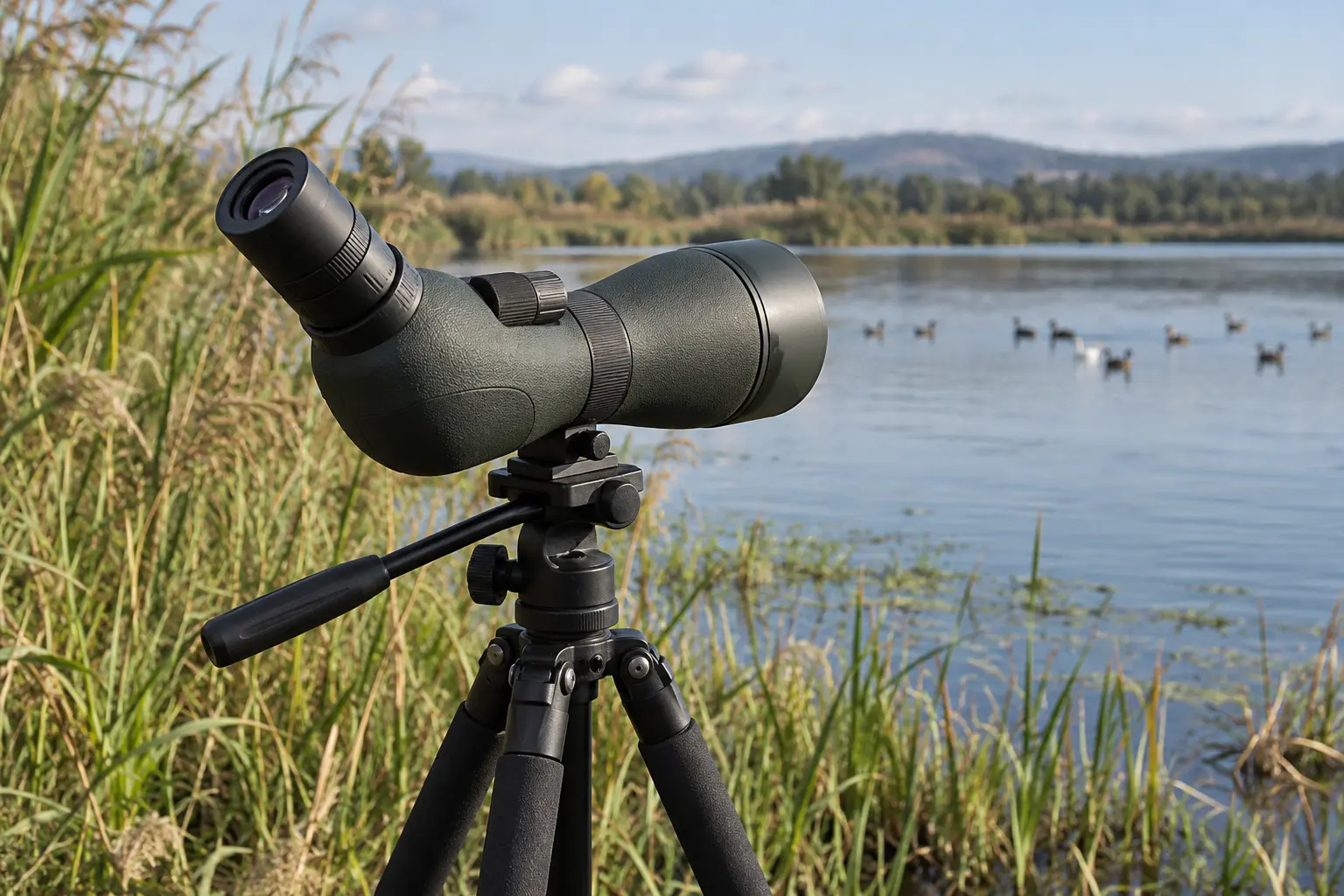
The best spotting scopes for bird watching under $500 should make distant birds easier to examine while leaving you with a usable, supported setup. A large objective and a 60x label are only part of that decision: low-power field of view, focus control, eyepiece comfort and tripod stability all affect whether the extra reach is useful. This guide compares five scopes with different roles, including portable 65 mm models, larger 80 mm choices and a compact ED travel option. We provide Amazon buying links and explain whether the scope alone is the right use of your budget. If $500 must cover everything, allow for a suitable tripod and head before choosing the body. Start with the quick verdict, then use the table to compare the size and viewing compromises that matter for your usual birding location.
Affiliate Disclosure: We may earn a commission at no extra cost to you when you make a qualifying purchase through affiliate links in this guide. Buying buttons open Amazon.com. Read our full affiliate disclosure.
Best Spotting Scopes for Bird Watching Under $500: quick comparison
On smaller screens, swipe across the table to compare all features and buying options.
| Image | Model | Magnification | Objective | Main consideration | Where to buy |
|---|---|---|---|---|---|
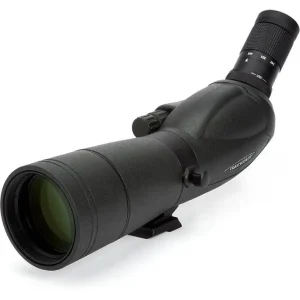 | Celestron TrailSeeker 16–48×65 Angled | 16–48x | 65 mm | Balanced portable full-size choice | Check PriceAmazon |
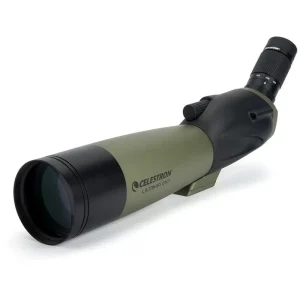 | Celestron Ultima 20–60×80 Angled | 20–60x | 80 mm | Budget 80 mm kit | Check PriceAmazon |
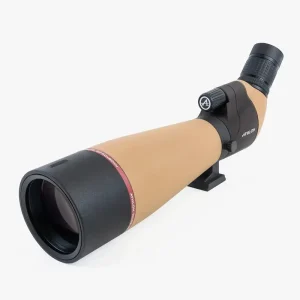 | Athlon Talos 20–60×80 | 20–60x | 80 mm | Lower-cost large-aperture option | Check PriceAmazon |
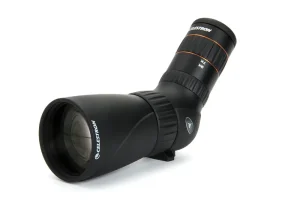 | Celestron Hummingbird 9–27×56 ED | 9–27x | 56 mm | Travel-friendly close-focus alternative | Check PriceAmazon |
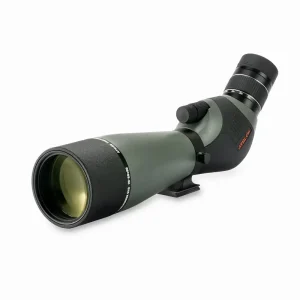 | Athlon Forerunner 20–60×80 HD | 20–60x | 80 mm | Dual-focus 80 mm comparison | Check PriceAmazon |
Open Amazon for the current price and availability. Confirm the exact model, condition and package contents, including any separately required eyepiece, tripod or accessories. Tax and shipping may affect the total.
How we chose these models
The five candidates span 56, 65 and 80 mm objectives to show how a limited budget can be allocated to portability, a broader starting view or a larger-aperture setup. The two Celestron conventional scopes, Hummingbird and two Athlon models have different viewing and support demands. A current offer must meet the stated budget for the exact configuration; the shortlist does not guarantee that every seller or bundle stays below $500.
- Confirm whether the eyepiece and usable support are included.
- Allow for any separate tripod and head before treating a scope as a complete purchase.
- Prefer useful low-power viewing and a stable image to a maximum zoom label.
These comparisons use manufacturer documentation and published model specifications. We have not conducted hands-on product tests. See how we review optics for the research and correction process.
01 / Balanced portable full-size choice
Celestron TrailSeeker 16–48×65 Angled
For an observer moving between several wetlands, the useful distinction is its comparatively moderate objective and a low starting magnification of 16x. Celestron specifies dual-speed focusing, a rotating tripod collar, XLT fully multicoated optics and an included zoom eyepiece. The published 136–68-foot field at 1,000 yards gives a wide starting point for finding subjects before zooming toward fine markings. This is a genuinely different proposition from carrying an 80 mm scope to every short stop.

Amazon.com
Product image: Celestron.Choose it for mixed day trips where you expect to carry your scope some distance yet still need a stable high-power view. The angled eyepiece may help a group share sightings without raising the tripod for every person.
At 48 ounces before tripod and head, it is still substantial hiking equipment, not a pocket scope. The 18-foot minimum focus is irrelevant to many distant shorebirds but can rule it out for close observation.
Reasons to choose it
- 16x starting power and dual-speed focusing.
- Rotating collar in a 65 mm angled scope.
What to weigh up
- 48 oz body is not a lightweight hiking option.
- Eye relief declines across the zoom range.
02 / Budget 80 mm kit
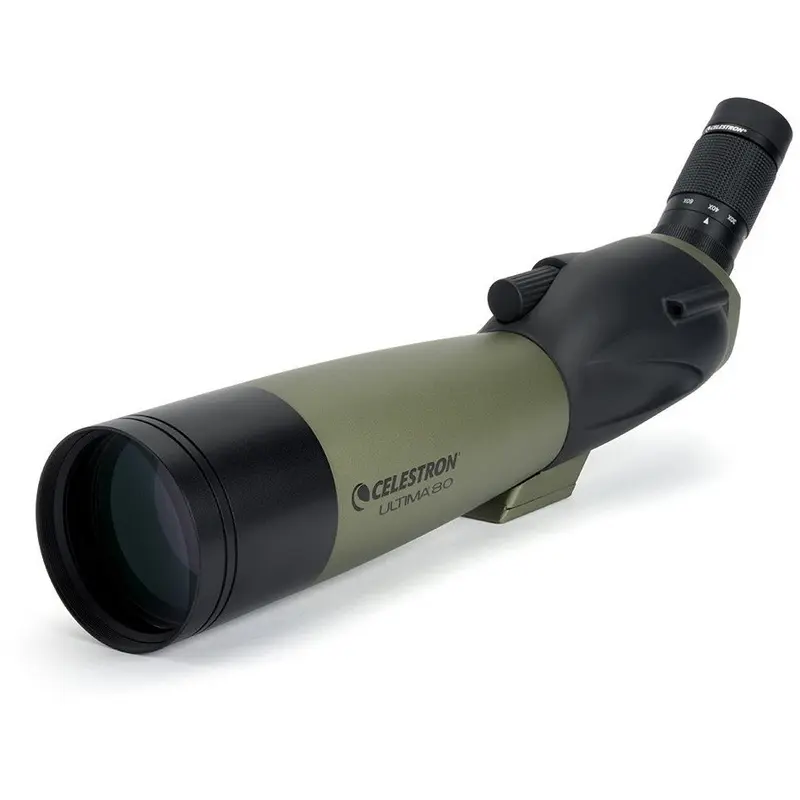
Celestron Ultima 20–60×80 Angled
An 80 mm aperture and included 20–60x eyepiece make the Ultima particularly relevant when most birdwatching occurs from a stationary hide. Its manufacturer lists a 45-degree viewing angle, a sight tube to help with initial targeting, multicoated optics, waterproof construction and a soft carrying case. The published field moves from 105 feet at 20x to 53 feet at 60x at 1,000 yards. The pricing is lower than several 65 mm competitors, showing why diameter and price alone do not create a ranking.
Amazon.com
Product image: Celestron.Best investigated by observers who primarily watch distant waterbirds from one accessible location and want the larger objective without spending their entire budget on the tube alone.
The longer 26.2-foot minimum focus makes it unsuitable for very close feeder birds or insects. The large housing requires a properly stable tripod, increasing the working cost and carrying effort. Celestron’s technical specifications list fully multicoated optics, while its brief feature summary says multicoated. Neither description is an independently measured transmission rating. A nominal 60x ceiling should not be read as a promise of a crisp image in every temperature and light level.
Reasons to choose it
- 80 mm objective with a 20–60x zoom.
- Angled viewing position for shared observation.
What to weigh up
- Full-size body and support require more packing space.
- Maximum power can be limited by atmosphere and vibration.
03 / Lower-cost large-aperture option
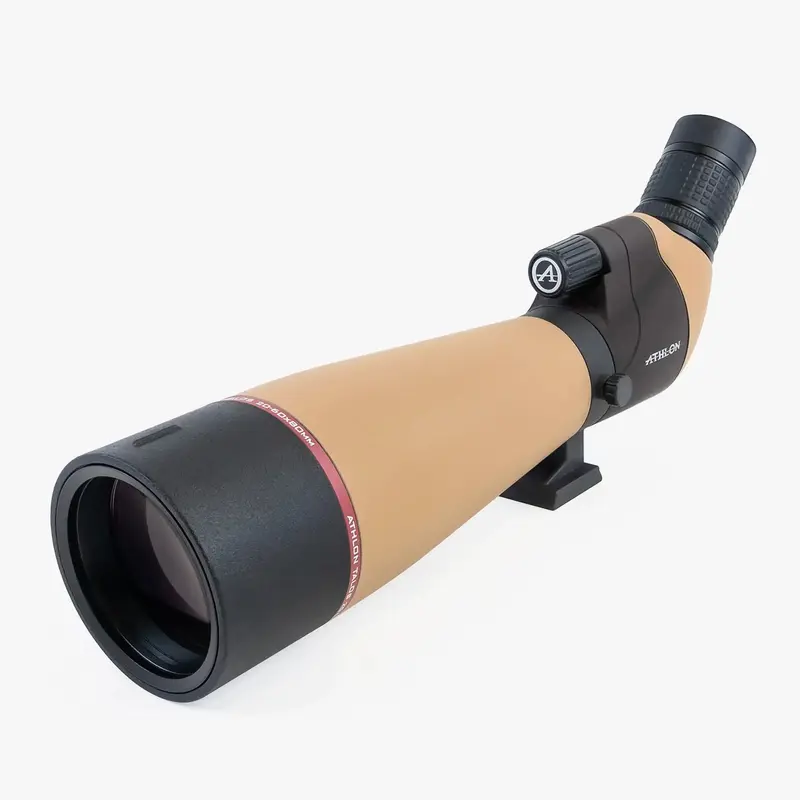
Athlon Talos 20–60×80
Athlon publishes fully multicoated lenses, a silver-coated K9 prism and nitrogen-purged waterproof construction. At 38.5 ounces, the maker’s figure is lower than the Celestron TrailSeeker 65 even though the Talos has an 80 mm objective. The 82.9–48-foot field at 1,000 yards is notably narrower at its low setting than the TrailSeeker’s field; this is a meaningful consideration when acquiring distant birds. The listed price leaves financial room for a sturdy tripod if you do not already own one.
Amazon.com
Product image: Athlon.Consider it if the scope will mostly be used at a seated observation point and you can allocate money toward stability rather than maximum lens marketing claims.
The narrower low-power field and basic focusing configuration may be less convenient when scanning complex shorelines. The supplied tabletop support mentioned in Athlon’s catalogue is not necessarily an adequate full-height tripod for standing birdwatching, and bundled contents should be checked against the current package. Do not treat the objective size and low price as proof of the best optical quality in the shortlist.
Reasons to choose it
- 80 mm objective for stationary viewing.
- Angled body with a 20–60x zoom.
What to weigh up
- 82.9 ft low-power field takes care when finding subjects.
- A suitable full-height tripod is a separate consideration.
04 / Travel-friendly close-focus alternative
Celestron Hummingbird 9–27×56 ED
This model deliberately trades the high-power and large-aperture ambitions of 80 mm scopes for a shorter 9–27x range and a compact body. Its 9.8-foot close focus can be useful near a garden feeder or when inspecting wildlife encountered along a trail. Celestron publishes ED glass, a 216–98-foot field at 1,000 yards and a 20.8-ounce weight. The smaller setup can make sense for a birder who wants a scope often enough to carry it on ordinary walks.

Amazon.com
Product image: Celestron.Worth shortlisting for travel, park walks, and mixed close-to-moderate viewing where the gear must be quick to unpack and easy to carry.
Maximum 27x magnification makes it a poor substitute for a 60x instrument when distant stationary shorebirds are the central pursuit. Eye relief is published at 15 mm, requiring careful trial for people wearing glasses. The ED label does not provide independent proof that the smaller scope outresolves every larger alternative. A monopod or tripod may still be necessary for comfortable extended viewing.
Reasons to choose it
- Unusually low 9x starting power for subject acquisition.
- ED design in a compact 56 mm angled scope.
What to weigh up
- 27x maximum is limited for very distant subjects.
- 15 mm eye relief needs checking with glasses.
05 / Dual-focus 80 mm comparison
Athlon Forerunner 20–60×80 HD
The Forerunner offers a different reason to spend more than the entry-level Talos. Athlon describes dual focusing rings, an integrated sunshade, advanced multicoatings, a rubber-armoured body and an extra-low-dispersion focusing element. Its product description and specification sheet do not agree on the chassis material, so that material is not asserted here. These are real design distinctions rather than an unsupported claim that it produces a universally sharper image. The included tabletop tripod and case may be convenient for initial use at a bench or hide, depending on the exact current package.
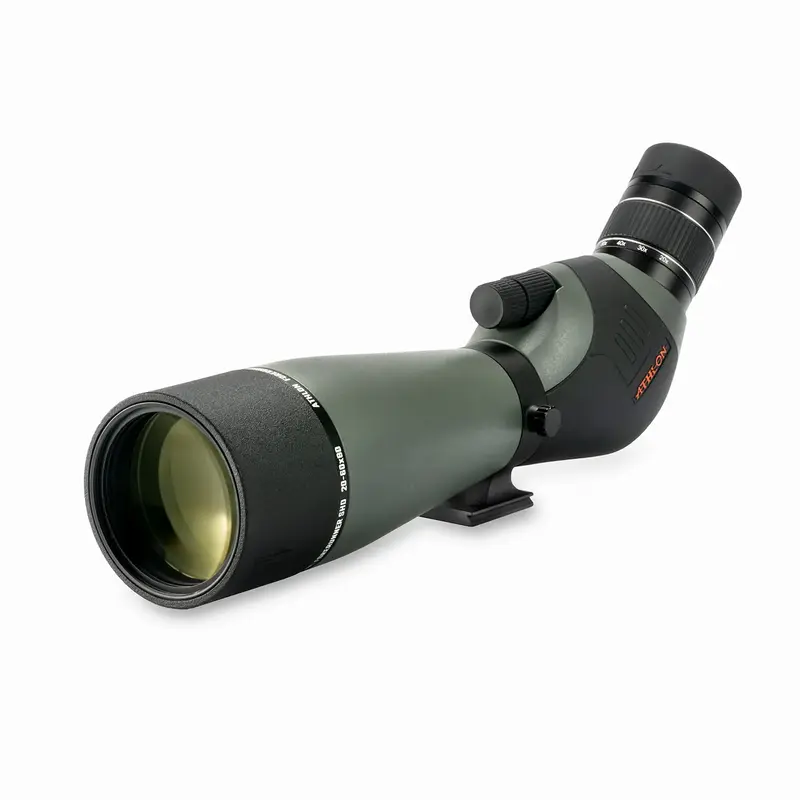
Amazon.com
Product image: Athlon.Compare it when the budget allows for better focus ergonomics and you primarily examine stationary wildlife at medium-to-long distances.
A tabletop tripod is not the same as a stable full-height birding support. The 20–60x range still faces haze, vibration and diminishing exit pupil at high zoom. The presence of an ED focusing element should not be misreported as an ED objective or as a lab-tested superiority ranking.
Reasons to choose it
- 80 mm objective with a dual-focus arrangement.
- 20–60x angled configuration within the guide’s reference budget.
What to weigh up
- Large scope format needs a stable head and tripod.
- 60x does not guarantee extra detail in poor conditions.
What to consider before buying
What a real under-$500 budget covers
A ceiling of $500 should mean the complete purchase cost is understood, not simply that the scope body is advertised for less than that amount. You may still need a sturdy tripod, a compatible head, a case or an adapter. Some makers include a zoom eyepiece while others sell optical bodies alone. All five instruments above have manufacturer-reported configurations, but the exact current offer contents should be checked before payment. A $300 scope plus an appropriate support could be a more useful purchase than a nominal $450 scope balanced on an unsuitable tripod. Set aside part of the budget for stability before choosing based on aperture.
Why we included different objective diameters
The 56, 65 and 80 mm designs serve different carrying and observation needs. An 80 mm objective can gather more light geometrically than a 56 mm one, but normally brings greater bulk and does not guarantee better image quality across brands. The Hummingbird’s portability and close focus are therefore not consolation prizes; they are meaningful priorities for travelling birders. Conversely, an 80 mm system can be an appealing choice when carried only from a car to a stationary observation point. Check actual dimensions, not only the diameter number, because focusing mechanisms and protective armour can alter packed size.
Moderate magnification often wins
Birdwatching is rarely a contest to operate at the largest possible zoom all day. At lower power, finding and keeping a bird in the field is generally easier. At 60x, focus becomes more critical and heat shimmer above mud or water may erase useful detail. The Hummingbird’s 27x maximum is a real limitation for some long-distance identification tasks but may be entirely adequate for travel observations. The TrailSeeker’s 16x low end gives a broader starting view than many 20x scopes. Select the range according to subject movement and distance, then practise centring the bird before increasing zoom.
Tripod stability cannot be an afterthought
An inexpensive scope with stable support frequently provides a more useful view than a costly tube on shaky legs. Check the combined weight of scope, eyepiece and any camera attachment against the head and tripod ratings. Wind, ground vibration, maximum leg extension and awkward balance all affect steadiness. At high zoom even touching the focus wheel may visibly move the subject. If you already own a photo tripod, inspect its plate compatibility and pan control before assuming it is suitable for long-distance birdwatching. A supplied tabletop support can be convenient for a bench but not automatically for standing observers.
Field width changes how quickly you find birds
Two 20–60x scopes can have different fields at the same power. The Athlon Talos specifies a low-power field around 82.9 feet at 1,000 yards, compared with 105 feet for the Celestron Ultima 80. The wider scene can help locate a bird before zooming, although that does not prove edge sharpness. Compare figures with equivalent units and at the same zoom setting. Use recognizable shoreline landmarks and a low initial magnification to acquire targets. A narrow field may be acceptable for a stationary perched raptor but frustrating for a wader moving rapidly among similar birds.
How eye relief affects spectacle wearers
A scope’s published eye relief is the intended viewing distance behind the eyepiece. Eyeglasses can hold your eyes farther away and make the outer field difficult to see. Figures from 15 to 18 mm in this group are helpful screening information, not guaranteed comfort. Retract eyecups and try the low and high zoom settings with your normal frames. If you cannot see a complete circle without pressure on your glasses, investigate another eyepiece or model. Do not assume body angle or objective diameter can resolve an eyepiece fit problem.
Choosing angled or straight construction
Most selections here use an angled eyepiece, which can make shared observation more convenient and often allows a lower tripod height. A straight scope may be easier to point directly through a narrow hide opening or from certain vehicle-mounted positions. There is no inherent optical quality advantage. Since this guide concentrates on distinct value choices rather than comparing every shape variant, readers with a strong straight-body preference should check equivalent manufacturer configurations. Our angled-versus-straight guide explains how posture and sight lines should drive the decision.
Understanding coatings without false rankings
Extra-low-dispersion glass, fully multicoated lenses and specialized prism coatings can influence colour fringing and transmission. They are not directly comparable as standalone badges. Athlon’s Talos and Forerunner differ in focusing design and listed optical construction, while Celestron uses its own coating terminology. Evaluate independent testing that names the exact product generation, and give comfort and focus precision the same attention as glass descriptions.
Waterproof does not mean indestructible
Outdoor spotting scopes may be described as waterproof, nitrogen-filled or fog resistant, but that does not create unlimited protection against impact, seawater or improper storage. Read the product’s exact environmental specification and exclusions. After wet field sessions, dry the exterior before enclosing the scope in its case. Use appropriate lens-care materials to remove grit before wiping; do not rub a gritty surface with a shirt. Weather sealing can be a valuable feature for wetlands, but the reliability of the tripod connections and case also influences how well equipment survives repeated use.
Retail price and availability checks
Compare the exact Amazon offer with the configuration described here, because a shared family name can cover different zoom ranges, body orientations and package contents. Check the exact product number, angled or straight orientation, objective diameter, whether the eyepiece is included and the current U.S. checkout price. If the complete offer exceeds your $500 limit, compare a less expensive configuration while keeping suitable support in the budget. Amazon prices and available packages can change; confirm the details before checkout.
A simple choice by observation setting
For several short hikes and varying viewing distances, first compare the Hummingbird ED and TrailSeeker 65. For a stationary waterfowl hide with a careful budget, compare the Ultima 80 and Talos 80, taking account of fields, focus feel and support. The Forerunner deserves consideration when its more elaborate focus controls are valuable and a reliable seller is available. Choose the scope that matches the birding you actually do most often.
When you should spend less
An occasional birdwatcher may be better served by a comfortable binocular than by a high-powered scope, particularly if most subjects are close, moving and encountered during walks. A scope adds setup time and support costs. If your interest centres on distant shorebirds, the investment can be sensible; if it centres on woodland songbirds, buying the biggest objective may be an expensive diversion. Consider borrowing a scope at an organized bird walk to discover how frequently it helps. Spending less today can leave room to buy a better tripod later, when you know your actual requirements.
What is missing from manufacturer specifications
Product listings do not establish how a particular unit handles flare, how much resolution falls near the field edge or how comfortable its focus wheel feels for your hands. They can also omit warranty exclusions or accessory compatibility details. Users should examine credible sample-identified reviews and, where practical, handle an instrument in person. Claims of superior low-light or sharpness need matching test conditions rather than an attractive lens label.
Final recommendation
There is no single scope that best serves every buyer with $500 available. A portable 56 or 65 mm model may be a smarter purchase than a larger 80 mm instrument for a hiker, while fixed-site observers may value the aperture and zoom of the latter. The manufacturer figures show meaningful distinctions in weight, close focus, field and focusing construction. Start at moderate power, verify the full tripod budget and select from those distinctions. Check the complete offer against your $500 limit before ordering.
Turn the $500 ceiling into a complete shopping plan
Write down the parts you still need before comparing scope offers. If you already have a suitable tripod and head, more of the budget can go toward the scope features you prefer. If you need support as well, reserve that money first and compare the remaining amount with the retailer’s actual scope price. The difference between the Talos and a more expensive body may be useful if it makes a stable complete setup possible.
Keep optional photography accessories separate from the essentials. A phone adapter is worth considering when you know the exact eyepiece and how often you want to record images. It is less useful than a comfortable, steady direct view if you are still learning to aim and focus. Before checkout, check package contents carefully so that you neither buy a duplicate accessory nor overlook a necessary plate, eyepiece or carrying component.
The amount left within your budget depends on the final Amazon offer and what its package includes. Recalculate with tax, shipping and the support you selected. That produces a more useful decision than treating every scope priced below $500 as an equally complete purchase.
Before you choose
Frequently asked questions
Can $500 buy a useful birdwatching scope?
It can cover a useful scope, but decide whether that total also needs to include the tripod, head and carrying equipment. A less expensive body on stable support may be more useful than spending the full amount on a scope that cannot be held steadily at your viewing location.
Should I choose 65 mm or 80 mm on this budget?
Consider how far you carry the kit and the light in which you observe. An 80 mm objective offers a larger aperture but usually adds bulk. A 65 mm format can be easier to move between viewpoints. Compare actual model weights and the required support rather than deciding from diameter alone.
Will a 60x scope always show more bird detail?
No. Atmospheric shimmer, wind, vibration and optical performance can limit useful detail before you reach maximum power. Begin at the lowest setting, center the bird and increase magnification only while the image remains informative. A lower but clearer view is often the easier one to identify from.
Can I use a camera tripod I already own?
Check the tripod, head, plate and mounting screw against the complete scope setup. Load capacity alone does not establish comfortable panning or resistance to vibration. Try focus adjustment and movement at higher power before relying on it for a long birding session, particularly with a heavier 80 mm scope.
Is an angled scope easier for sharing?
An angled eyepiece can allow people of different heights to use a lower tripod with fewer height changes. A straight scope may feel more intuitive when first aiming at a distant subject. Think about your usual hide, viewing platform or seated position as well as whether the scope will be shared.
Do all Amazon offers stay below $500?
No. Seller prices and included equipment can change. Use the buying link to confirm the exact scope, eyepiece and condition, then add tax, shipping and any separate support equipment. If the complete offer exceeds your $500 limit, compare another option or wait for a suitable offer.
Sources and buying information
Product details come from manufacturer documentation for the models listed. Use the Amazon buying links for the current offer, seller, condition and package contents.
Related practical guides
About the author
Simon Jack
Simon Jack is the named author of FieldLens Guide's research-based binocular, spotting scope and wildlife observation articles. His published editorial approach focuses on verifying model-specific manufacturer specifications, explaining optical tradeoffs in plain language, and matching equipment to real birdwatching, hiking and nature-observation needs. These articles do not claim hands-on product tests unless explicitly documented.