

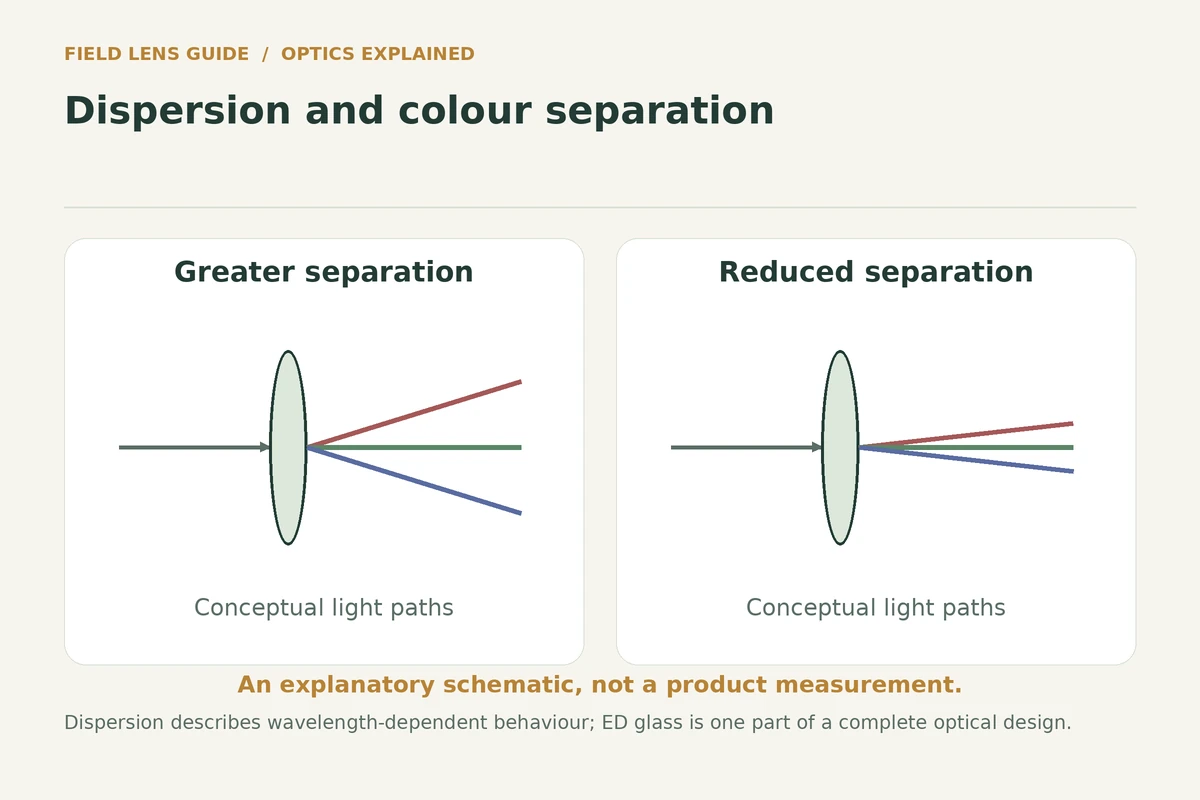
ED glass binoculars use extra-low-dispersion optical glass to help control chromatic aberration, a form of colour fringing caused by different wavelengths of light focusing at different points. This is a real engineering feature, but it is not an independent guarantee of top image quality or a replacement for evaluating a complete optical system. The explanation of roof and Porro prism designs covers a separate optical construction choice that an ED label does not describe.
Why white light produces colour fringes
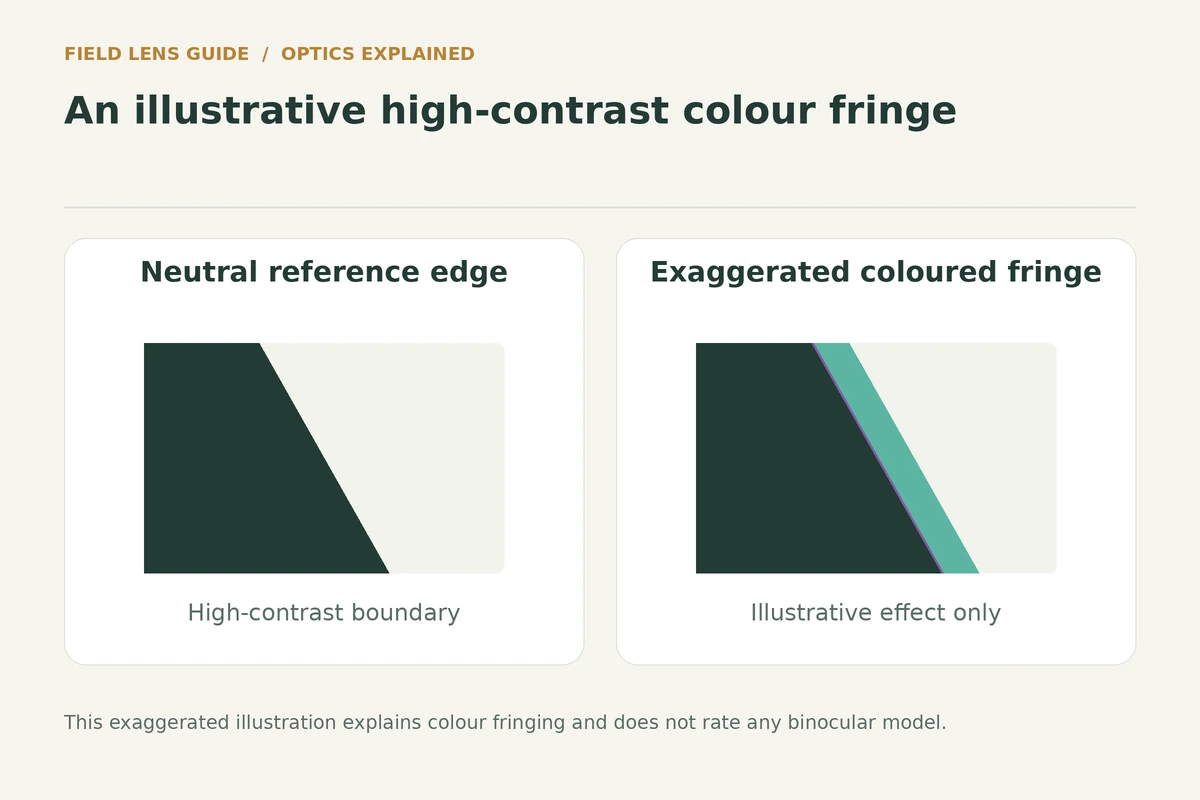
White light contains a range of wavelengths that refract differently when passing through optical glass. If the lens design does not bring those wavelengths to a sufficiently similar focal point, a high-contrast subject can show coloured edges. A dark bird against a bright sky may reveal purple or green fringes. This defect is known as chromatic aberration. The degree visible depends on magnification, the viewing position, the lens design and the actual subject. Colour fringing is not necessarily a focus failure, and increasing magnification can make it more obvious.
The meaning of extra-low dispersion
ED stands for extra-low dispersion. Nikon explains that special optical materials with unusual dispersion characteristics can reduce the secondary spectrum that remains after conventional achromatic correction. An ED element is used in combination with other lenses rather than performing all the correction by itself. The way those elements are arranged and precisely manufactured determines the finished image. A product name using ED may refer to an objective element, and it should not automatically be interpreted as every optical component being made from one special glass type.
What an ED binocular may improve
The most direct intended benefit is reducing false colour around high-contrast outlines. A well-corrected optic can make fine boundaries and feather edges look more natural. Better control of unwanted colour may contribute to the impression of clarity and contrast, but the magnitude varies by product. ED glass does not directly set field width, focus travel, eye relief or waterproofing. A binocular can contain ED glass while still having an awkward focusing wheel or poorly fitting eyecups. Evaluate the complete instrument rather than elevating one material into a universal quality award. Our 8×42 birdwatching comparison puts ED and other design differences alongside eye relief, field width and close focus.
ED and HD are not interchangeable standards
ED describes an optical material property, whereas HD is used in a variety of product names and does not necessarily identify a fixed glass composition. UHD and APO may also have manufacturer-specific technical meanings or refer to broader design goals. Therefore a model labelled HD is not automatically inferior to one labelled ED, nor does an ED label guarantee a specific measured resolution advantage. Read actual construction descriptions and seek controlled comparisons when image-quality differences matter. Marketing language should not substitute for data or personal fit.
ED glass is not a prism coating
Phase-correction coatings address wavefront effects from certain roof-prism arrangements. Reflective dielectric coatings can improve reflectance at internal surfaces. ED objective glass targets dispersion and colour fringing. Those are three separate functions. A manufacturer’s product may use all of them, only some, or alternative designs. Comparing two models solely because one advertises ED and another advertises dielectric prisms mixes unrelated technologies. Nikon’s optical guide provides useful distinctions among the different corrections used inside binoculars.
Can non-ED binoculars look good?
Yes. Conventional optical glass can produce satisfying images when the lens design and manufacturing are good. ED materials offer additional design options for colour correction, but they do not make all other engineering irrelevant. Image contrast also depends on stray-light control and coatings, while a comfortable viewing position affects how well a person sees the image. Under ordinary daylight on a low-contrast subject, the visible difference between two models may be smaller than an advertisement suggests. Never claim that a model without ED cannot identify birds accurately.
How to spot false colour in a comparison
Choose a detailed high-contrast target under safe ordinary light, such as a dark branch against a bright overcast sky. Adjust both binoculars to your eyes and focus the central region carefully. Look for coloured fringes that remain when focus is correct, and repeat at different positions within the field. Avoid pointing optics at the sun or testing on dangerously reflective sources. Compare equally magnified instruments where possible. A poorly focused binocular may appear to have worse colour correction than it actually does, which is why careful setup is essential.
Lateral versus longitudinal effects
Different chromatic aberrations can appear in different ways. Colour fringing around the edge of a wide field can differ from colour fringes visible around an object near the centre or in front of the focus plane. No single casual viewing test captures every type. Lens combinations are engineered to balance these defects with others such as field curvature and distortion. A company can legitimately claim reduced colour fringing without guaranteeing that no coloured outlines will ever appear. The useful question is whether the correction improves your normal observation tasks.
Does ED glass increase brightness?
ED glass is primarily discussed in relation to dispersion and colour correction, not as an independent brightness multiplier. Actual light delivery involves objectives, prism arrangement, coatings, transmission and exit pupil. A high-quality ED binocular may appear clearer under difficult light, but that is not proof the ED material alone transmits more light. Nikon’s separate brightness guidance explains why even optics with the same exit pupil can differ in transmission. Do not state a percentage increase without matched independent measurements.
Why field of view still matters
For woodland birding, the ease of finding and tracking a subject can matter more than small optical improvements at the centre. The real field is determined by magnification and eyepiece geometry, not directly by the presence of an ED element. An ED binocular with a narrow usable field may be more frustrating for fast-moving subjects than a well-made alternative with broader framing. Read the manufacturer field value and check whether glasses allow its full circle to be seen. Our field-of-view explanation covers that distinct issue.
Eye relief and body comfort
A buyer tempted by ED branding should still check the interpupillary adjustment range, eyecup depth, eye relief and weight. Spectacle wearers may lose the outer field with inadequate clearance even if the optical glass is exceptional. A heavy body or poor balance can induce hand shake that hides subtle feather details. Try viewing a stationary bird or sign for several minutes and note focusing comfort. The better binocular is often the one that your eyes and hands can use naturally, not the product carrying the most abbreviations.
How pricing should influence the decision
ED models may cost more than otherwise similar entry-level versions, but price also reflects construction, accessory package, warranty and distribution. Compare complete products in the same class and be cautious about model families with both ED and non-ED generations. Celestron Nature DX and Nature DX ED, for example, are separate products with different published specifications. A premium is justified when the actual finished viewing experience improves enough for your use. Never assume that the extra letters guarantee an independently measured performance gain equal to the price difference.
Useful applications
Birdwatchers studying fine feather boundaries, observers viewing dark mammals against bright sky and people using a spotting scope at substantial magnification may appreciate strong chromatic correction. For casual travel sightseeing, carrying convenience or field width may take priority. In overcast woodland, focusing precision and contrast can also influence recognition. ED is one factor worth considering when comparing similar binoculars, not the first and last screening criterion. Make a shortlist based on the habitat and normal viewing distance before using glass material as a tie-breaker.
Final buying interpretation
Treat ED as a credible description of an optical design feature when a manufacturer documents it. Use it as a reason to investigate a model, not as a substitute for testing the actual eyecups, field and focusing mechanism. Verify that the exact model includes the material, since similarly named products may not. Compare official specifications and independent test methods where available. The most useful result of ED construction is potentially cleaner high-contrast detail, but a strong overall binocular must still balance transmission, field, handling and durability. For a smaller instrument, our compact birdwatching binocular comparison shows how optical features interact with carrying size.
Manufacturer references
About the author
Simon Jack
Simon Jack is the named author of FieldLens Guide's research-based binocular, spotting scope and wildlife observation articles. His published editorial approach focuses on verifying model-specific manufacturer specifications, explaining optical tradeoffs in plain language, and matching equipment to real birdwatching, hiking and nature-observation needs. These articles do not claim hands-on product tests unless explicitly documented.