

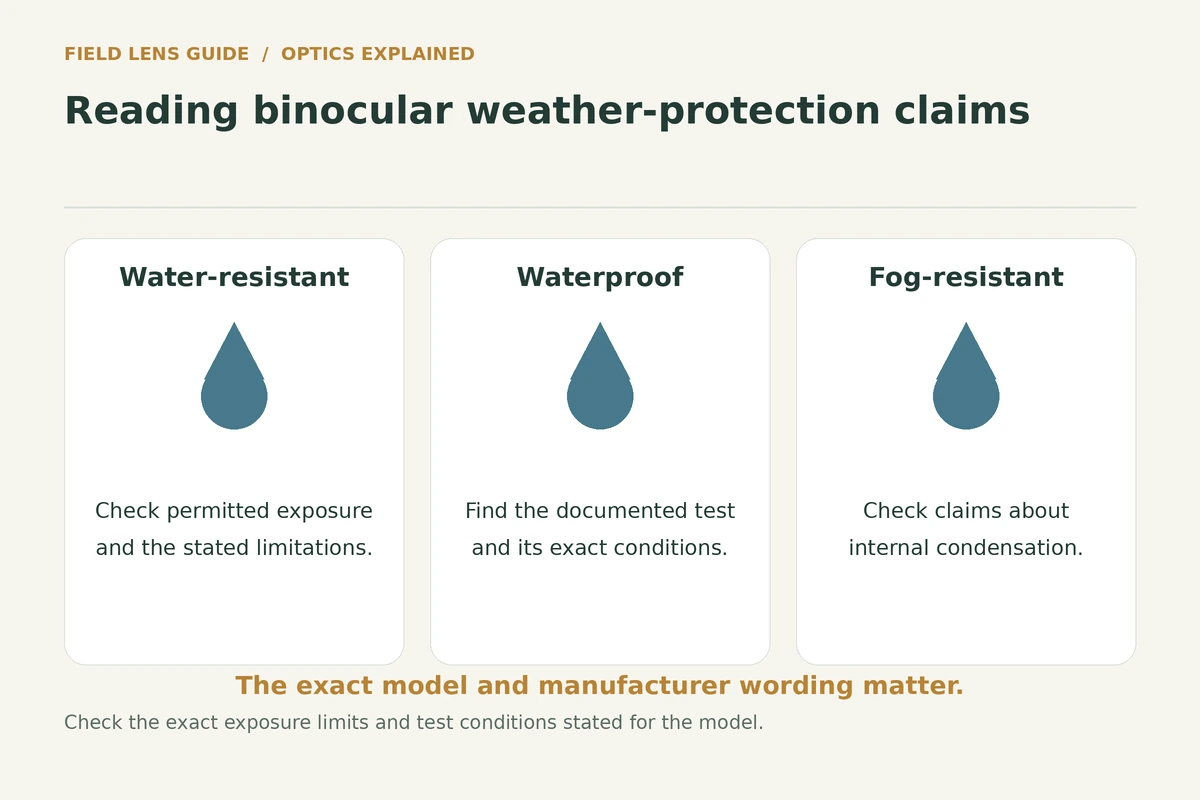
Waterproof vs water-resistant binoculars is a question about the specific amount of water exposure a product is designed to withstand. Words such as waterproof, fogproof and nitrogen-purged are not interchangeable guarantees. The exact manufacturer rating, test conditions and maintenance instructions matter more than a broad retailer label.
If your normal walks involve showers or wet vegetation, the technical distinctions here can help narrow the equipment list. Our waterproof hiking binocular comparison separates documented IPX7 tests, manufacturer immersion limits and less specific waterproof claims rather than treating them as equivalent.
Water resistance is not a universal rating
A product described as water resistant may tolerate light splashes or brief rain, but that phrase does not automatically describe an immersion test. The precise claim should come from the manufacturer of the exact model. Celestron’s entry-level UpClose G2 7×35 is described as water resistant and not nitrogen filled, while its Nature DX ED 8×42 is described as waterproof and nitrogen filled. These are meaningful product distinctions. Do not assume that a binocular is safe to immerse simply because its exterior has rubber armour or because it can survive a short shower.
What a documented IPX7 test means
IPX7 is commonly associated with temporary immersion in water under defined conditions. Celestron explicitly lists an IPX7 test of one metre for 30 minutes on its TrailSeeker ED 8×32. This is a more precise statement than a generic waterproof label. The test does not mean the instrument is intended for underwater viewing or strong water jets, and it does not establish dust resistance: the X denotes that a dust-protection number is not given in that marking. Always follow the exact maker’s manual and warranty limitations.
Manufacturer tests can differ
Nikon describes certain MONARCH and PROSTAFF models as waterproof for immersion up to one metre for ten minutes, and explicitly says they are not designed for underwater use. Celestron’s IPX7 figure for a different model specifies thirty minutes. The two claims should not be silently treated as equivalent. Even when two products are both described as waterproof, compare the actual depth, duration, environmental conditions and any exclusions. A rating for an older model does not necessarily apply to a redesigned version of the same product family.
Nitrogen filling is a separate feature
A binocular may be filled with dry nitrogen gas and sealed to reduce internal condensation risk. This is often marketed as fogproof construction, but it does not prevent moisture from condensing on an exterior lens when cold glass meets humid air. Nitrogen is not a magical coating and does not make a dropped instrument unbreakable. Gas sealing quality can also change if an optic is damaged or improperly repaired. Check the product’s particular sealing and purging specifications rather than using the presence of a gas label to infer unlimited water resistance.
Argon filling works toward similar goals
Some manufacturers specify argon purging instead of nitrogen. Both approaches are intended to keep the internal optical environment dry when accompanied by sound seals. Do not conclude that one gas automatically guarantees a better image or permanent protection without comparable data. A binocular can still develop external condensation if temperature conditions favour it. Mechanical seals, production quality and service support remain important. A manufacturer warranty may cover certain defects, but should not be assumed to cover every kind of water exposure or accidental damage.
Why rubber armour is not a waterproof seal
Textured rubber or elastomer armour can improve grip and protect against minor surface knocks. It does not by itself seal eyepiece joints, focusing shafts or body seams. A binocular can look rugged yet lack a documented immersion rating. The user should read the product manual, not infer sealing from appearance. After rain, wipe external water in the manner recommended for the model and check that moisture has not collected beneath caps. Avoid forcing wet or gritty focus controls, which can cause mechanical problems separate from the optical sealing question.
Rain, dew and fog differ
Rain is liquid water arriving from outside; dew forms on surfaces under suitable temperature and humidity conditions; fogging may appear on external lenses or within a compromised housing. These should not be treated as the same failure. A fully waterproof binocular can still have dew on the exposed objective. Do not rub the glass aggressively to clear it. Our fog-prevention guide explains safe acclimation and storage. Recurrent internal fog, unlike brief exterior condensation, deserves manufacturer attention.
Salt water requires special caution
Coastal birdwatching exposes binoculars to salt spray that can leave abrasive crystals and corrosive residue. Some manufacturers publish special cleaning guidance for selected waterproof products, but not every instrument can safely be rinsed. Do not immerse a water-resistant model because a different waterproof product allows a particular rinse procedure. Keep the case clean, avoid direct spray when practical and remove salt only through approved instructions. Sea conditions can also introduce sand, making dry rubbing especially risky. A generic waterproof label is not a substitute for careful handling near the shore.
Temperature changes and storage
Moving from air conditioning into humid outdoors may cause external fog even on well-sealed binoculars. Let the instrument adjust rather than applying strong heat. After a wet walk, dry the exterior and avoid sealing the binoculars into a damp soft case for long periods. High humidity in storage can contribute to mould, while extreme heat may damage seals and adhesives. A secure dry storage environment protects optics better than relying on a feature list alone. Avoid leaving equipment on a hot vehicle dashboard.
What to do if water seems to enter
If the internal image becomes persistently hazy, or fog develops behind a lens after ordinary use, do not try to open the housing. Optical elements require precise alignment and disassembly can destroy existing seals and warranty coverage. Record the model code and conditions, then contact the manufacturer or qualified repair service. Drying or wiping the outside is unlikely to resolve moisture trapped deep inside the barrel. Do not treat online advice about one brand as an approved repair method for another.
Immersion claims do not cover all accidents
A binocular meeting a defined immersion test may still be damaged by a fall, impact or salt contamination. Waterproof is not synonymous with shockproof, crushproof or safe for extended underwater use. Eyecups, focus mechanisms and hinge assemblies may also have service limits that differ from the basic lens housing. Secure the strap before crossing streams or climbing a wet trail. If equipment is dropped, examine it for alignment and mechanical problems as well as obvious external water damage.
Which protection level fits normal birding
A user walking city parks in fair weather might not need a model built for immersion, although protection against occasional rain is still useful. Someone visiting coastal wetlands, canoe viewpoints or consistently damp forests has a stronger reason to prioritize a documented seal. The carrying case, strap and cleaning routine also affect long-term reliability. Check how often your equipment actually encounters spray or downpours, rather than assuming the maximum protection claim is always the best value. Optical quality and eyecup comfort should remain part of the decision.
How to read a product page critically
Confirm the exact binocular model, magnification, lens diameter and version. Look for test depth and duration, a named IP rating, an explicit fogproof or purging statement and warranty terms. If the product page simply says waterproof without details, do not invent a numeric rating. Retailers sometimes combine reviews and specifications from several variants. Prefer current manufacturer documentation for technical claims, and verify any product photo or link corresponds to the same version. Keep notes of the source date when preparing a buyer’s guide.
A sensible after-rain procedure
Return from wet birding with protective caps fitted where appropriate and ensure the exterior is dry before long-term storage. Clean only actual contamination using approved optical materials, removing loose grit first. Allow damp straps or cases to dry separately. Check focus-wheel and eyecup operation without forcing them. If you see persistent internal condensation, arrange professional assessment. The right routine is usually simple, but it prevents accidental damage from aggressive cleaning or prolonged storage in damp material.

Buying conclusion
Choose a binocular with water protection appropriate to your usual environment, but insist on exact manufacturer claims. Water-resistant and waterproof are not interchangeable; gas purging refers primarily to internal condensation; and an immersion rating has limits. Celestron and Nikon provide useful examples of why model-level documentation matters. Match the product’s protection to rain, salt spray and travel exposure, then assess field, focus and eye comfort as separate qualities. The best outdoor binocular is reliable in its real use conditions, not the one with the boldest generic label.
Manufacturer references
- Celestron TrailSeeker ED IPX7 specification
- Nikon PROSTAFF P7 waterproof limits
- Celestron UpClose G2 water resistance
About the author
Simon Jack
Simon Jack is the named author of FieldLens Guide's research-based binocular, spotting scope and wildlife observation articles. His published editorial approach focuses on verifying model-specific manufacturer specifications, explaining optical tradeoffs in plain language, and matching equipment to real birdwatching, hiking and nature-observation needs. These articles do not claim hands-on product tests unless explicitly documented.