
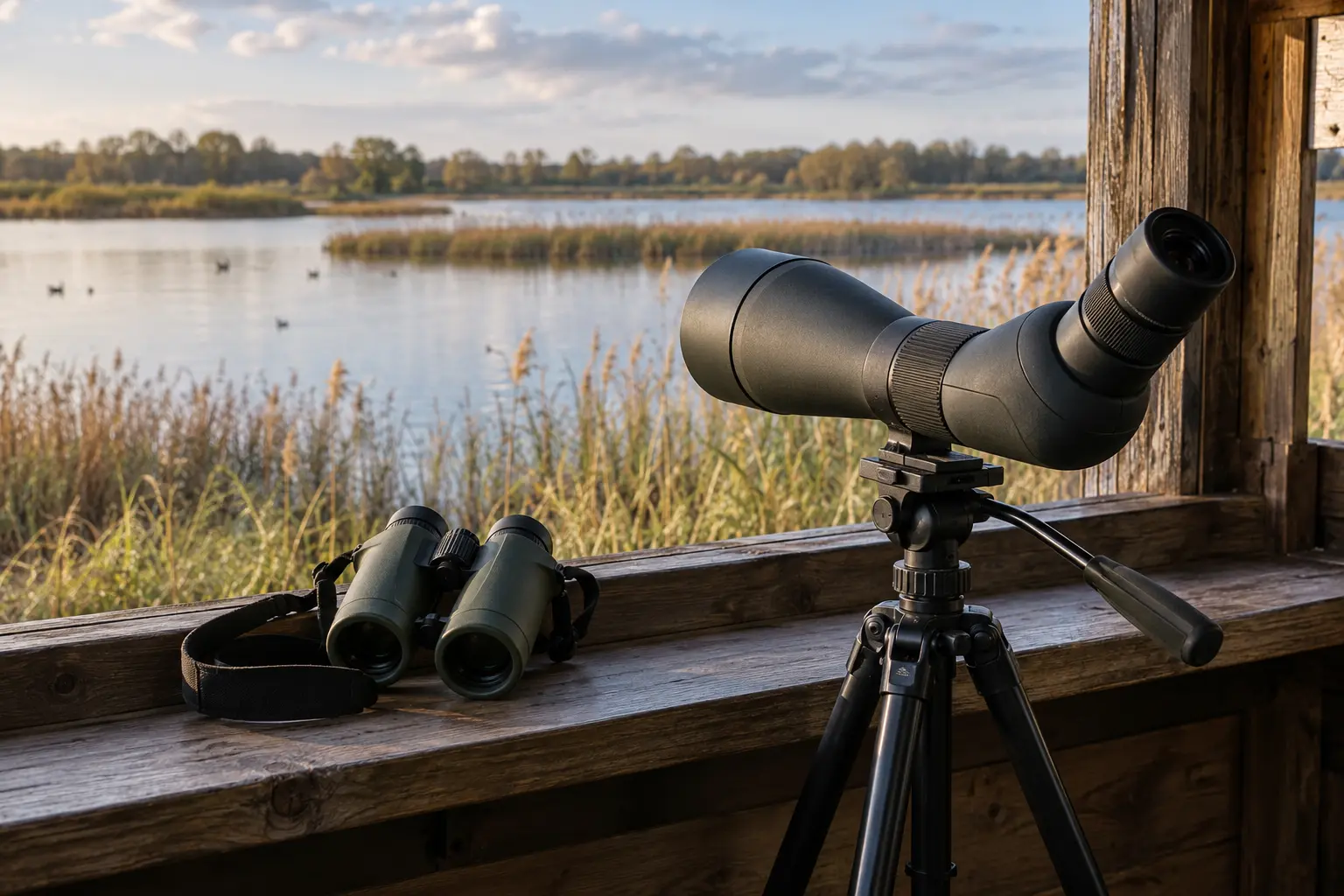
The binoculars vs spotting scope for bird watching decision starts with viewing distance and how quickly a subject moves. Binoculars are usually handheld optical instruments for finding and following birds quickly. A spotting scope is a higher-power device ordinarily used on a tripod for studying distant subjects. Both are useful, but they solve different problems. A bird hopping among nearby branches is often easier to locate with an 8x binocular, while a distant wader across an estuary might reward the magnified view of a scope. A beginner should consider actual observation distance, subject movement and carrying burden before deciding which equipment deserves priority.
For everyday woodland and local birdwatching, the beginner binocular guide explains useful lower-power handheld choices. If most of your subjects are far across water, our beginner spotting scope guide compares ready-to-use and portable higher-magnification options.
The difference in magnification
Popular birdwatching binoculars commonly provide eight-times or ten-times enlargement. Spotting scopes often have zoom ranges such as 20–60x, giving a much larger apparent image of a distant subject. Yet increasing power magnifies air shimmer and vibration, not just useful markings. An unsteady 60x image can reveal less information than a sharp and stable view at 25x. Cornell Lab emphasizes sensible scope magnification and optical quality rather than buying based on the biggest advertised number. Magnification alone cannot substitute for a well-constructed optical system.

Acquiring the target
Before inspecting fine detail, you must find the bird. Binoculars generally have a wider field of view and can be raised rapidly to the eyes. A high-power scope narrows the surrounding scene, making a moving bird harder to capture. Learn to identify a landmark using unaided sight, then use binoculars for initial observation. If the bird settles at a distance, aim a scope toward that landmark at low power. Zooming only after acquisition saves time and reduces the tendency to scan blindly through a narrow view.
Woodland and garden observation
A small bird moving between twigs can disappear quickly. A handheld binocular with manageable magnification, quick focusing and a broad view is usually ideal for this kind of birdwatching. The scope can be cumbersome when a bird changes distance or direction every few seconds. For backyard feeders, close-focus capability may matter more than extreme power because subjects can appear only a few metres away. Invest first in an optic that handles those routine situations. A large spotting scope is better suited to long-distance, relatively stationary targets.
Shorebirds and distant waterfowl
An estuary or wide lake can place birds far beyond the comfortable detail range of binoculars. A steady spotting scope may help identify bill shape, leg colour and subtle plumage patterns on stationary shorebirds. Binoculars remain valuable for following flight and finding the subject within a broad landscape. Use them to locate a bird near a recognizable rock or reed bank, then point the scope at the landmark. Atmospheric turbulence over water may limit the usefulness of high zoom, so moderate power sometimes produces the most informative view. If you are choosing a first scope within a fixed budget, compare the documented options in our under-$500 spotting-scope guide.
Real field of view
Field width determines how much surrounding habitat is visible. A low-power binocular frequently gives enough context to track moving birds, whereas a scope at 40x may display a narrow portion of a shoreline. The exact difference depends on eyepiece design and should be checked from official measurements rather than assumed. If a scope user loses the subject, reducing zoom before searching is more efficient than sweeping randomly at high magnification. People wearing glasses also need enough usable eye relief to view the complete image circle.
Stability and support
Binoculars at 8x or 10x are intended for handheld use in many situations, although bracing elbows can improve steadiness. A spotting scope at much higher power needs a suitable tripod and head. Wind, movement of the focus control and the flexibility of fully extended legs can cause visible shaking. The manufacturer’s load rating matters, but does not alone guarantee stability in real conditions. A premium optic on a flimsy stand may provide a frustrating view. Budget for the complete support system rather than viewing it as an optional accessory. Our spotting-scope tripod comparison covers practical support considerations.
Low-light viewing
Large spotting-scope objectives can gather considerable light, but high magnification creates a smaller exit pupil. For comparison, 65 mm divided by 60x is about 1.08 mm, while 42 mm divided by 8x is 5.25 mm. Those figures are geometric rather than direct measurements of image brightness, since coatings, image scale and eye physiology also matter. They help explain why a high-power scope can be uncomfortable in fading light. Choose sensible magnification and assess the actual optics under conditions like those you expect to encounter.
Total carried weight
A binocular usually requires a strap, protective case and little additional equipment. A scope brings a tripod, head, mounting plate, eyepiece and sometimes a phone adapter. Together these parts may be difficult to carry for hours. A long-distance hiker who sees birds unpredictably may prefer a compact binocular for every outing. Someone who drives to a wetland observation platform can use a larger tripod-mounted scope without significant transport difficulty. Evaluate the whole kit, not only the bare optical body in an advertisement.
Shared viewing
At a fixed lookout, a spotting scope offers a useful way for several people to examine the same distant bird. Angled eyepieces can help observers of different heights without frequent tripod adjustments, although safe footing remains necessary. Binoculars give individuals freedom to scan separate areas or follow moving birds. A group may therefore benefit from both forms of optics. It is misleading to claim one replaces the other for every situation. Think about whether you mainly observe alone, in a family group or during organized birding events.
Phone photography and digiscoping
A phone adapter can record an image from a spotting scope’s eyepiece. Digiscoping can help document distant birds but requires accurate camera alignment, a compatible adapter and stable support. A high zoom setting does not guarantee a sharp photograph when the bird moves, the wind blows or the air shimmers. Binocular phone adapters exist but may be awkward to stabilize for long-distance recording. If images are the primary goal, compare dedicated camera options too. Choose a scope for observation first unless its photography compatibility has been carefully checked.
Cost comparison
A binocular is normally ready for use with the included strap. A spotting scope may be advertised as a body without eyepiece, while a sufficient tripod and pan head can increase the total price. Compare complete kits, warranty support and replacement-parts availability. For a limited budget, a comfortable binocular used daily may be a better investment than a high-powered scope mounted on inadequate support. Conversely, someone whose main interest is distant shorebird identification may genuinely benefit from making a scope their next major purchase.
Using both tools together
Start by scanning habitat with unaided vision and binoculars, noting landmarks and the location of stationary subjects. Set the tripod on safe ground and mount the scope securely. Aim on low zoom toward the landmark, focus and increase power only when the image becomes more informative. If the bird flies, return to binoculars for tracking instead of attempting rapid high-power panning. This workflow is efficient and reduces strain from repeatedly searching a large area through a narrow scope field.

Which should a beginner buy?
For mixed park, garden and woodland birdwatching, binoculars are usually the sensible first instrument because of portability and ease of use. Add a spotting scope when repeated observations involve distant birds that cannot be studied adequately through normal handheld magnification. A person concentrating on accessible estuaries may choose a scope sooner. Neither decision requires the absolute highest magnification. Use a realistic record of your normal sightings, viewing distances and total equipment costs to select a tool that gets regular use.
The final choice
Binoculars and spotting scopes are complementary. One helps find moving birds quickly and carry equipment comfortably; the other allows patient high-power inspection from a stable position. No instrument can defeat bad atmosphere, poor focusing or unstable support. Cornell Lab’s spotting-scope guide provides useful principles for choosing higher magnification, but the correct purchase still depends on your habitat and how you observe. Avoid replacing useful binoculars with a scope simply because its numbers look more impressive, and avoid dismissing a scope when distant bird identification is your main challenge.
Reference
Cornell Lab: choosing a spotting scope
About the author
Simon Jack
Simon Jack is the named author of FieldLens Guide's research-based binocular, spotting scope and wildlife observation articles. His published editorial approach focuses on verifying model-specific manufacturer specifications, explaining optical tradeoffs in plain language, and matching equipment to real birdwatching, hiking and nature-observation needs. These articles do not claim hands-on product tests unless explicitly documented.